How Many Books Should a Child Own? Building a Small Home Library
Parents often ask how many books are enough, usually while standing in front of a shelf that is already full. The number is rarely the real question.
This article offers general information for families. It is not medical, psychological or developmental advice; ask a qualified professional about your own child.
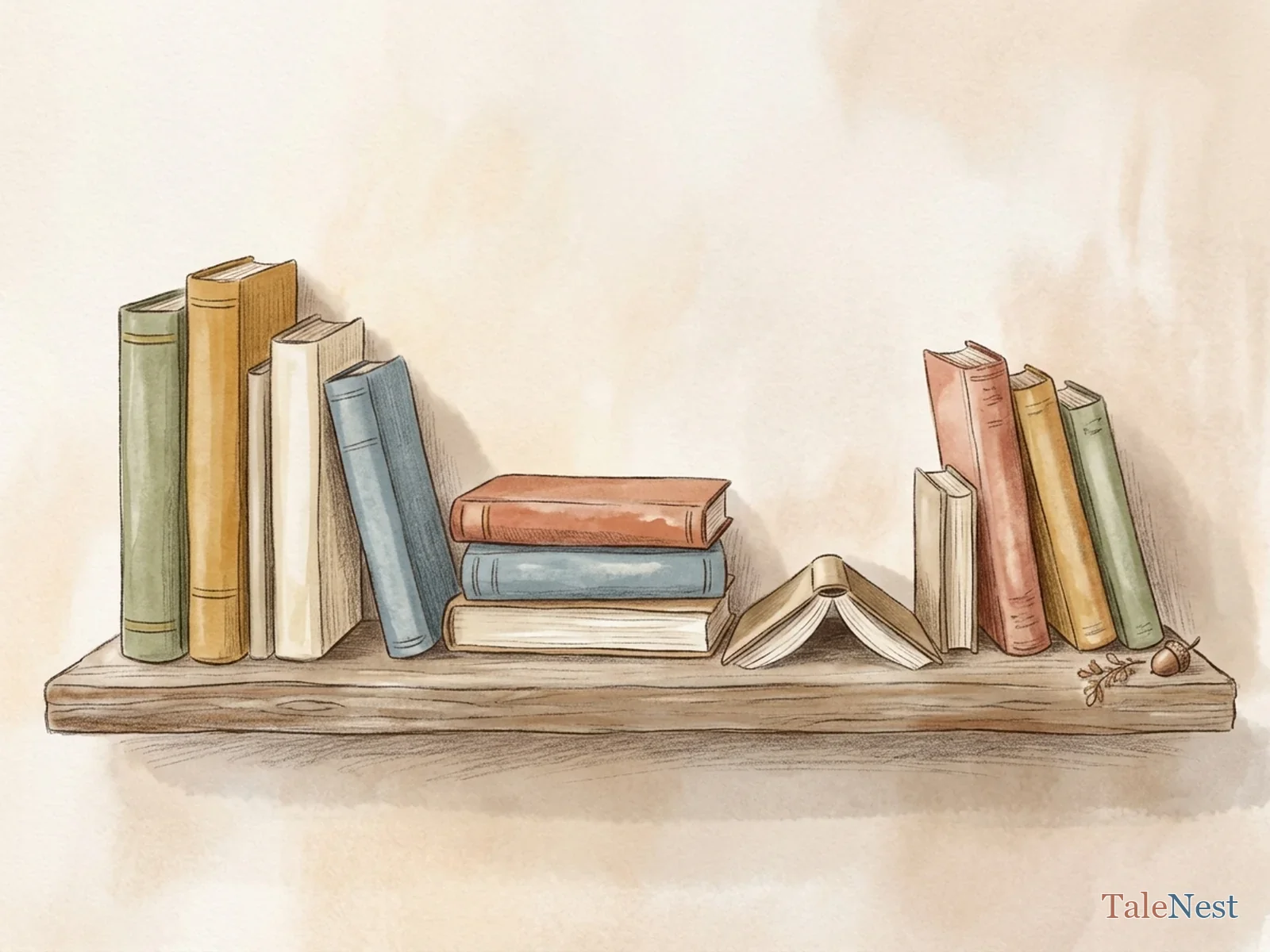
Parents often ask how many books are enough, usually while standing in front of a shelf that is already full. The number is rarely the real question. What matters is whether the books get used, picked up, opened, returned to. A large collection that sits untouched teaches a child that books are furniture. A small one that is read to pieces teaches that books are something you can have a relationship with. This is a guide to building the smaller kind. There is no number that suits every family, but there are habits that make a modest shelf work hard.
A small shelf works better
Rotation beats quantity
A child faced with forty spines tends to choose none of them. Too much choice at once is tiring, and the result is often the same request for the one book they already know. Rotation solves this simply: keep a fraction of the collection visible and put the rest away. Six or eight titles within reach is plenty for most evenings. Swap them every couple of weeks, or sooner if interest fades. Rotation also lets you watch what your child reaches for, instead of guessing from what you bought. Let their choices, not your aspirations, decide what stays on the shelf.
Visible covers matter
Children choose with their eyes long before they choose with their words. A spine turned inward gives them nothing to go on, so a shelf of face-out books is easier to use than a neat row of titles. If space is tight, face-out storage need not be elaborate: a low rack, a shallow crate, even the top step of a stool. What matters is that the cover is visible and the book can be taken without asking. And resist the urge to file by age or by merit. A shelf arranged for adult approval will be read by adults.
A starting set of twelve
Four classics, four new, four folktales
If you are beginning from nothing, twelve books is a workable number. Four can be the stories adults in the family already know, the ones you can recite without opening the page, which makes them easy to read at bedtime when you are tired. Four can be newer picture books, chosen for their pictures and rhythm rather than for any lesson they promise. Four can be folktales from different traditions, including one from your own culture. This is not a rule about quality, only a way of making sure the shelf has range: familiar and strange, modern and old, home and elsewhere. A book you dislike reading aloud will spend months on the shelf doing nothing.
One guide for the adult
Set aside one book that is not for the child at all. A short, practical guide to reading aloud, choosing books or answering children's questions makes the collection more useful than another story. Keep it where you can reach it, not on the child's shelf. The point is not to follow a method exactly but to have somewhere to turn when you run out of patience or ideas. Parents who read a little about how children respond to stories often become less worried about doing it right, and that ease is felt by the child. A guide also models something worth showing: that adults are still learning.
Where to put them
Eye level and reachable
Store the books where a child can reach them without help. That usually means low, at the child's eye level when standing, or lower. A shelf mounted at adult height keeps the room tidy but turns every reading into a request, and requests get refused on tired evenings. Make sure the books out can be reached by the youngest child who uses them, and accept that some will be pulled down and left on the floor. Tidiness is a poor trade for independence. A child who can fetch a book alone will fetch one far more often than a child who has to ask.
A single basket for tonight
Alongside the shelf, keep one small basket for the books currently in use. It might hold the two titles being read this week and one old favourite. When a child asks for a story, the choice is already narrowed. The basket is also where the book lives, so the last read does not vanish into another room. Empty the shelf into it, not the other way around. After a few weeks the basket usually becomes the first place a child looks when they want a story. That is a good sign, not a system to perfect.
Borrowing and sharing
How often to rotate
Libraries make rotation easy, and a regular visit gives a child more variety than any home shelf can hold. Two or three books at a time is enough for a week; more than that and the good ones get lost. Go on the same day each week if you can, and let the child choose, even when their choices seem odd to you. Keep your own shelf as the steady part of the supply and treat library books as the changing part. Between the two, most children get both repetition and novelty.
Caring for borrowed books
Borrowed books need a few simple rules. Teach them as habits rather than warnings: a clean table, hands before pages, no food near the book, and a fold of paper used as a bookmark instead of a bent corner. Keep scrap paper by the reading place so the last rule is easy to follow. When a book is damaged, say so at the library; staff would rather know than discover it. Children who help with these tasks learn that a shared object has a life beyond their own use of it.
Common questions
Are e-books enough?
For some families, yes. A tablet holds hundreds of titles and is useful when space is tight. But a screen is a different object from a book: no cover to find on a shelf, no page to turn back to in the dark. Keep a few physical ones as well, and read from the screen with the attention you would give a printed page.
What about duplicated titles?
Duplicates are normal in households with more than one child, or with one child who insists on the same story for months. Keep them while they are used, and let one copy live somewhere else, a grandparent's house, a bag, the car. If a third copy appears and none is read, pass one on. A book loved to pieces can be replaced.