How to Read a Short Story Aloud in Under Seven Minutes
Seven minutes is a genuine limit, not a lesser version of reading. Plenty of evenings offer exactly that much calm attention, and a short story read well inside it will do more than a longer one rushed and resented.
This article offers general information for families. It is not medical, psychological or developmental advice; ask a qualified professional about your own child.
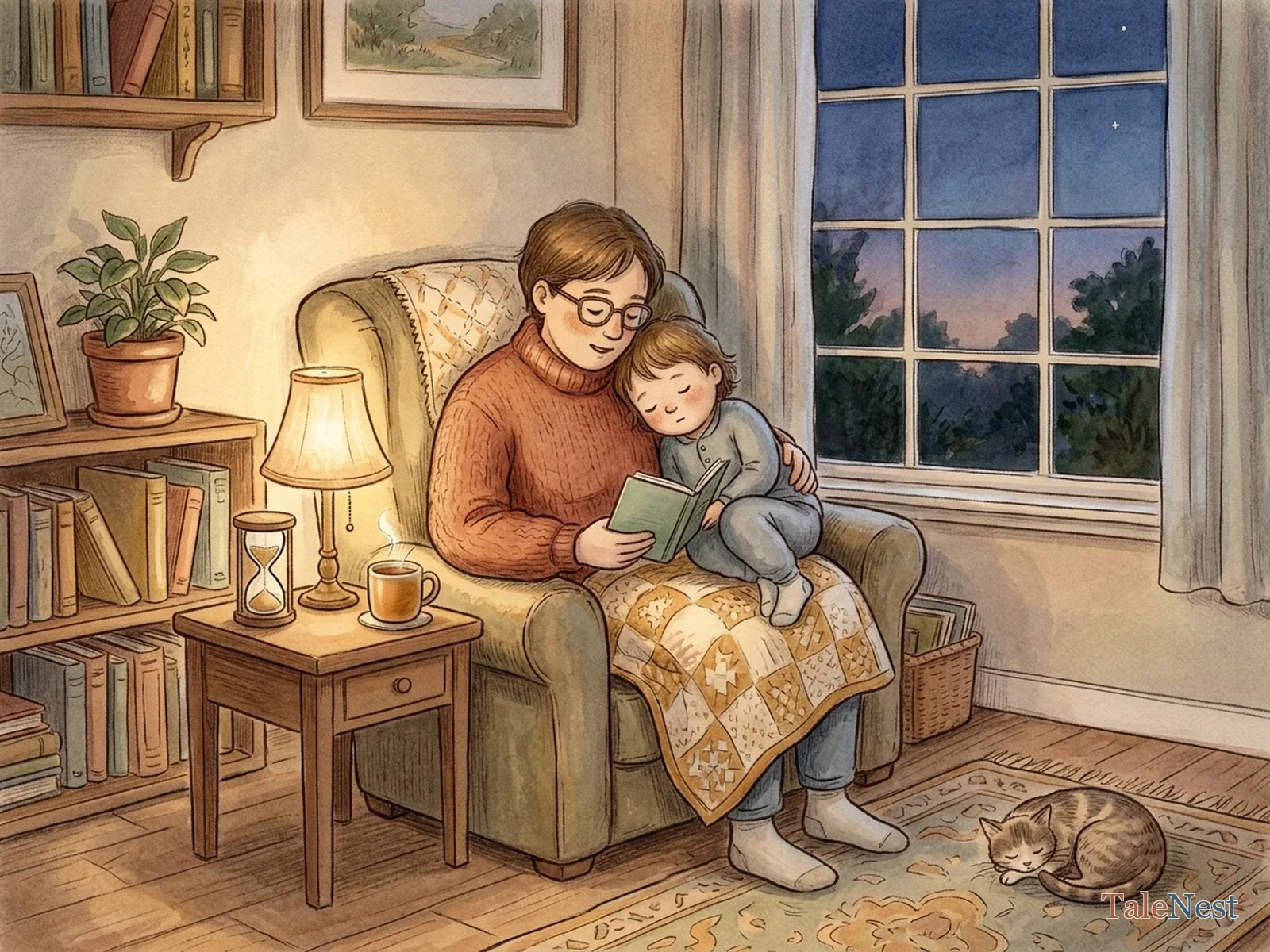
Seven minutes is a genuine limit, not a lesser version of reading. Plenty of evenings offer exactly that much calm attention, and a short story read well inside it will do more than a longer one rushed and resented. The goal is not to finish fast. It is to give a child one complete story, with a beginning and an ending they can hold, before their attention drifts or the house gets loud. What follows is a method for making that small window work, drawn from the ordinary business of choosing a book, reading it, and noticing when a listener is still with you.
Before you start
Choosing a story by length
Length is the first decision, and it is worth making honestly. Pick a story you can read aloud in four or five minutes at a conversational pace, leaving a minute on either side for settling and for a question at the end. A good test is to count the words rather than the pages: a picture book with thirty words a page can run long if the illustrations invite stopping, while a chapter of two hundred words may take less time than it looks. For a child who is new to listening, shorter is not a limitation. A story that ends while they still want more is the one they will ask for again.
Reading it once to yourself
Read the story alone before you read it to anyone. This is not preparation for performance; it is so you know where the hard words are, where the sentence turns, and how long the whole thing actually takes. Children forgive a stumbling adult more readily than one who stops mid-page to work out a name. Read it once with a clock if you have never timed yourself, and notice the lines you would be tempted to skip. Those lines are usually the ones that carry the story. Knowing them in advance lets you keep moving instead of deciding in the moment.
Pace, voice and pauses
Slowing down at dialogue
Most adults read faster than they speak, and faster than a child can follow. The fix is not to read everything slowly, which soon sounds unnatural, but to change speed where the text gives you a reason. Dialogue is the clearest signal. When a character speaks, drop your pace a little and let the words land separately from the narration around them. You do not need accents or a different voice for each figure. A small change in speed and volume is enough to show that someone is speaking rather than being described. Children track who is talking by how the line sounds, and that quiet cue helps them stay oriented.
Where to stop and breathe
A short story has only a handful of natural stopping points, and you do not need to mark all of them. Stop where a scene ends, where something is found or lost, or where a decision is made. A pause of two seconds at these places gives a listener time to picture what changed. Resist the urge to explain during the pause. The silence is doing the work. If a child breaks in with a question, answer it in a sentence and return to the page; a long discussion in the middle of a seven-minute reading will swallow the story. Save the fuller conversation for the last page.
Keeping a young listener with you
One question at the right moment
One well-placed question is worth a stream of them. Ask it just before a turning point, not after: what do you think is behind the door, why did she go back, who do you think took the cake. The question should be answerable in a few words and should not have a single correct answer. If you ask three or four across a short story, the reading turns into a quiz and the child starts guessing what you want to hear. One question, asked at the moment the story itself raises it, keeps the listener active without pulling them out of the tale.
Letting the picture do half the work
In an illustrated story, the picture is not a reward for finishing the words. It carries information, and a child reads it while you read the text. Hold the book where it can be seen, and give a beat on the pages where the drawing changes something: a face, a place, a hidden detail. You do not have to point everything out. Letting a child notice a small figure in the corner on their own is more satisfying than being told where to look. If the words and the image say the same thing, trust the image and keep reading; the redundancy is there for a reason and does not need your comment.
When the reading runs long
Cutting without breaking the story
Sometimes a story runs past seven minutes. Before you cut anything, check whether the extra time is yours rather than the text's: a slow opening or a repeated refrain you have read aloud twice may be the cause. If you must shorten, cut description, not events. Remove a sentence of setting, a repeated line, or a second example of something already clear. Never cut the reason a character acts or the moment the problem is resolved. A child can follow a thinner story; they cannot follow one whose cause has gone missing.
Splitting across two evenings
Some stories are worth keeping whole even if they take two nights. If you split one, end the first evening at a pause that already feels like a stopping place, a journey begun, a choice made, and say plainly that you will finish it tomorrow. Do not stop in the middle of a sentence to fill time. On the second evening, spend one sentence recalling where you left off, then read straight through. A story divided this way often stays with a child longer than a single sitting, because they have had a night to wonder what happens next.
Common questions
Should I use different voices?
Only if it comes naturally. Distinct voices can help a child follow who is speaking, but an uneven imitation is more distracting than a plain reading. A change in pace, volume or posture is enough. If you enjoy voices and a child asks for them, use them; if they make you self-conscious, leave them out.
What if they ask to skip pages?
Let them. A child who asks to skip usually knows what they are avoiding or what they want to get back to. Skip the pages without comment and keep the story moving. Later, away from the book, you can ask what they skipped and why. Often the reason is simple: a frightening picture, a dull passage, or the wish to reach the ending again.