Why Every Culture Has a Trickster: What Children Learn from Clever Fools
Every tradition seems to keep one figure who bends the rules and gets away with it. The trickster is small or ordinary, rarely the strongest in the room, and almost never the person you would choose to represent the community.
This article offers general information for families. It is not medical, psychological or developmental advice; ask a qualified professional about your own child.
Every tradition seems to keep one figure who bends the rules and gets away with it. The trickster is small or ordinary, rarely the strongest in the room, and almost never the person you would choose to represent the community. Yet the stories travel and last. They are funny, sometimes crude, and often more interested in a good joke than a clean moral. For children they offer something valuable: a chance to watch someone weak use their wits on the powerful, and to laugh while the world's certainties turn upside down. Understanding why this figure keeps appearing helps us read the tales with more than a shrug.
What a trickster is
Not a villain, not a hero
A trickster is not simply a bad character, and calling one a hero flatters them too much. They cheat, lie and play pranks, but the tales do not usually ask us to admire their honesty. What they admire is the mind at work: the quick answer, the reversed expectation, the ability to turn a stronger opponent's rules against them. A villain is frightening and wants harm; a trickster is often playful and wants a win, or a meal, or simply the last word. The figure sits outside the usual moral categories on purpose. That awkward middle position is what makes the stories interesting and what makes adults unsure how to explain them.
Examples from different traditions
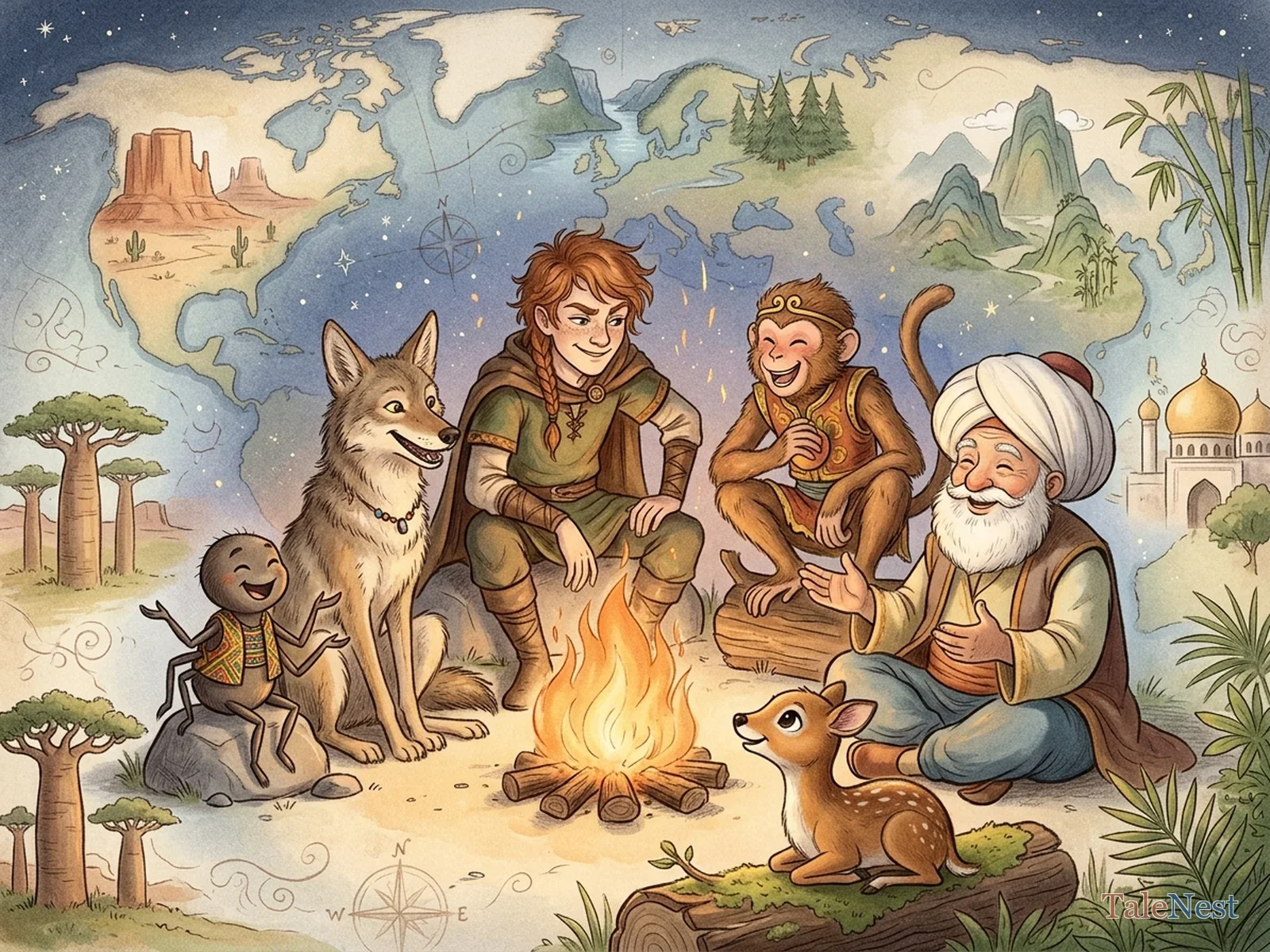
The names change from place to place while the shape stays familiar. In West African tales Anansi the spider uses cunning to get the better of larger animals. Coyote appears in many Indigenous North American traditions as a maker of mischief who also teaches by getting things wrong. Raven does similar work in stories from the Pacific Northwest. Nasreddin Hodja, told across the Middle East and Central Asia, is a fool whose simple questions expose the greed of judges and merchants. European folklore gives us Reynard the Fox, and Norse myth gives us Loki. None of these figures is identical to the others, but a child who knows one will recognise the moves in another.
Why the type survives
Rules tested safely
Trickster tales let an audience test a rule without breaking it. The story puts a character in a situation where the ordinary instructions fail, the giant is too big, the king is too sure of himself, the queue is too long, and watches them find a way through. Because it happens in a tale, nothing real is at stake. A child can enjoy the rule being bent and still go home and follow it. That combination is rare. Most stories either uphold order or imagine its collapse; the trickster does both at once, which is why the tales survive in oral tradition and keep being retold.
Intelligence over strength
The trickster is usually the weaker party. That is the point. In a world where size and status decide most outcomes, these stories give the small and the young a figure who wins by thinking. A child who has been pushed to the back of the line recognises the pleasure of a character who gets the last word without a fight. The moral is not that cleverness excuses cruelty, but that a mind is a resource even when you have nothing else. This is a quietly useful idea for a young reader, and it is delivered as entertainment rather than instruction, which is why it lands.
Reading a trickster tale with children
Asking who was fooled and why
The simplest question after a trickster tale is also the best: who was fooled, and why did they believe it? Children enjoy this because they can usually answer in detail. They notice that the greedy man expected a reward, or that the proud animal refused to look down. Naming the reason turns the joke into an observation about how people think. Resist turning it into a lesson about the trickster's virtue. Ask instead about the person who was taken in. A child who can explain why someone believed a lie has learned something about human nature that will outlast the story.
Separating cleverness from cruelty
Some trickster tales are unkind. An animal is hurt, a person is humiliated, and the joke depends on their pain. It is fine to say so. You can enjoy a story and still notice that someone in it was treated badly. Ask whether the trick could have worked without the cruelty, and whether the character had another choice. This is not censorship or a test of the tale's worth; it is a way of helping a child hold amusement and judgement at the same time. The best conversations here are short. A sentence or two at the right moment is enough, and too much serious talk will flatten a funny story.
What it teaches without moralising
Questioning authority kindly
Tricksters often get the better of someone who has decided they deserve respect: a judge, a landlord, a boss. The tales do not tell children to disobey every rule. They show that a person in charge can be wrong, and that pointing this out does not have to be cruel. A child can carry that into a classroom or a family without becoming difficult. The tone matters more than the message. When the trick is playful rather than bitter, it models a way of questioning that keeps the relationship intact.
Accepting the joke
Not every story has to improve us. A trickster tale is often funny first and instructive second, and children appreciate being allowed to laugh without a follow-up question. Let the joke stand. If you insist on drawing a moral from every prank, the child learns that enjoyment needs permission. Laughing together at a silly outcome is a small, ordinary pleasure, and it is part of what reading together is for. The tale will do its quiet work without a summary.
Common questions
Is the trickster a bad role model?
Not if the reading includes a little honest comment. A child can enjoy a clever cheat without wanting to become one. The risk comes from presenting the trickster as admirable in every way, which the tales themselves rarely do. Name what was clever and what was unkind, then leave it. Most children understand the difference by the time they are old enough to follow the plot.
Which tale should we start with?
Choose one that is short and funny, with a trick a child can explain afterwards. Anansi stories are a good entry point because the spider is small and the tricks are easy to follow. Read one version first and let the child meet the character before comparing others. Avoid the longest, most biting tales until they know the type. A good first trickster story leaves them laughing and able to say, in their own words, exactly how the trick worked.