
Hansel, Gretel and the Candy House
Left in the forest by desperate parents, two siblings follow a trail of crumbs to a house made of cake, and a witch with a very large appetite.
 Retold by Idalia SantosAges 6+6 min read920 words
This is a work of fiction, retold in original language for TaleNest. Names, places and events are part of the story.
At the edge of a great forest lived a poor woodcutter with his wife and their two children, a boy named Hansel and a girl named Gretel. He worked from dawn to dusk, but no matter how hard he toiled, he could never earn enough to fill his family’s bellies. One year the harvest failed, food grew scarce, and the children went to bed hungry night after night. At last the parents sat down at their bare table and made a heartbreaking decision. “We cannot feed them,” said the mother. “We must leave them in the forest and hope that someone kinder and better off will take them in.”
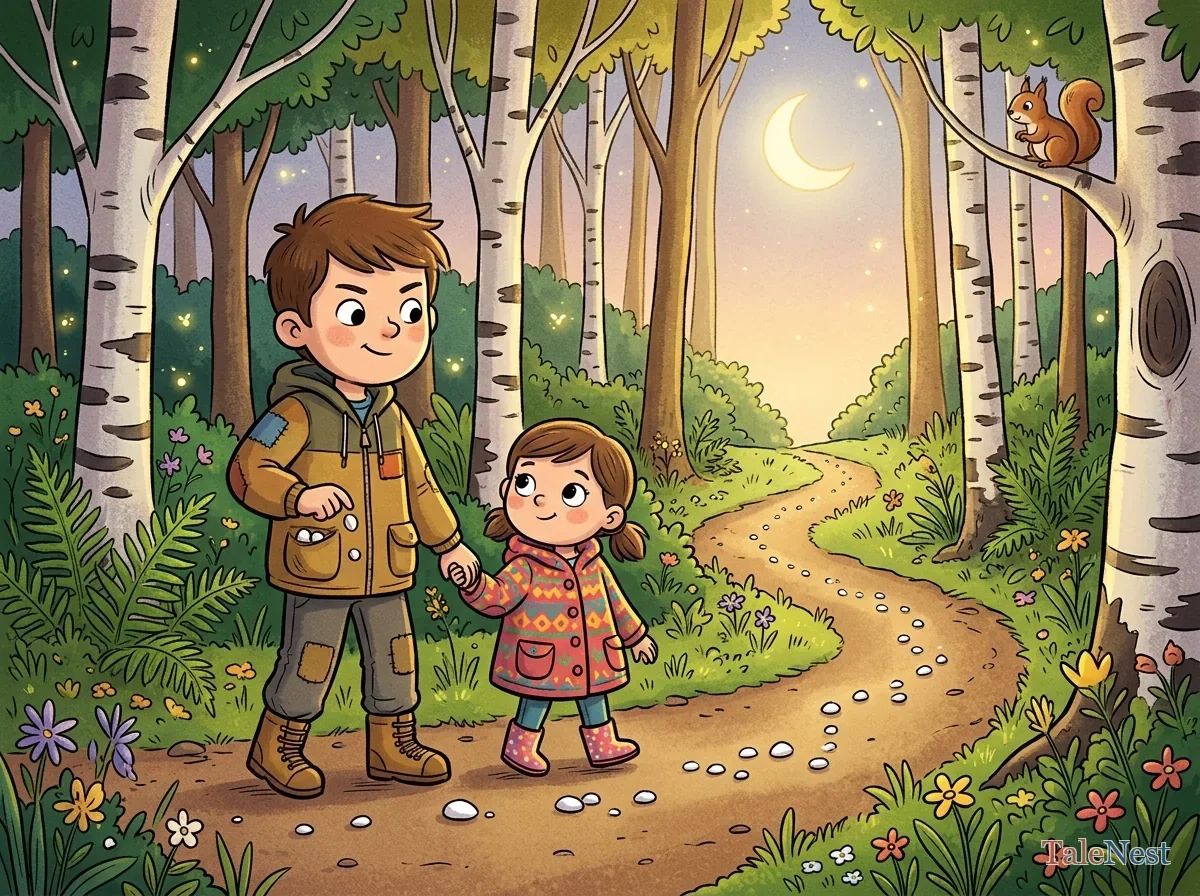
Hansel and Gretel were lying awake, too hungry to sleep, and they heard every word. Gretel began to cry, but Hansel took her hand. “Do not worry,” he whispered. “I will find a way back, I promise. Trust me.” When the parents were asleep, he crept out, gathered a pocketful of small white pebbles, and slipped them into his coat.
The next day the whole family walked into the forest. Hansel lingered behind, dropping a pebble every few steps. At a clearing the parents built a fire and told the children to rest. “Wait here,” they said, “and we will go a little farther to gather wood.” Hansel and Gretel sat by the warm fire until they fell asleep. When they woke, the fire had died to ashes and their parents were gone. Gretel began to sob, but Hansel said, “Look at the pebbles shining in the moonlight. They will show us the way home.” And sure enough, the little stones glittered like stars along the path, guiding them safely back to the cottage before dawn. Their parents were overjoyed to see them.
Not long after, the hunger returned, and the parents decided to leave the children in the deeper part of the woods where they had never been. This time the door was locked at night, so Hansel could not fetch his pebbles. Instead he rubbed the crust of his daily bread into crumbs and scattered them as they walked. But when the moon rose, there was not a crumb to be seen: the birds of the forest had eaten every one. Hansel and Gretel wandered for two whole days, weaker and more frightened with each step, until they could walk no farther.
“Quick thinking and sticking together can overcome even the most frightening situation, and sweet appearances may hide a dangerous heart.”The little lesson
Just when they thought they must give up, they saw the most wonderful sight: a little house built entirely of bread, with a roof of cake and windows of clear sugar. “Look, Gretel!” cried Hansel. “We can eat the roof and the walls!” They ran up and began breaking off pieces of the sweet cake. They were so busy eating that they did not notice the door open, nor the old woman who stepped out. “Well, well,” she said in a soft, sugary voice. “What are two hungry children doing at my house? Come in, my dears, and I will give you a proper meal.”
She led them inside, gave them milk and pancakes, apples and nuts, and tucked them into a soft bed. She seemed so kind. But in the morning the old woman grabbed Hansel, locked him in a cage in the barn, and said, “There you will stay until you are nice and fat, and then I shall eat you.” Then she shook Gretel awake and ordered her to fetch water and cook, for her brother must be fattened quickly. Gretel’s eyes widened with horror. This was no kind old woman. She was a wicked witch, and Gretel was alone with her.
Each morning the witch came to Hansel’s cage. “Stick out your finger,” she would say, for she was nearly blind and could not see how thin he was. But Hansel would hold out a chicken bone instead, and the witch, feeling the bone, would mutter, “Too thin, too thin,” and go away disappointed. This went on for weeks, and the witch grew more impatient every day, until at last she decided she had waited long enough. “Gretel!“ she snapped. “Light the oven and knead the dough. In you go tomorrow!”
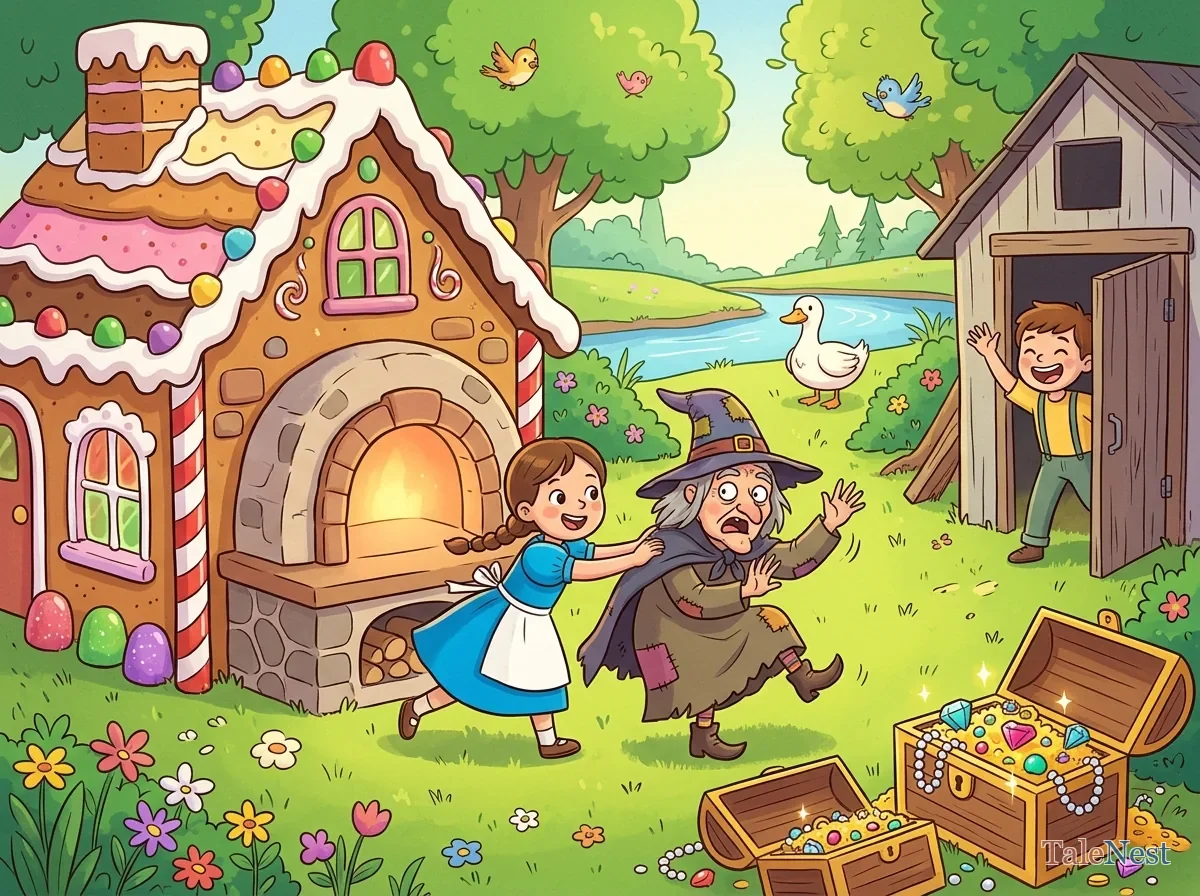
Gretel’s heart hammered. She knew what the witch meant to do, but she kept her face calm. “I do not know how to knead dough,” she said. “Show me how.” “Silly girl,” said the witch, “stand aside and watch.” She bent her head into the oven to demonstrate, and in one swift motion Gretel gave her a great shove, slammed the iron door, and turned the key. Then she ran to the barn, freed Hansel, and the two threw their arms around each other, laughing and crying with relief. Before they left, they searched the witch’s house and found boxes and boxes of pearls and glittering jewels, which they stuffed into their pockets.
They ran until they came to a wide river, and there was no boat and no bridge. “How will we ever cross?” cried Gretel. Just then a friendly white duck came paddling by. “Climb on my back,” said the duck, and it carried them safely to the other side. With the jewels in their pockets and the sun rising ahead, they raced toward the little cottage at the edge of the woods. Their parents, who had mourned them as lost, wept with joy when they appeared, and wept again when they saw the treasures they had brought home. They never went hungry again, and the whole family lived together in peace and happiness for the rest of their days.
Quick thinking and sticking together can overcome even the most frightening situation, and sweet appearances may hide a dangerous heart.


