
How Crab Became Doctor Know-It-All
A poor woodcarter buys a sign, a coat and a clever tongue, until a rich lord's stolen gold turns his bluff into a reputation that spreads like wildfire.
 Retold by Idalia SantosAges 6+5 min read984 words
This is a work of fiction, retold in original language for TaleNest. Names, places and events are part of the story.
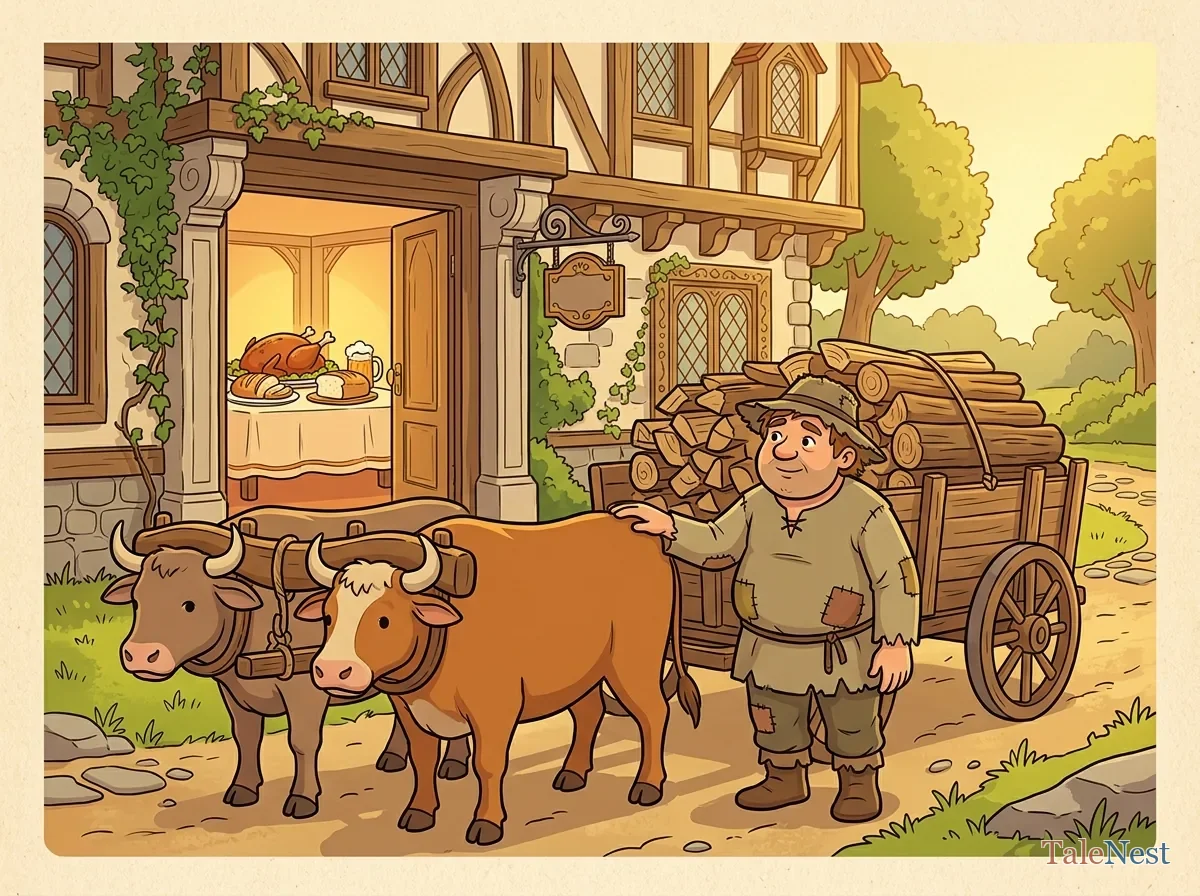
Once upon a time there lived a poor farmer named Crab, who scraped a living by driving a cart drawn by two oxen. One morning he heaped the cart with firewood and jogged into the city to sell the load to a physician for two gold ducats. While the man counted out the payment he was halfway through a splendid dinner: roasted meat, white bread, and a mug that foamed at the rim. Crab stood watching, swallowing hard, and a wish took shape in him as surely as smoke climbs from a chimney. Why should a man like him not become a doctor, with a fine coat and a table always laid?
'Why not?' said the physician, wiping his chin. 'It is simple enough. First, buy yourself a spelling primer. Next, sell your cart and your two oxen, and with the money buy the clothes that belong to a doctor, the long gown, the hat, the whole outfit. Thirdly, have a sign painted in large letters: I AM DOCTOR KNOW-IT-ALL. Nail it high above your front door so that nobody who passes can miss it.'
Crab carried out every instruction to the letter. He bought the primer, sold the cart and the oxen, dressed himself in a sober gown, and nailed the sign so high that it caught the eye of everybody in the street. It was not long before neighbours began knocking at his door with coughs and aches and puzzling pains. Crab received them all with immense assurance, nodding gravely and prescribing rest, though the only thing he truly knew was the sentence on his own signboard.
Then a wealthy nobleman was robbed. His servants were questioned, his rooms turned upside down, and still the stolen money did not appear. At last somebody mentioned a certain Doctor Know-It-All who lived near the edge of town and was said to be able to find anything. The nobleman drove straight to his door. 'Are you the Doctor Know-It-All?' he asked. 'I am,' said Crab. 'Then come with me at once and recover my money.'
So the lord, the doctor and the doctor's wife Grete set off for the great house together. The table was already laid when they arrived, and the nobleman begged his guests to eat before beginning their search.
The first footman entered bearing a platter heaped with savoury meats. Crab nudged his wife in the ribs. 'Grete,' he murmured, 'that is the first one.' All he meant was that this fellow had carried the first course. But the servant's heart gave a lurch. He was one of the thieves, and he took the words for an accusation. The moment he was outside he hissed to his companions: 'He knows everything. We are lost. He said I was the first.'
“A quick wit and a bit of nerve can make even a plain farmer appear wiser than all the scholars in the land.”The little lesson
The second footman had no wish to go in, but there was no escaping it. He came forward with his dish, and again came the nudge. 'Grete, that is the second.' The second man turned as pale as his own apron and hurried out as fast as his legs would carry him.
The third man's luck was no better. 'Grete,' said Crab, 'that is the third.' The third servant scurried away to join the others in the passage, where they stood shivering and whispering together.
The fourth servant brought a covered dish, and the nobleman, eager to try his guest's skill, asked him to name what lay beneath the lid. The dish was full of crabs. Crab stared at it, utterly at a loss. Then he flung up his hands and cried: 'Woe to you, poor Crab!'
'There you are!' cried the lord, delighted. 'He knows! If he can tell what is hidden in a covered dish, he will know who has taken my money just as easily.'
The fourth servant was beside himself with fright. He caught the doctor's eye and jerked his head toward the door, signalling him to step outside. In the passage the four thieves crowded round. They confessed the whole plot, promised to return every coin and add a generous share besides, if only he would keep their names from the nobleman, for if their guilt were known, they would lose their heads. Then they told him exactly where the money lay hidden.

Crab allowed himself to be persuaded. He walked back into the dining room, seated himself and said: 'My lord, I shall now look in my book and discover where the money is.' Now there was a fifth man in the conspiracy, and he had crept into the chimney to learn how much the doctor really knew.
Crab opened his primer and began to turn the pages, hunting for the picture of the rooster. Page after page slipped past, and still he could not find it. He turned them slowly, then faster, then slowly again, while the answer waited for him in the passage. At last he said in a loud voice: 'I know you are in there. You may as well come out.'
The man hiding in the chimney took these words for a command aimed straight at him. Terror got the better of him. He tumbled out in a cloud of soot and cried: 'That man knows everything!'
Doctor Know-It-All then showed the nobleman where the stolen coins were buried, but he never once breathed a word about who had taken them. He was richly rewarded by both parties: handsomely paid by the lord for recovering the treasure, and generously tipped by the servants for guarding their secret. Before the year was out, his fame had spread through the whole countryside.
And that is how a farmer who could not tell a riddle from a seafood supper came to be taken for the cleverest man in the county, a reminder that a bold face and a lucky guess will often carry a person further than a whole shelf of books.
A quick wit and a bit of nerve can make even a plain farmer appear wiser than all the scholars in the land.


