
Kiam and the Little Blue Bird
A boy who always gets his way finds a blue bird with broken wings, and discovers that the greatest gift is helping something fly home again.
 Retold by Idalia SantosAges 4+6 min read778 words
Retold and rewritten by Idalia Santos for TaleNest. This version is original prose in English; the illustrations and accompanying text were created for this site.
This is a work of fiction, retold in original language for TaleNest. Names, places and events are part of the story.
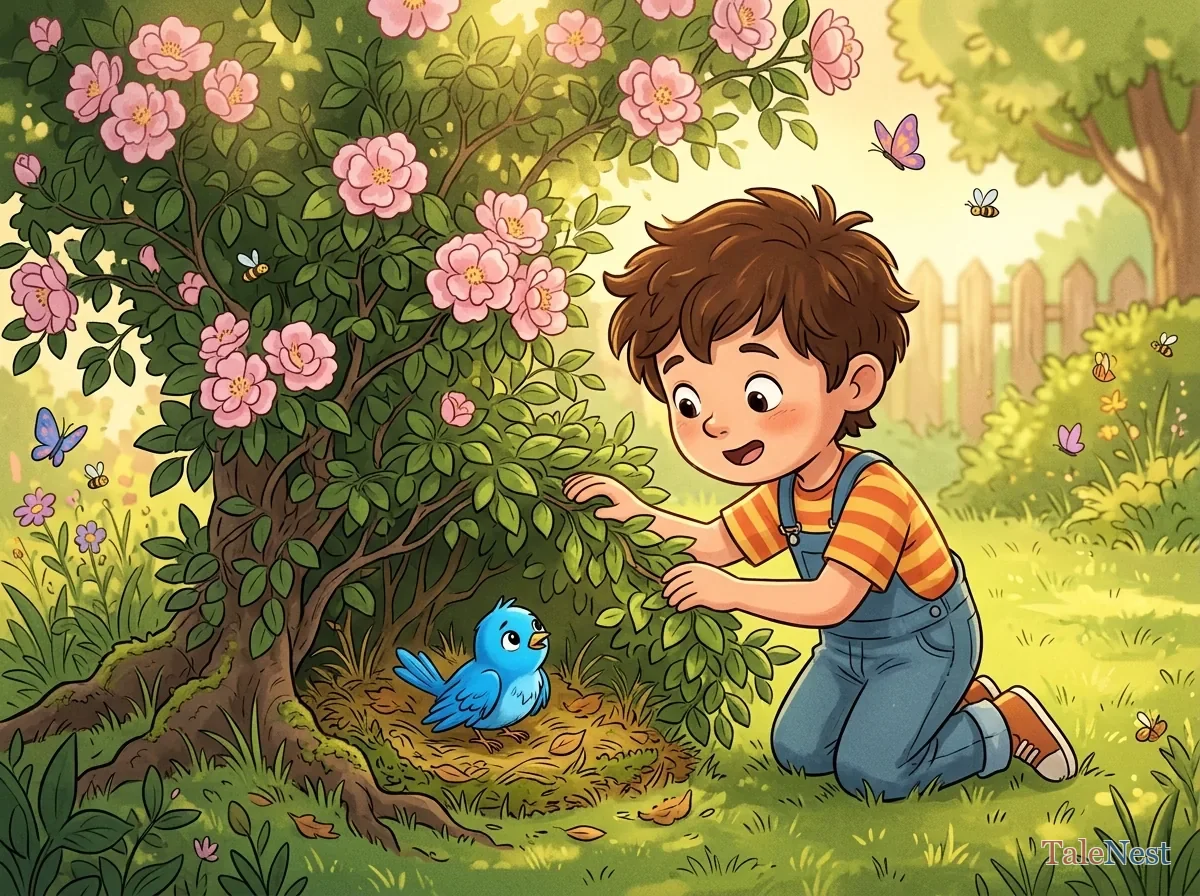
Kiam was wandering through his garden one morning, kicking a pebble and wondering what toy he should ask for on his upcoming birthday, when he heard a soft, tiny chirp. He stopped and looked all around. What he found made him jump with delight. Beneath the old rosebush lay a little bird with brilliant blue feathers, and its wings were broken. Kiam knelt down, hardly able to believe his luck. “What a beautiful bird!” he cried. “You shall be my new pet. I'll call you Bluey.”
But Bluey was not happy. He looked up at the boy with eyes so full of sadness that Kiam might have noticed, if he had been looking. “I don't want to be a pet,” the little bird seemed to say. “I want to go back to my family in the forest, but my wings won't work.” Kiam frowned. He was quite used to having exactly what he wanted, and he did not like being told no, even by a bird. “Oh, no, you're coming with me,” he said. “Besides, you can't fly just now, so I shan't need a cage.”
Kiam carried the bird into the house, thinking only of how he would show off his wonderful new pet to all his friends. He made a soft nest for Bluey and spent the afternoon playing with him in the sitting room, quite forgetting that the bird might have wishes of his own. He imagined the look on his friends' faces when they saw the dazzling blue feathers, and he smiled to himself at the thought.
That afternoon Kiam's grandmother came into the room and found him with the bird. “That bird doesn't look very happy, Kiam,” she said gently. Kiam shrugged. “He's only a bird,” he replied. “Haven't you noticed?” asked his grandmother, sitting down beside him. “How would you feel if you were far from home, hurt and frightened?” Kiam looked down and fiddled with the edge of his shirt. He remembered the time he had got lost in a big park, and how his stomach had knotted with fear. “I suppose I'd feel sad,” he admitted quietly. “And scared.”
“True worth is not measured by what we have, but by what we give to others without expecting anything back.”The little lesson
“That is exactly how this little bird feels,” said his grandmother. “And he must be in a great deal of pain. Didn't you notice his broken wings? Perhaps, instead of thinking about what you want, you could think about what he needs.” Kiam looked down at Bluey. The bird looked back with bright, hopeful eyes, and suddenly Kiam saw him properly for the first time. “I'll help you,” he decided. “We'll mend your wings, and then we'll take you back to the garden.” His grandmother smiled and went to fetch bandages and a little box lined with soft cloth.
With his grandmother's help, Kiam cared for Bluey for many weeks. He fed him carefully, kept his wing still, and spoke to him kindly every morning. Each day he checked the bandage and watched for the smallest sign of improvement. At last, one bright afternoon, Bluey stretched his wings and flew. It was not a very high flight, nor a very long one, but he flew. Kiam's eyes filled with tears of happiness as he carried the bird out to the garden.
A whole flock of blue birds was waiting among the rosebushes, and they greeted Bluey with joyful songs. He hopped from Kiam's hands to a low branch, then lifted into the air to join them. “Thank you, Kiam,” he called before he flew away. “You healed not only my wings, but my heart as well.” Kiam watched the blue birds wheel against the sky until they were tiny specks, and though he felt a little sad to say goodbye, something warm and wonderful was growing inside him.
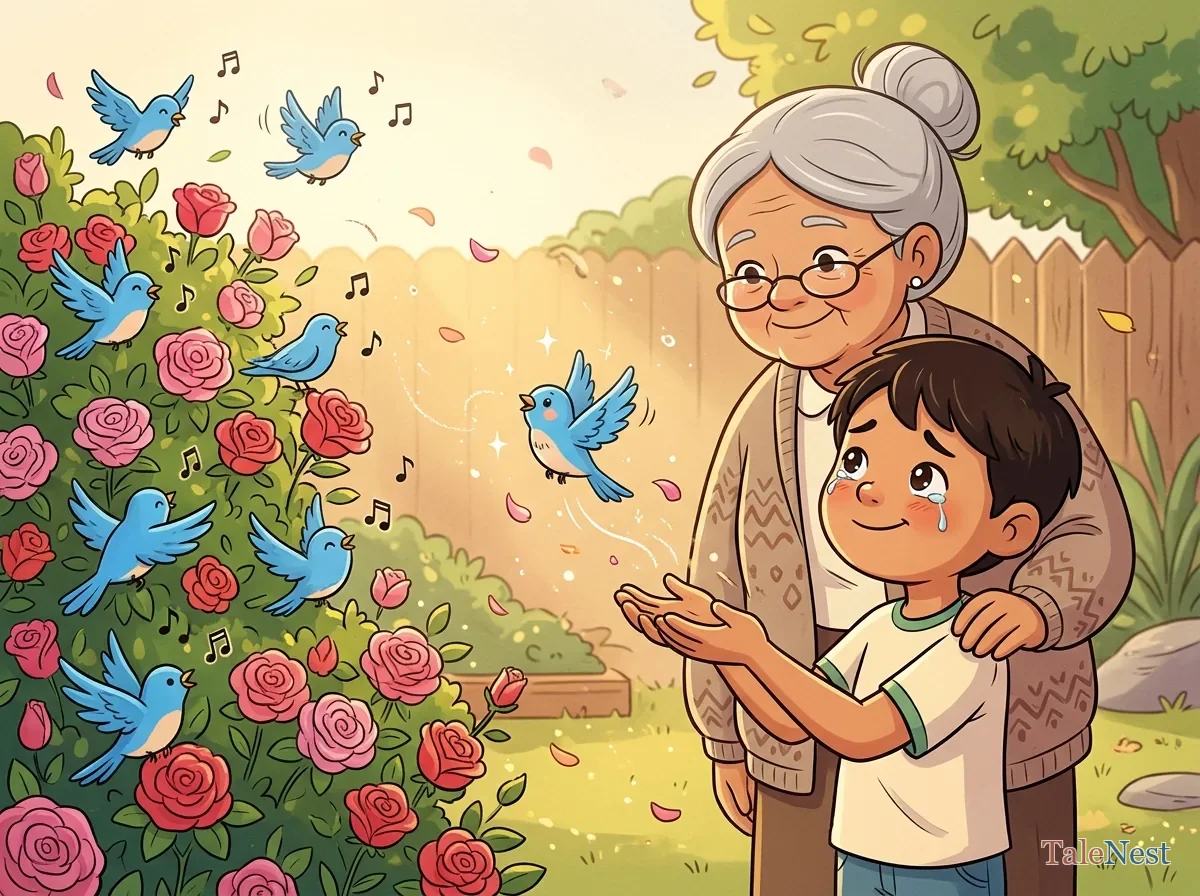
“Grandma,” he said a few days later, “I feel something in my tummy, and here behind my eyes, and I don't know what it is.” “Does it hurt?” she asked. “Do you feel poorly?” “No!” he said. “It's just that I've never felt it before.” His grandmother looked at him with great love. “Ah, my dear,” she said. “That is the joy of giving, without expecting anything in return.” Kiam smiled. He understood at last that by helping Bluey he had healed something in himself too.
He went back into the house carrying a lesson he would never forget: a person's true worth is not measured by what they have, but by what they are willing to give. And from that day on, whenever Kiam saw someone or something in need, he thought of a little blue bird with broken wings, and he stopped thinking about himself long enough to lend a hand.
True worth is not measured by what we have, but by what we give to others without expecting anything back.


