
Lazy Henry and the Honey Jar
Why carry a goat when a beehive will do? A delightfully idle couple discover that the easiest life still takes a little care.
 Retold by Idalia SantosAges 10+4 min read775 words
This is a work of fiction, retold in original language for TaleNest. Names, places and events are part of the story.
Henry was a lazy fellow. His whole day's work consisted of leading his goat out to graze, yet every evening, as he drove it home, he would grumble: “It is a weary, wearing thing, this dragging the goat to the meadow year after year. If a man could only lie down and sleep! But no—you must keep both eyes open, watch that the beast does not wander off or poke its nose into the gardens. What chance has a body to be at peace and enjoy life?”
Henry sat down to think how he might rid himself of the burden. He thought a long while without hitting on anything, and then he cried: “I have got it! I will marry Trina. She has a goat of her own; she can drive hers out with mine, and I will be tormented no more.”
So off he trudged to Trina's parents to ask for their daughter's hand. The parents did not hesitate a moment.
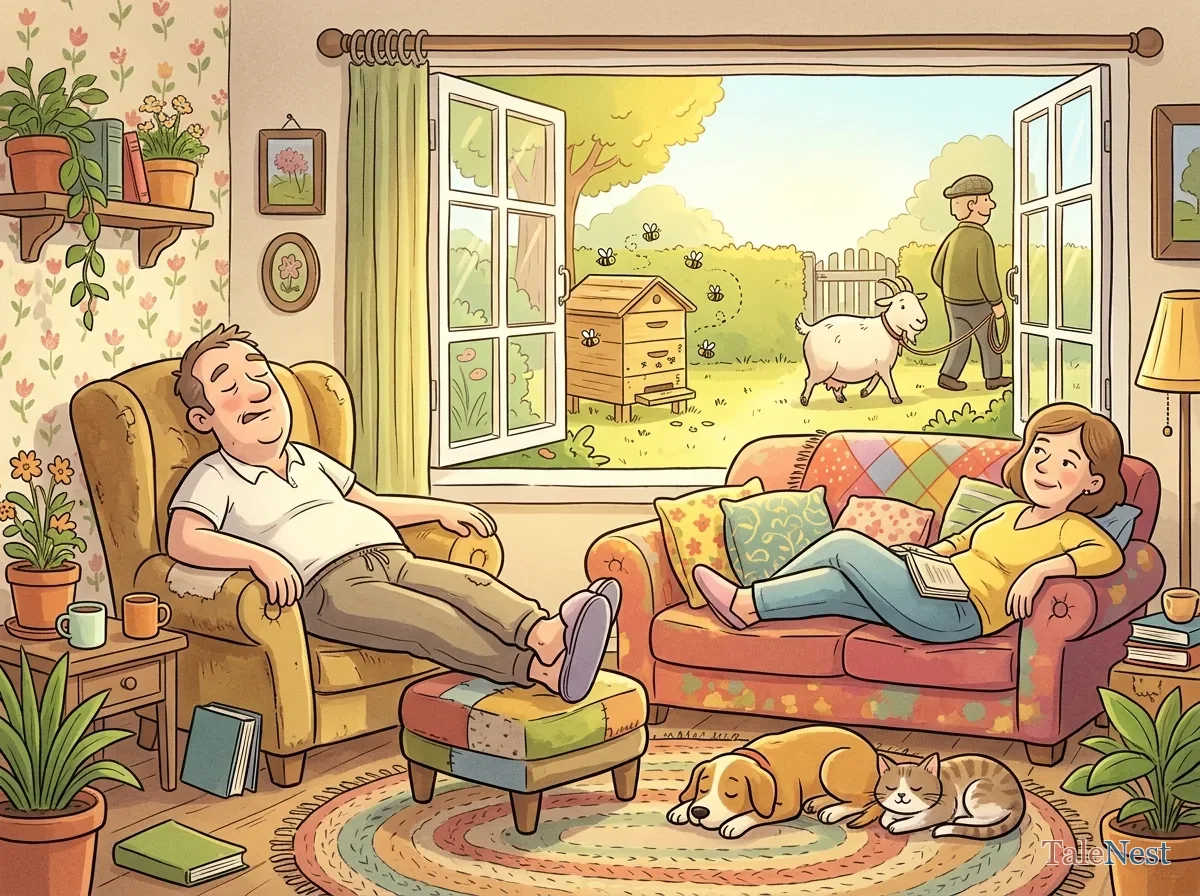
Trina became his wife and took both goats to pasture, while Henry lived happily with nothing to trouble him but his own idleness. Now and then he walked with her to the field. “I only come,” he would say, “so that the rest will taste better on the way home. Otherwise a fellow loses his relish for repose.”
But it turned out that Trina was no more industrious than her husband. “Henry, my love,” she said one day, “why sour our lives for nothing and squander the finest years of our youth? Would it not be wiser to trade our two goats to the neighbor for a beehive? We will set it behind the house in a sunny corner and never give it another thought. Bees need no watching and no driving to pasture; they fly where they please, know the way home, and fill their combs with honey, without ever bothering their owner.”
“You have spoken like a sensible woman who knows her mind,” said Henry. “Let us do it this instant. Besides, honey is sweeter and more nourishing than goat's milk, and it keeps far longer.”
“A life spent dodging work may feel comfortable, but laziness blinds people to the cost of their own choices, and even the sweetest prize can be lost in a careless moment.”The little lesson
The neighbor was only too glad to swap a hive for the two goats. From first light till late evening the bees toiled back and forth, packing the combs with splendid honey, so that by autumn Henry had filled a fine jar with it.
They set the jar on a shelf nailed high upon the bedroom wall, and because they feared someone might steal it, Trina took a hazel stick and laid it beside the bed. Thus, without rising, she could reach out and thrash or shoo away anyone who tried to touch the honey.
Lazy Henry never stirred from the sheets before noon. One morning, still lying abed, he said to his wife: “You are polishing off that honey. Before you have eaten every scrap, we had better buy a goose and a gosling with it.”
“Not until we have a child to look after them,” said Trina. “Do you suppose I will do all the work of rearing them and wear myself out for nothing?”
“And do you suppose the child will mind your geese? Children nowadays do not obey; they think they know more than their parents.”

“Oh!” cried Trina, “my boy will have a sorry time of it if he does not do as he is told. I will take a switch and tan his hide.” She snatched up the hazel stick she kept by the bedside for chasing mice, and brandished it in her excitement. “See, Henry?” she shouted. “That is how I will thrash him!”
And with that she had the ill luck to smack the jar upon the shelf. It struck the wall, crashed to the floor in shards, and every drop of honey spilled and spread across the boards. “There is your goose and gosling,” said Henry. “Now nobody need mind them at all. And it is a mercy the jar did not fall on my head—we may count ourselves lucky.”
Then, spying a little honey left on one of the broken pieces, he stretched out his arm to grab it. “Look, wife,” said he, “we will taste this bit and then rest after the fright. It is no matter if we rise a trifle later than usual—the day is long.”
“True,” said Trina. “One always arrives in time. Let me tell you: once a snail was invited to a wedding. He set out, and instead of reaching the wedding he reached the christening. In front of the house he stumbled and tumbled from the top of the fence, crying, “They are right—hurry is always the worst!”
A life spent dodging work may feel comfortable, but laziness blinds people to the cost of their own choices, and even the sweetest prize can be lost in a careless moment.


