
Queen of the Sun and Moon
An enchanted fish grants a poor couple every wish, but each gift only feeds a greedier one until the sea itself decides enough is enough.
 Retold by Idalia SantosAges 6+6 min read992 words
This is a work of fiction, retold in original language for TaleNest. Names, places and events are part of the story.
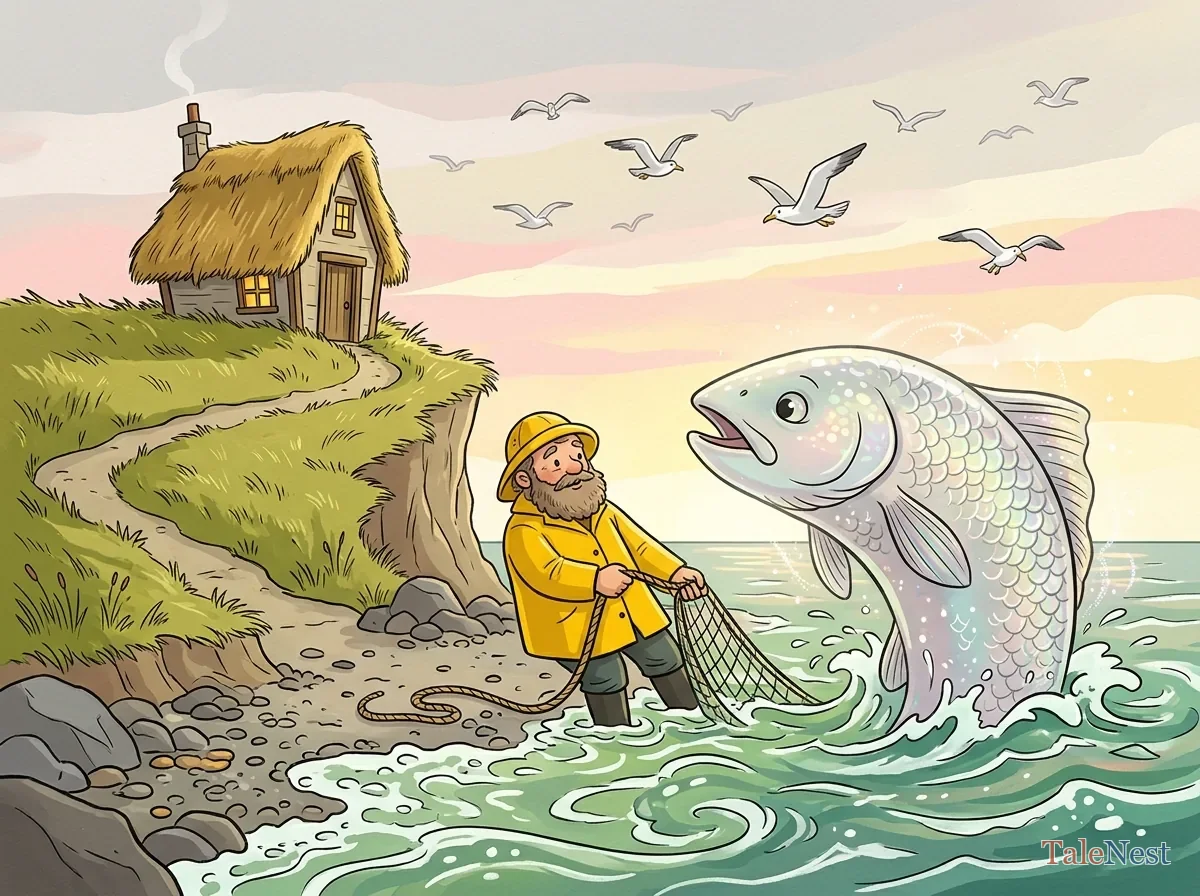
On a lonely headland where the North Sea worried the rocks stood a crooked hut with a roof the colour of wet straw. A fisherman lived there with his wife. Every morning he shouldered his rod and went down to the water, and what few fish he caught he sold at the market in the next village. With the coins they brought home the two scraped along, never quite starving and never quite full.
One morning the line went taut with such force that the rod bent like a young tree. The fisherman pulled with all his might, and up through the green water came a fish of such size that he gaped at it. Then, to his greater astonishment, the creature spoke. “Let me go,” it said. “I am no common fish but a prince under a spell. Set me free and you will never be sorry.” “Then go,” said the fisherman, and he worked the hook free and lowered the great fish back into the sea. It paused, then dived into the deep and was gone.
That evening he told his wife of his wonder. “And you did not think to ask anything for letting him go?” she cried. “Why, no,” said the fisherman. “Besides, what should I have asked for?” “You hesitate?” she exclaimed. “We live in wretchedness. Go back and ask for a decent little country house. If he is truly a prince, that is a trifle.”
The fisherman walked down to his rock and waited. When the fish did not rise, he began to mutter his troubles aloud. But the fish had not swum far; hearing him, it pushed its head above the waves. “Did you wish to see me?” it asked. “I am sorry to trouble you, but my wife wants me to ask a favour,” said the man. “It costs me nothing to grant what you desire,” said the fish. “Next time, to call me, sing this: Little fish, little fish, swim to me, for Alice my wife has a wish, and her wish must be granted.” “I will sing it,” said the fisherman, “but all we want is our poor hut turned into a country house.” “It is done,” said the enchanted prince. “Go home and you will find it so.”
“Greed that never says enough can sweep away even the gifts freely given, while contentment keeps what kindness has provided.”The little lesson
When the man reached home, a neat house with a garden stood where the hut had been, and his wife waited at the door, beaming. Their peace lasted one day. On the second morning she began to fret. “The house is not nearly so comfortable as it looked,” she said. “I should prefer a great castle. You must go to the prince again and ask.” The fisherman was sure the request was wrong, but the fish had been so kind that he trudged back and sang the little song. At once the fish appeared. “Here I am. What do you want?” “I hate to bother you,” said the fisherman, “but my wife insists on a great stone castle instead of the country house.” “You have not bothered me,” said the fish. “Go home; your wife's wish is granted.”
He went, and found a vast castle where the little house had been. His wife stood at the foot of the steps. Together they walked through halls furnished with such taste that they gasped at every room, and in each a servant stood waiting for orders. Behind the castle lay a great wood. They wandered from window to window, hardly believing the richness was theirs.
A few days later the wife drew him aside. “You will go back to the shore,” she said, “and ask the enchanted prince to make me queen.” “That is impossible!” he cried. “What do you lack? Have you not everything?” “That shows what a man you are, content with scraps,” she said sourly. Seeing a terrible quarrel brewing, he went down to the sea and sang his song again. The fish rose. “I think I am about to ask the impossible,” the man began. “Nothing is impossible to me,” said the fish. “It is this: my wife wants to be queen.” “Then do not worry,” said the fish. “Go home; it is done.”
On the road home he met soldiers beating drums and blowing trumpets. At the castle everyone spoke of Her Gracious Majesty Alice. He found her in the great hall, seated on a golden throne in the middle of the floor.
Time passed, but ambition would not let her rest. A few weeks later she sent a minister to summon her husband. “I want one more favour from your friend the fish,” she said the moment he stood before her. “Another favour?” he cried. “Are you not rich and powerful? What can you want now?” “I am powerful, but morning and evening it vexes me to see the sun and moon rise and set without my leave. I mean to be queen of them as well.”
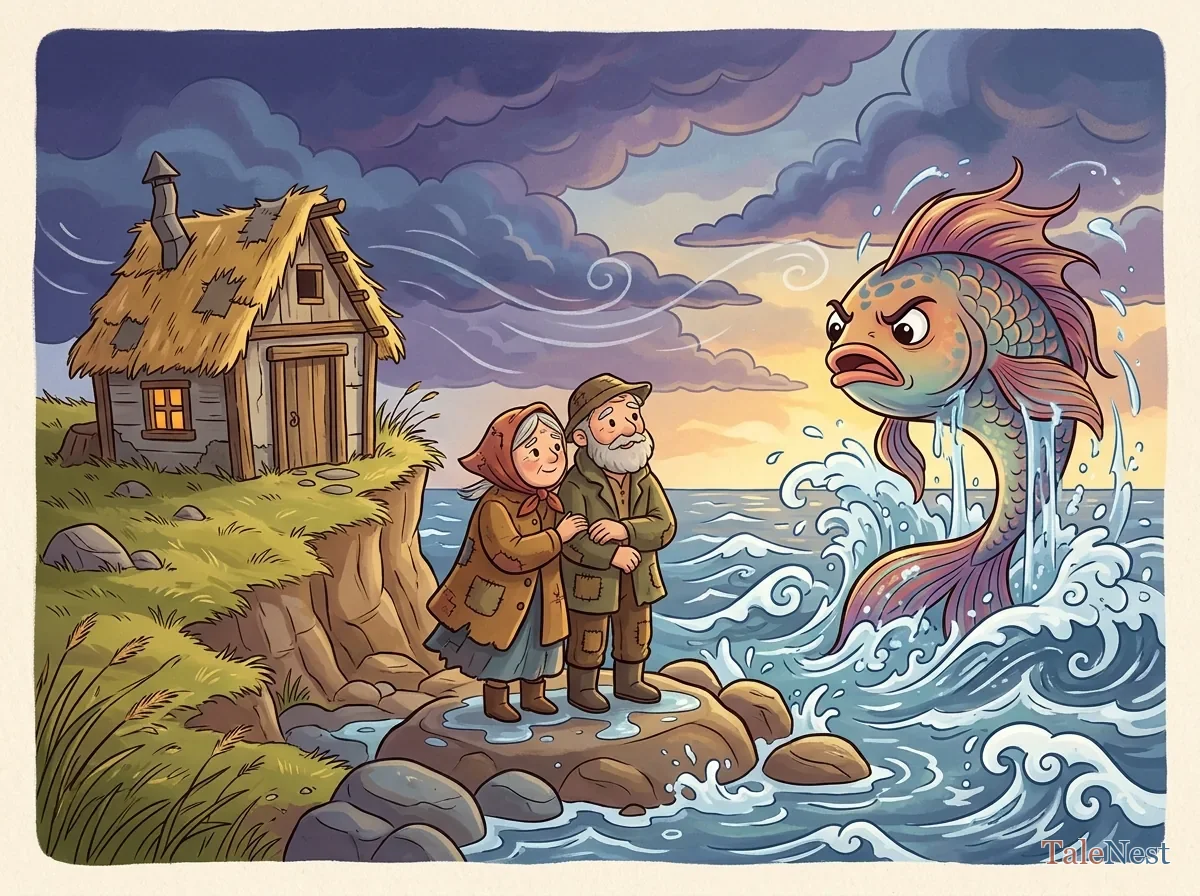
The fisherman went to his rock, more anxious than ever, and called the prince with the song. The fish appeared, but this time its brow was knitted. “What do you want now?” it demanded. The man trembled. He nearly asked for nothing, but dread of his wife's temper won, and he spoke in a small voice: “My wife wants to be queen of the sun and moon.” “That is what she wants?” roared the fish. “Then she shall not be! Go home, it is no palace now but the old hut, and be thankful I do not punish your greed.”
The fisherman did not argue. At home he said to his wife, “From this day there will be no more greedy dreams. We shall be poor for the rest of our lives. And one more thing: I will not hear another complaint from you, never, not ever.” They say she learned her lesson, and lived contentedly, even cheerfully, in the poor hut beside the sea until her days were done.
Greed that never says enough can sweep away even the gifts freely given, while contentment keeps what kindness has provided.


