
The Boy Who Heard Freedom
A nervous apprentice in Philadelphia watches the founding fathers sign a declaration, then asks the one question that turns liberty from a word into a responsibility.
 Retold by Idalia SantosAll ages5 min read878 words
Retold and rewritten by Idalia Santos for TaleNest. This version is original prose in English; the illustrations and accompanying text were created for this site.
This is a work of fiction, retold in original language for TaleNest. Names, places and events are part of the story.
Caleb's hands were damp with sweat. It was his first day as an apprentice in the great assembly hall in Philadelphia, and he had been given the simple, terrifying task of carrying water to the most important men in the colonies. The room was crowded with gentlemen in dark coats and powdered white wigs, their faces grave, their voices low. Yet beneath the talk there was a strange tension in the air, as though the walls themselves were holding their breath, waiting for something enormous to happen.
From his corner, Caleb watched with his heart in his throat. He could hardly believe he stood so near to men he had always thought of as heroes, Thomas Jefferson, John Adams, Benjamin Franklin. They sat around a long table, speaking with a passion that made the candle flames tremble. Caleb did not follow every word, but he understood enough to know what they were debating: freedom.
“We cannot go on obeying the king of England,” said John Adams firmly, tapping the table. “The time has come to be independent, to make our own laws and answer to ourselves.”
Thomas Jefferson, whose gaze was calm but unyielding, nodded as he read from the parchment in his hands. He had written it himself, every line. These were words that would change the fate of everyone in the room, and of countless others who would never set eyes on it.
“These words,” Jefferson said, “explain why we must be free, why every person has rights that no one can take away. Liberty. Justice. Equality.”
Caleb listened to each word as though it were being carved into stone. He had never heard freedom described like this, not as a favour handed down by a king, but as something that belonged to people simply because they were people. Something inside him insisted that he was witnessing a moment the world would remember forever.
The debate ran on for hours. Not everyone was convinced. “If we break with the king,” one delegate warned, “there may be war!”
“Freedom belongs to everyone and carries a responsibility to care for others, for liberty without kindness is no freedom at all.”The little lesson
“There may well be,” replied Benjamin Franklin, the wisest voice in the room, calm as a winter lake. “But it is a risk we must run if we mean to be free.”
A restless murmuring passed through the hall. Caleb noticed several delegates staring at the floor, lost in private thoughts of their families, their lands, everything they stood to lose if this bold gamble failed. The air felt heavier with every passing minute.
At last Jefferson rose to his feet, and when he spoke his voice rang with solemn certainty. “Today we decide something of great importance. We decide to be a free nation. If we put our names to this document, we tell the world that we will no longer be governed by a distant power, but by ourselves.”
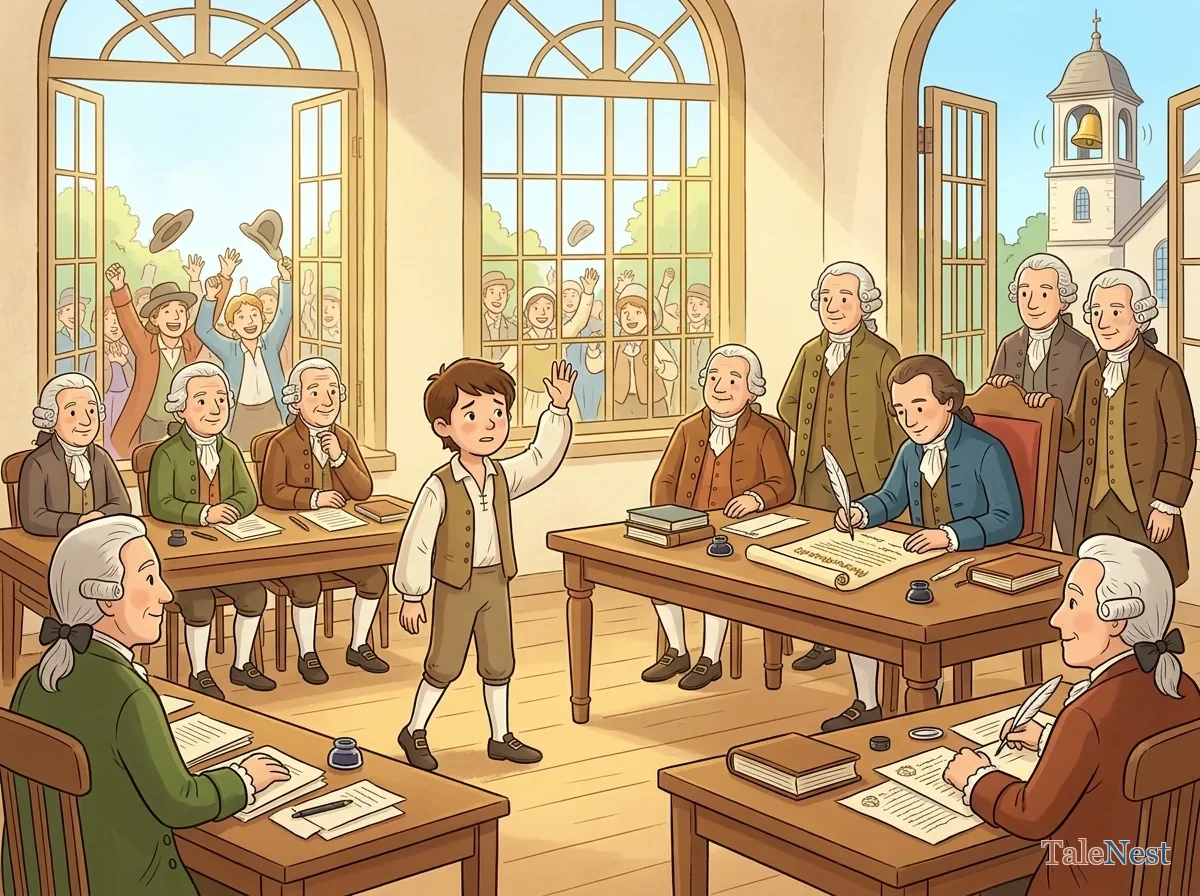
Silence settled over the room. The men looked from one face to another, and slowly, one by one, they drew near the table. Each took up the quill and signed. Caleb, still in his corner, felt a knot tighten in his stomach; he knew he was watching something extraordinary come into being.
But just as he decided the matter was finished, a small question began to worry at him. It seemed too simple to ask, yet it would not go away. Summoning all his courage, he raised his hand a few inches. “Begging your pardon...” he began, his voice trembling.
Every eye in the hall turned. Caleb swallowed hard and pressed on. “If we sign this, will we truly all be free? Does it mean that everyone can do as they please, without fear?”
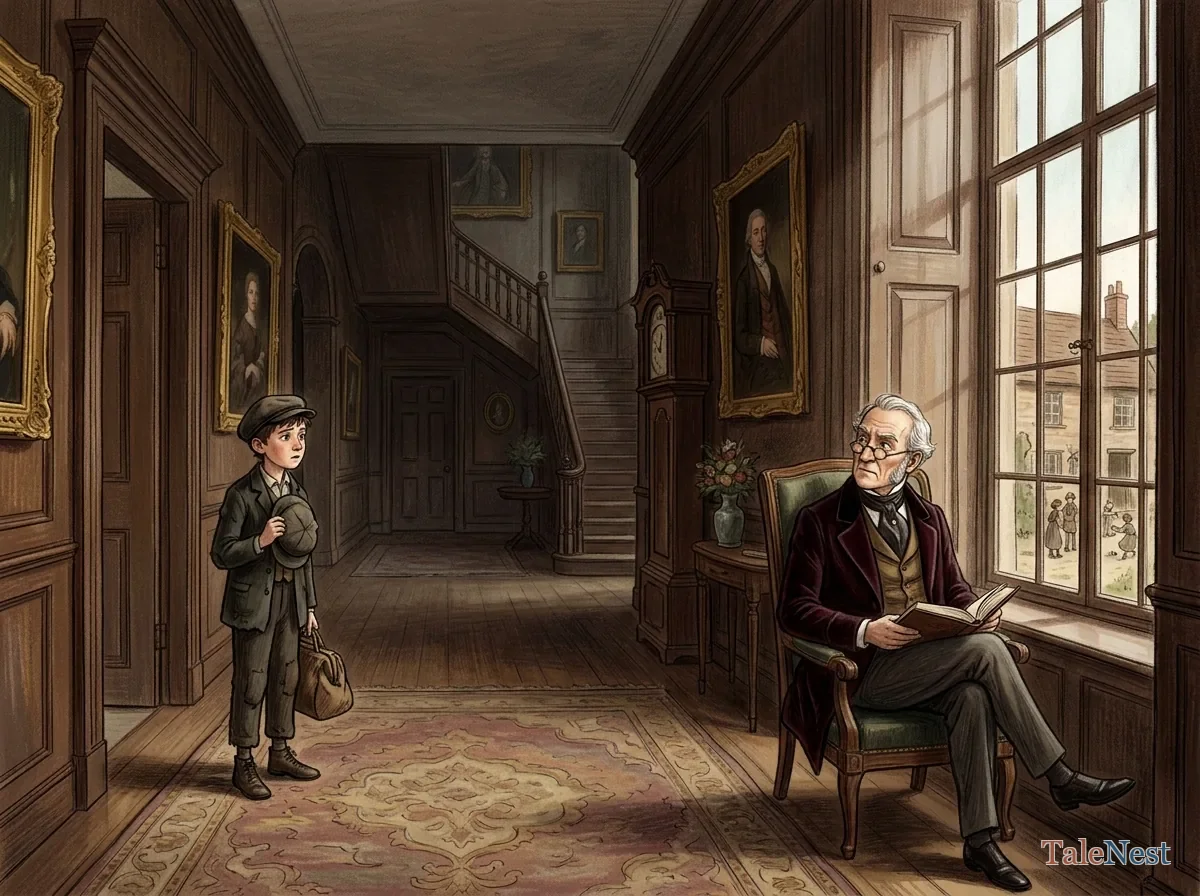
The delegates exchanged startled glances. It was a child's question, plain and enormous. Jefferson regarded him with a gentle smile. “That is our hope, young Caleb,” he said. “We sign so that all of us may share the same rights, so that no one need live in fear beneath the rule of a far-off king.”
“But we must also remember,” Franklin broke in, “that liberty is not only a right. It is a responsibility. We cannot do whatever we like without thought for others. Real freedom comes when we care for one another.”
Caleb nodded slowly, turning the words over. Freedom was a grand and powerful thing, yes, but it also meant behaving with kindness and respect toward the people around you.
When the last signature was set upon the parchment, a long sigh of relief swept the room. The men stood and shook one another's hands. They had taken a decision that would alter the course of history.
Outside, the bells began to peal, carrying the news to the streets: the American colonies were free and independent. Caleb followed the delegates into the daylight and watched the people erupt in celebration. The very air seemed thick with hope. He did not know exactly what the years ahead would bring, but he felt a swelling pride at having been present when it began.
For now he understood: freedom was not a privilege for a chosen few, but a promise meant for everyone. And though the road ahead would be hard, on that fourth day of July in 1776, Caleb, and the whole of America, began a new life.


