
The Butterfly Clock
When the baker shouts that night has come at noon, a girl with a magnifying glass follows silver feathers to a secret garden where unlived hours wait as butterflies.
 Retold by Idalia SantosAges 4+5 min read844 words
Retold and rewritten by Idalia Santos for TaleNest. This version is original prose in English; the illustrations and accompanying text were created for this site.
This is a work of fiction, retold in original language for TaleNest. Names, places and events are part of the story.
In the village of Avellaneda there lived a girl named Lúa. She owned a small magnifying glass and possessed a powerful appetite for solving mysteries. No oddity in the village escaped her notice for long, and she carried the lens everywhere, ready for the least little clue.
One morning the baker came running into the square, shouting at the top of his voice, “It's night already!” He was covered in flour and quite out of breath.
But the sun was shining brightly overhead. It was the middle of the morning, and yet the light had already turned lazy and low, as though the afternoon were hurrying to be done.
Lúa raised her magnifying glass to her eye. Something very odd was happening to the day. The hours were slipping away, one after another, like beads off a broken string.
“This is a mystery,” she said.
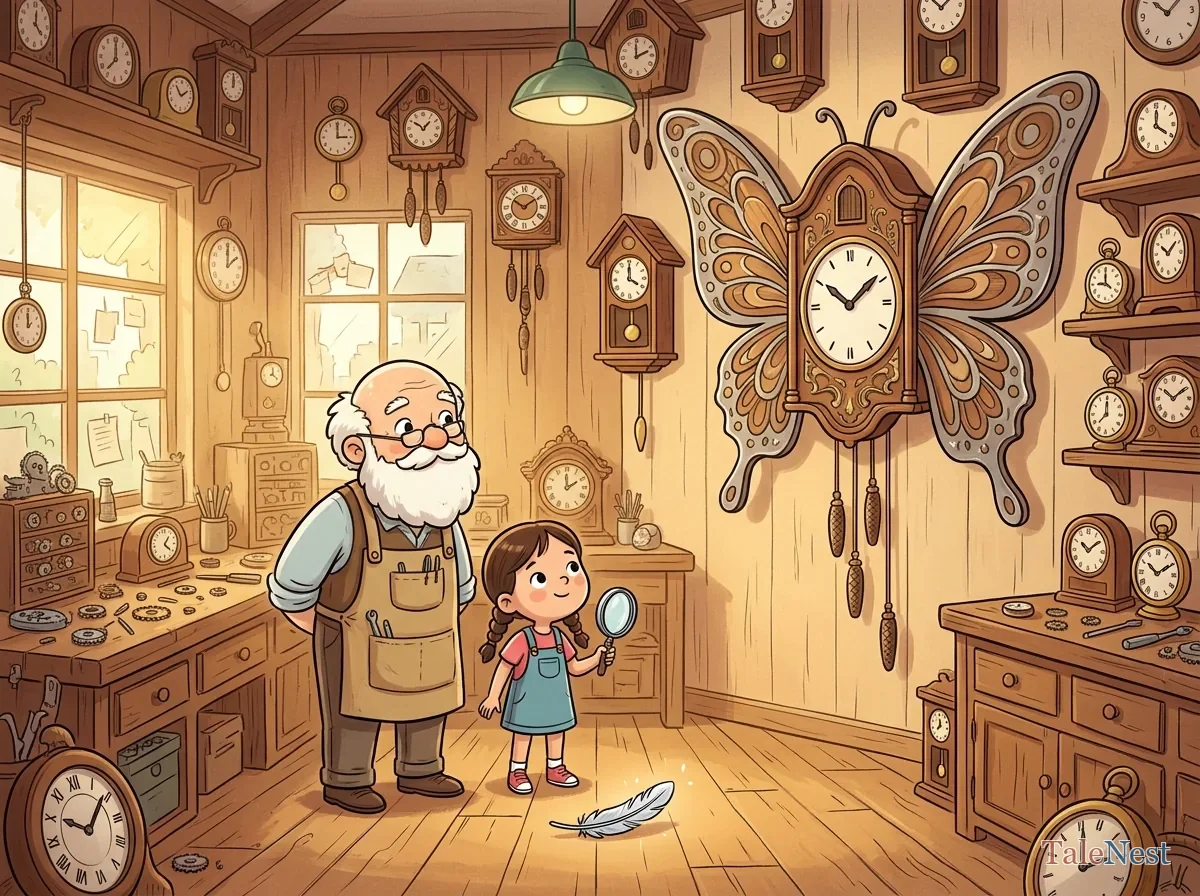
She ran to her grandfather Tobías's watch shop. The little bell over the door went tick, tick, tick as she entered. A thousand clocks ticked and chimed inside, but the largest one of all, the one she loved best, was silent.
“Grandfather, look,” said Lúa. “The Butterfly Clock has stopped singing.”
Grandfather Tobías came over, scratching his white beard. He was a slow, gentle man who smelled of oil and brass, and he loved that particular clock more than all the others put together.
“You're right, little one,” he said, peering up at it. “I haven't heard it in days. Not since the hours began to go missing.”
Lúa pointed her magnifying glass at the floor. Something was gleaming there. A silver feather.
“A clue,” she whispered.
Grandfather's eyes grew wide. “A feather? Birds never come in here.”
They went out together to hunt for more. In the square they found another feather beside the fountain, lying on the wet stones as though it had been left there on purpose. Then another in old Mrs Rosa's garden among the roses. Then another near the bench where the postman ate his sandwiches, still warm from the sun.
“Somebody is stealing our hours,” said Lúa.
“A life rushed through is a life half lived; slowing down to notice the small things gives the hours back their shine.”The little lesson
They followed the trail of feathers. It led them around behind the watch shop, to an old door half-hidden in a curtain of ivy.
“I never knew that door was there,” said Grandfather, astonished.
They pushed it open gently. Beyond lay a secret garden. The air smelled of lavender. The sky looked bluer than it had any right to be. And on every flower a silver butterfly trembled, hundreds of them, thousands, their wings catching the light. They rose in soft clouds when the wind stirred and settled again like a shimmer of rain.
“The hours!” cried Lúa.
Grandfather Tobías sat down on a stone bench. A butterfly settled on his hand. Two tiny hands had been etched onto its wings, like the hands of a clock.
“Lúa, I think I understand,” he said, and his voice shook a little.
“What is it, Grandfather?”
“I built that clock when I was a young man,” he said. “But I was always in a hurry. I worked without stopping. I never looked up at the sky. I never stopped to smell the flowers. I made this garden so that I would not forget. And then I forgot all about it.”
Lúa watched the butterflies. They flew slowly, as though they had all the time in the world, which, in a way, they did. She had never seen anything so unhurried.
“Why are there so many?” she asked.
“Because in this village nobody looks, and nobody listens, and nobody takes a proper breath. The hours that are never truly lived turn into butterflies. They come here to wait.”
Lúa stood very still. She closed her eyes. She listened to the wind. She felt the sun warm on her cheeks. She breathed in the lavender.
Then she heard something.

“Tick.”
A butterfly flew right up to her nose.
“Tock.”
Another climbed onto Grandfather's shoulder.
“Tick, tock, tick, tock.”
The butterflies began to fly toward the watch shop. They poured through the old door like a river of silver, thousands upon thousands, and the garden grew quiet behind them. The Butterfly Clock opened its carved wings. And it began to sing again.
“Tick, tock, tick, tock!”
All over the village people looked up at the sky. The baker paused to smell his bread. Mrs Rosa watered her flowers unhurriedly. The postman sat on his bench and watched the clouds go by, and nobody called out that it was night any more.
The hours had come back. But they were different now. They seemed to shine a little.
Grandfather Tobías pulled Lúa into a hug. “You've solved the mystery, little detective.”
Lúa smiled. She slipped her magnifying glass into her pocket, and slipped a silver feather in beside it.
From that day she visited her grandfather every afternoon. They drank milk with honey and watched the clock. And whenever a butterfly drifted past, the two of them smiled without saying a word.
Because now they knew its secret.
A life rushed through is a life half lived; slowing down to notice the small things gives the hours back their shine.


