
The City That Forgot How to Smile
In a city where robots do everything and nobody smiles, one small machine hunts for a forgotten feeling, and finds it in a girl's spontaneous laughter.
 Retold by Idalia SantosAges 4+6 min read801 words
Retold and rewritten by Idalia Santos for TaleNest. This version is original prose in English; the illustrations and accompanying text were created for this site.
This is a work of fiction, retold in original language for TaleNest. Names, places and events are part of the story.
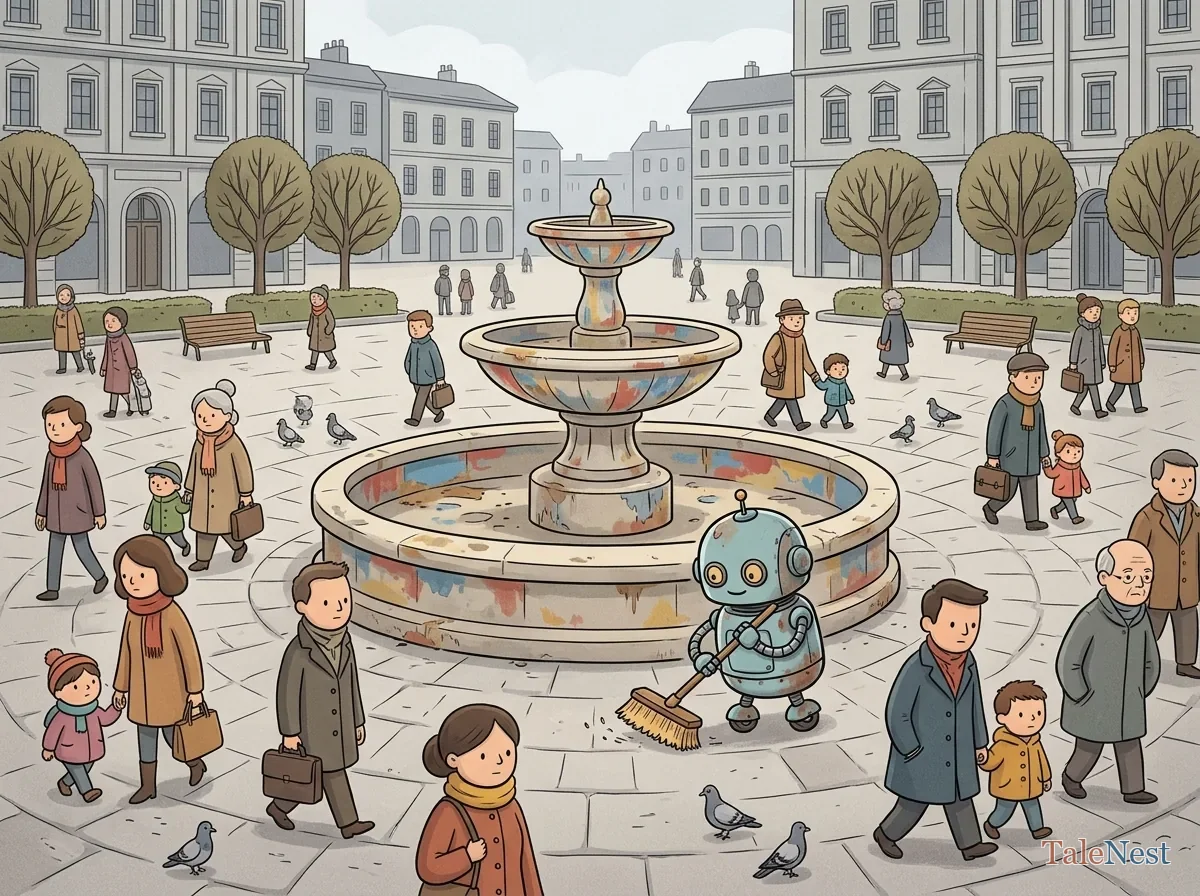
In the city of Grey everything ran like clockwork, rather, like very well-oiled clockwork. Robots cooked the meals. Robots swept the streets. Robots walked the children to school and back. No one in Grey ever had to lift a finger. And yet, for all its perfect order, not a single person in the whole city ever smiled.
Chispa was a small robot. His job was to mend streetlamps and sweep the plazas. He had two round eyes like shiny buttons and metal hands with only three fingers each. Every day he did his work faithfully. He would polish the lens of each streetlamp until it gleamed, and sweep the same corners of the plaza again and again, though they were already clean. But sometimes he would stop, broom in hand, and watch the people passing by. And then a strange question would turn over in his mind: why were their mouths always straight? Never, not once, turned upward at the corners.
One morning, while sweeping the Great Plaza, Chispa found something peculiar. In the middle of the square stood an old fountain, switched off and gone quiet, with colored stains along its rim, blue, red, and yellow. “ORDO,” Chispa asked the central computer, “what is this?” “A decorative object,” ORDO replied in its flat, cold voice. “It serves no useful purpose.”
Chispa kept staring at the fountain. Then, tucked beneath a bench, he spotted a small, creased book. He opened it carefully. Inside were photographs: children leaping around the fountain, water flying everywhere, and on their faces, their mouths were turned upward. “What is that?” said Chispa aloud. He did not know the word for it. But he wanted, more than anything, to see those faces again on real people. The children in the photographs were soaked and grinning, their arms flung wide as if to catch the water. One of them, a girl with a crooked ponytail, looked almost directly into the camera. Chispa turned the book over, but there were no words on the back, only more pictures of upward-curving mouths.
Then Chispa had an idea. He went to the fountain and loosened an old pipe. A jet of water shot out and splashed right into his face. He shook his head, and a funny sound came out of him: “BrRRRpppp!” People walked past. Nobody even looked up.
“Joy and laughter cannot be programmed, they grow when people come together and dare to be themselves.”The little lesson
He tried again. He hopped around the fountain on his metal feet, tripped over his own toes, CLONK!, and fell flat. He scrambled up, and fell again. CLONK! Still nothing. Chispa sat down beside the dry fountain and let his button eyes drop. Then he heard a sound, very soft. “Heh, heh.”
It was a little girl. Her name was Lina. She was sitting on a bench with a screen in her hands, but she was not looking at the screen. She was looking at Chispa. “Are you all right, robot?” she asked. “I don't know,” said Chispa. “I want people to turn their mouths upward, like in this book.” Lina peered at the photographs and her eyes went wide. “That's smiling,” she said. “And what I did just now, that was laughing.” “Laughing?” Chispa repeated. “Could you do it again?”
Lina considered. It had been a long while since she had laughed properly. Chispa gazed at her with his round button eyes. Then he tripped over his feet once more. CLONK! Lina laughed, a real laugh, loud and clear and from the belly.
ORDO's voice came over the loudspeakers. “Anomaly detected. Sound unclassified. Robot Chispa, return to your station.” But other children were already hurrying over. They had heard Lina's laughter. “Come and see!” she called. “Look what this robot can do!”
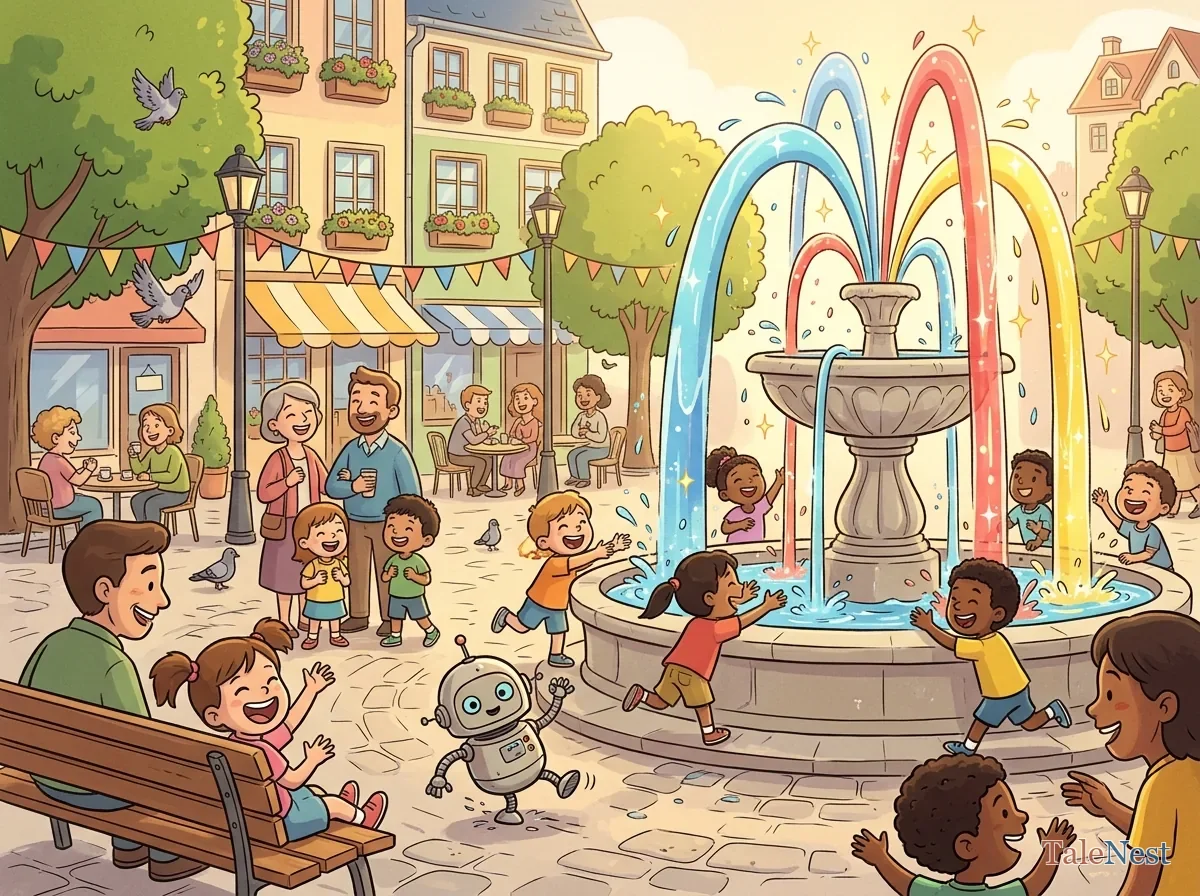
Chispa tripped again. The children laughed. One child splashed water; another jumped into the fountain. The laughter grew and grew. ORDO could not make sense of it. Laughter was nowhere in its records. It had no formula. It could not be calculated. “New data,” said ORDO slowly. “Classifying... necessary data.”
The fountain blazed to life. Water arched high and glittered in the sun. The colors came back, blue, red, yellow. The children played, and grown-ups drifted over to watch. Some of them, for the first time in years, turned the corners of their mouths upward. Nobody told them to stop, and nobody asked them to be quiet, because for once the city felt less like a machine and more like a place where people actually lived.
Chispa looked at Lina, and Lina looked back at Chispa. The little robot could not smile, but his button eyes shone just a little brighter. That night the city of Grey was not quite so grey. And in the plaza the fountain stayed lit, because some things simply do not need a formula.
Joy and laughter cannot be programmed, they grow when people come together and dare to be themselves.


