
The Crocodile Who Wouldn't Leave
Verónica gets a real crocodile for asking, then loses interest, until burglars break in and the creature she called a passing whim becomes the friend who saves her.
 Retold by Idalia SantosAges 6+5 min read1000 words
Retold and rewritten by Idalia Santos for TaleNest. This version is original prose in English; the illustrations and accompanying text were created for this site.
This is a work of fiction, retold in original language for TaleNest. Names, places and events are part of the story.
Verónica was a girl who collected wants the way other children collect marbles. If a thing caught her eye, she asked for it, and if she asked for it often enough, her parents, who could never bear to see her disappointed, made sure it appeared. Silly hats, mechanical birds, a pony carved from wood that cost more than a coach: the house groaned under the weight of her passing fancies.
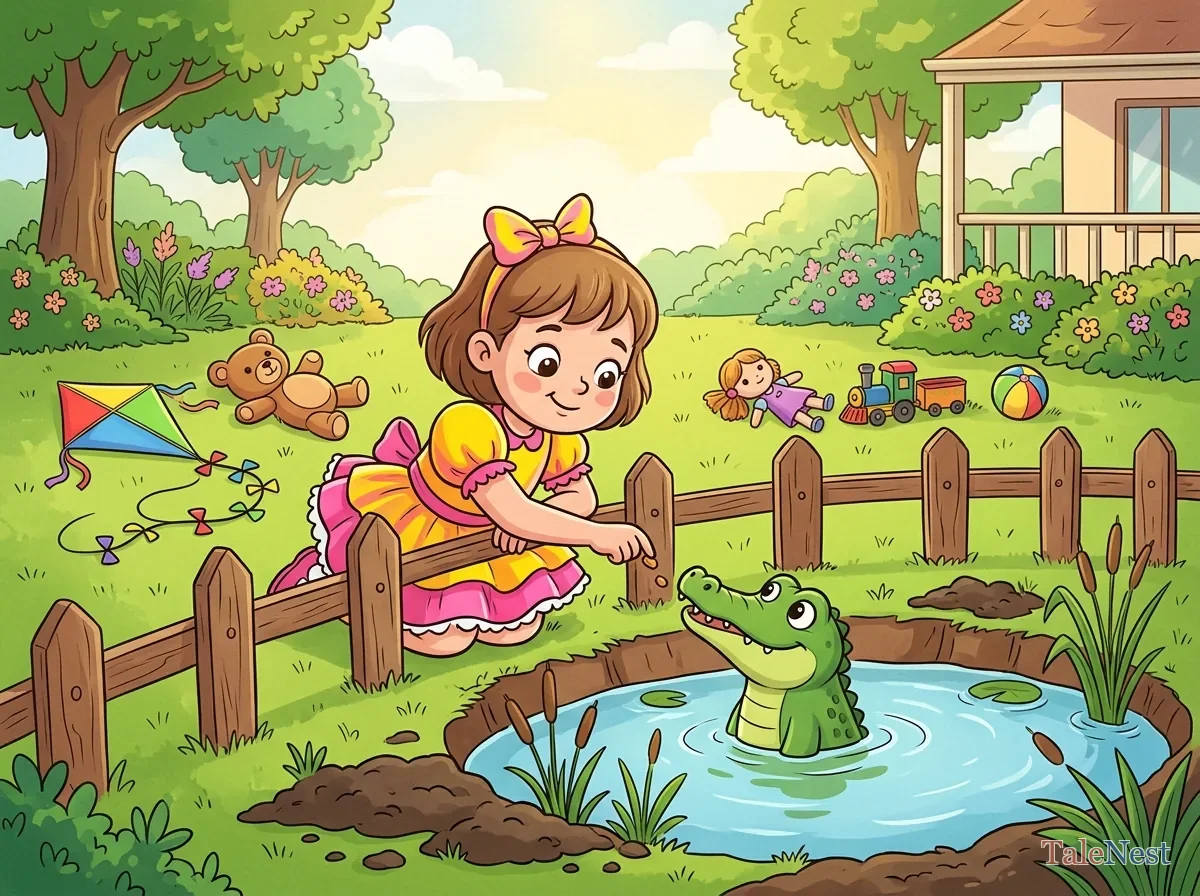
So it was no great surprise when, one bright morning, she announced that what she truly wanted was a crocodile. A real one. Not a toy, not a picture in a book, but a living, snapping, scale-covered crocodile. Her parents exchanged glances, but, as always, they gave in. By the week's end a young crocodile had arrived, blinking in the sunlight, and a special pond had been dug in the garden with a sturdy fence built all around it so that he could not wander off.
For a few days Verónica was delighted. She knelt by the fence with her chin in her hands, watching him glide through the water, and she fed him tidbits from her own plate. She gave him a name and spoke to him as though he could answer. But Verónica's affection had the attention span of a sparkler. Soon a new doll caught her eye, and then a kite, and the crocodile spent more and more hours alone with his reflection.
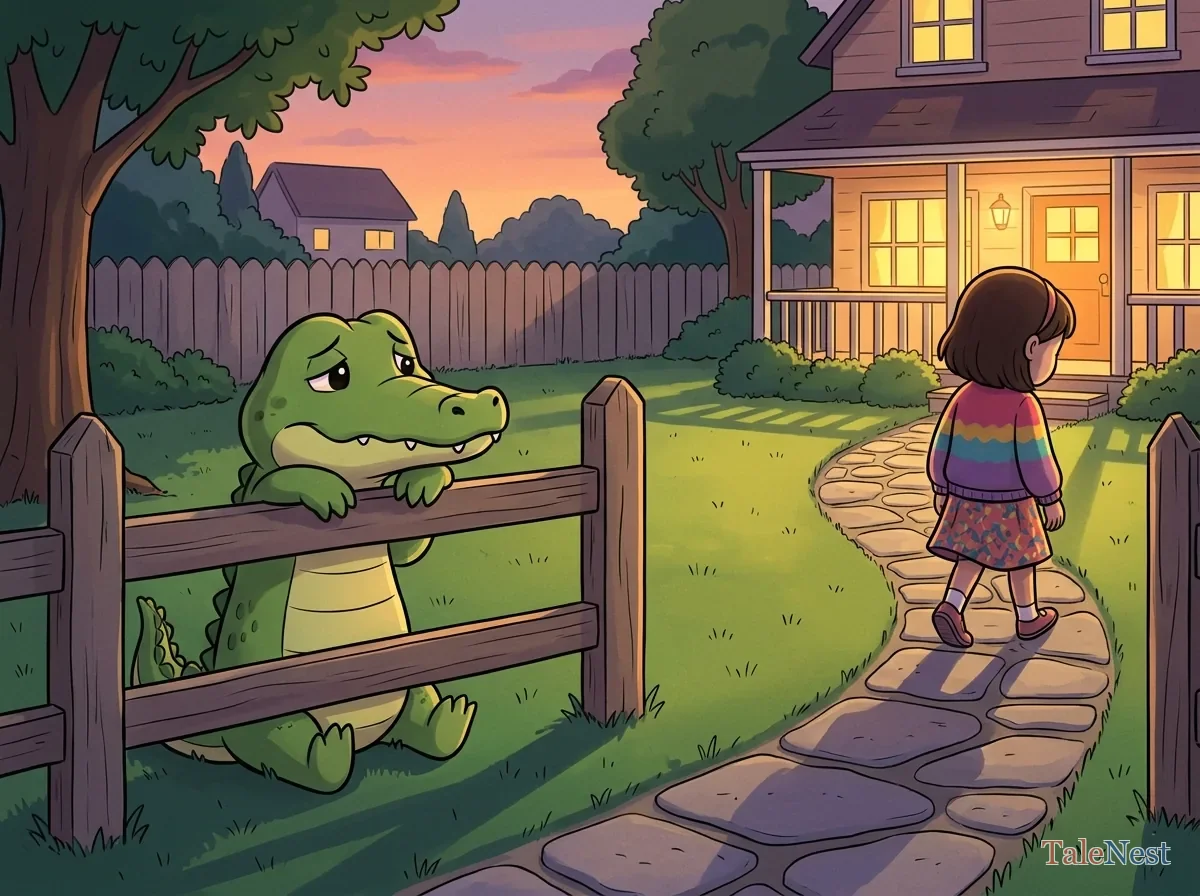
He did not understand being forgotten. He had never known anyone but her. To this small green creature, the girl who leaned over the fence was the whole world, warmer than the sun, more interesting than the fishes, the one who brought food and soft words. When she stopped coming, he waited. Then he waited some more. He did not know how to be angry with her. He only knew how to miss her.
Her father noticed, and he tried a bit of sternness. “Verónica,” he said one evening, “if you will not look after that crocodile, I shall have to call the zoo and let them take him.” He thought the threat would make her cling to the creature and promise to do better. To his dismay, her face lit up. “Really?” she cried. “That would be wonderful! I've rather run out of things to give him.” Her father walked away shaking his head.
“The things we take for granted can become our truest friends. Kindness, gratitude, and keeping our promises turn a passing fancy into a bond worth holding onto.”The little lesson
The next afternoon, while Verónica was home alone, three men slipped into the house. They were robbers, and they meant to find the safe her father kept in his study. The leader grabbed her by the arm. “Take us to your father's safe,” he snarled. “Do as I say, or we take you with us and hold you for ransom. Your father will pay handsomely to get you back.”
Verónica, who was never at a loss for a rude answer, tossed her head. “As if I'd tell you,” she said. “And anyway, you couldn't open it if I did.” The men exchanged a look, and one of them shook her roughly. “I said, take us to it!”
All this time, the crocodile had been watching from the pond. He saw the men's hands on her, heard the fear underneath her bravado, and something in his ancient, simple heart made up its mind. With two powerful snaps of his jaws he chewed through the wooden fence, and then he was sliding across the grass, low and quick, straight for the intruders.
The robbers turned and saw him coming. Their eyes went wide, and all thoughts of ransom vanished. They ran for the gate in a tangle of elbows and shouted curses, but not before the crocodile's jaws closed twice on the seat of the leader's trousers and once on a coat tail, leaving the villains considerably lighter of cloth and considerably wiser about crocodiles. Then he was gone, and the garden was still.
It was at that moment that Verónica's parents returned, with two keepers from the zoo in tow. They had come to collect the animal, and they arrived at a scene they did not understand: a broken fence, a girl white-faced and shaking, and a crocodile standing over her. Assuming the worst, her father snatched up a rifle and the keepers readied their own weapons.
“No! Don't!” Verónica screamed, and she flung herself across her crocodile's back, wrapping her arms around his scaly neck. “Don't you dare hurt him. He saved me.” The keepers lowered their guns, uncertain. “He attacked those men,” one of them said. “By the rules, an animal that bites has to be put down.”
“Then the rules are wrong,” Verónica cried, not letting go. “Those men were thieves, and they were hurting me. My crocodile didn't attack them, he protected me. If anyone deserves a medal, it's him.” She looked up at her father, her chin set in the stubborn line he knew so well. “I'm not letting you take him. From today, I look after him. Properly.”
Her father studied her for a long moment, then slowly lowered the rifle. “Very well,” he said. “But on one condition. No more whims, no more demanding every bright thing that crosses your sight. You keep this promise, and the crocodile stays.” “If I do, he's really mine?” “He's really yours.” “Then it's a bargain!” she said, and buried her face in the great green neck.
And so it was. Verónica kept her word. She cleaned the pond, counted out his meals, and sat by the fence telling him about her day, until he grew too big for the garden pond and had to be moved to the zoo, where a proper home had been prepared for him. She went to see him every single afternoon, and he always knew her step. The girl who had once traded him for a kite learned at last that the best things in life are not the ones you ask for, they are the ones who would cross a broken fence for you.
The things we take for granted can become our truest friends. Kindness, gratitude, and keeping our promises turn a passing fancy into a bond worth holding onto.


