
The Duck Who Meant Well
A proud Portuguese duck means only kindness when she takes a wounded songbird under her wing, but her vanity and quick temper turn every good intention into tragedy.
 Retold by Idalia SantosAges 8+6 min read998 words
This is a work of fiction, retold in original language for TaleNest. Names, places and events are part of the story.
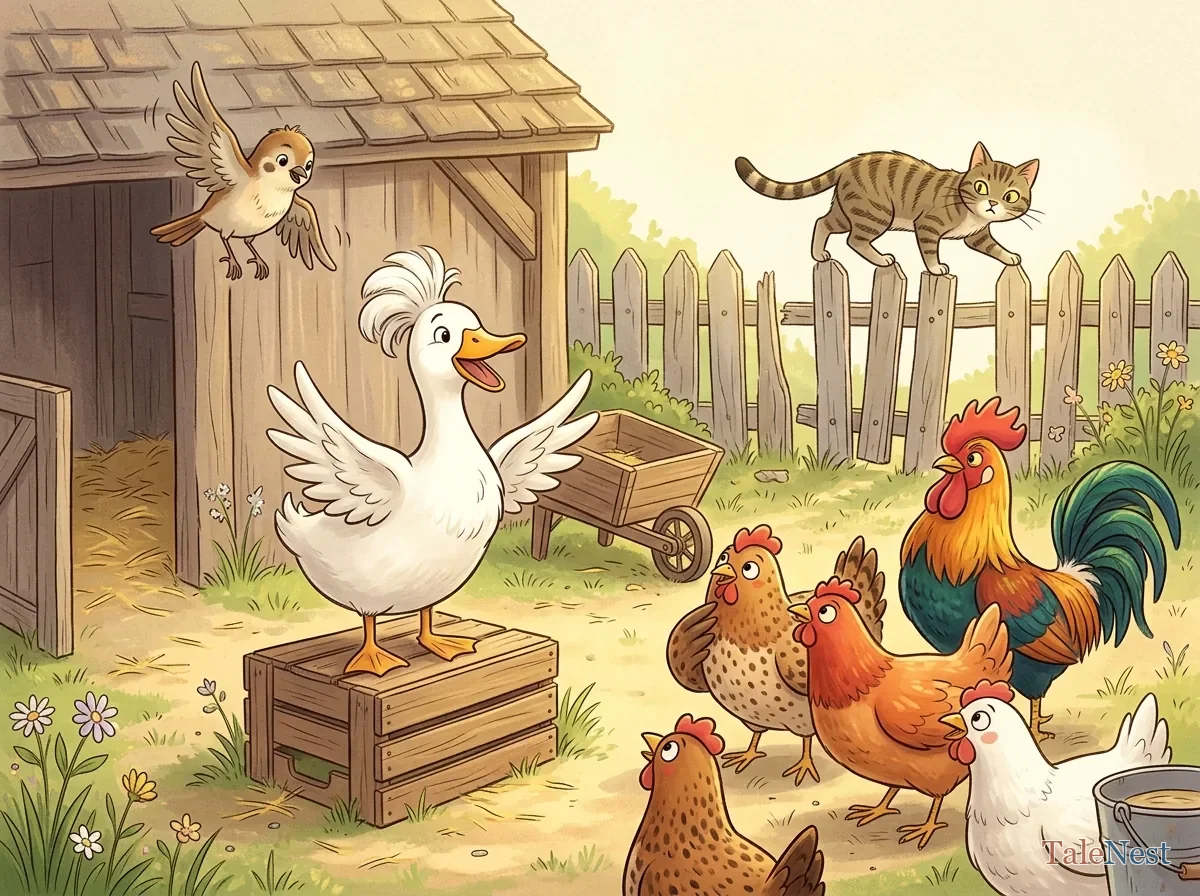
A duck arrived from Portugal, and everyone called her the Portuguese. Every duckling from her eggs inherited the name, a proof of noble blood. Now only one of that fine family remained in the yard, living among common hens, while a rooster strutted about in an arrogance nobody could bear.
“His dreadful crowing cuts through me,” she said. “If he would only show some moderation, but that is the virtue of well-bred souls. Look at the little birds in the next garden; now that is singing! I call their song Portugal, as I call everything exquisite. How I long for one beside me to mother tenderly. It is in my blood.”
Even as she spoke, one of those songbirds tumbled headfirst from the roof. The cat was waiting below, but the bird escaped with a broken wing and fluttered into the yard.
“The cat, of course!” cried the duck. “I know his sort from when I had ducklings. That such a creature may prowl the rooftops! In Portugal it would never be allowed.” She pitied the bird, and so did the other, unportuguese ducks.
“Poor thing!” they said, gathering round. “True, we cannot sing,” they admitted, “but we feel music. Something in us trembles when we hear it, whether we choose to say so or not.”
“I will say so,” declared the Portuguese, “and I will act.” She flapped onto the drinking trough and splashed so furiously to wet the bird that she very nearly drowned him, but her intention was excellent. “A good deed,” she said. “The rest of you should follow my example.”
“Tweet!” said the bird, shaking water from his broken wing. He understood she meant well. “You are a very kind lady,” he said, trembling at the thought of another shower. “I never think much about my feelings,” she replied, “but I love everyone except the cat, he ate two of my little ones. Make yourself at home; I am a stranger in a far land too.”
“Good intentions without humility can do more harm than cruelty; real kindness is shown in gentle deeds, not in fine breeding or proud words.”The little lesson
“She has Portugal on the brain,” said an ordinary duckling, and the others laughed. They befriended the bird at once. “The Portuguese certainly speaks well,” they said. “Words stick in our beaks, but we mean well.” An old duck told the bird he had a delightful voice. “Do not bother him,” said the Portuguese. “He needs rest. Shall I wet him again?” “Oh no, let me dry!” he begged.
“A good soaking is best, in my view,” she said. “Our neighbours the hens will call soon; two Chinese hens among them wear trousers, very cultivated, very imported, which raises them in my esteem.” The hens came, with the rooster, who was polite for once. “You sing beautifully,” he said. Soggy from his ducking, the bird looked like a Chinese chick. “Adorable!” cried the hens.
They whispered in the “p” language of refined Chinese fowl. “We are your species; ducks, even the Portuguese, are water birds. We have so many connections! We live among the hens, though born for a higher perch, and keep to ourselves, speaking only of virtue. Between us, nobody in the henhouse is worth a fig. Beware the duck yard: the Portuguese has culture, but she is passionate and talks far too much about Portugal.”
“How those Chinese hens chatter,” said some ducks. “We never speak to them.” Then her husband arrived and mistook the songbird for a sparrow. “I see no difference,” he said when corrected, “but I care not a straw. Childish.”
“Ignore him,” she whispered. “He is valued in his profession. Now I shall rest; our duty is to grow fat until stuffed with apples and prunes.” She dozed in the sun. The bird settled beside her; the hens scratched and left. A witty duckling said she would soon be “mama” again, and everyone laughed.
They drowsed, until someone tossed a bucket of vegetable parings into the yard. At the clatter every bird woke flapping. The Portuguese nearly crushed the bird in her haste. “Tweet! Don't trample me, good lady!” “Why lie in the path?” she snapped. “Don't be delicate, I have nerves and never once said tweet!” “Forgive me,” he said. “It slipped out.”
She ignored him, ate her fill of parings, and lay down. Hoping to please, he sang: “Tilly-lilly! Quip, quip! With all my heart I'll sing to you before I fly the wide world through.” “After a meal I always nap. Learn our ways; now I sleep!” When she woke he offered a grain of wheat.
She had slept badly and was sour. “Give that to a chick! Don't gape, don't bother me.” “She is angry,” mourned the bird. “I must have done something foolish.” “Foolish! A vulgar word; I won't tolerate rudeness.” “Yesterday the sun shone; today all is grey.” “You know nothing of weather. The day isn't over. Don't pull that face.”
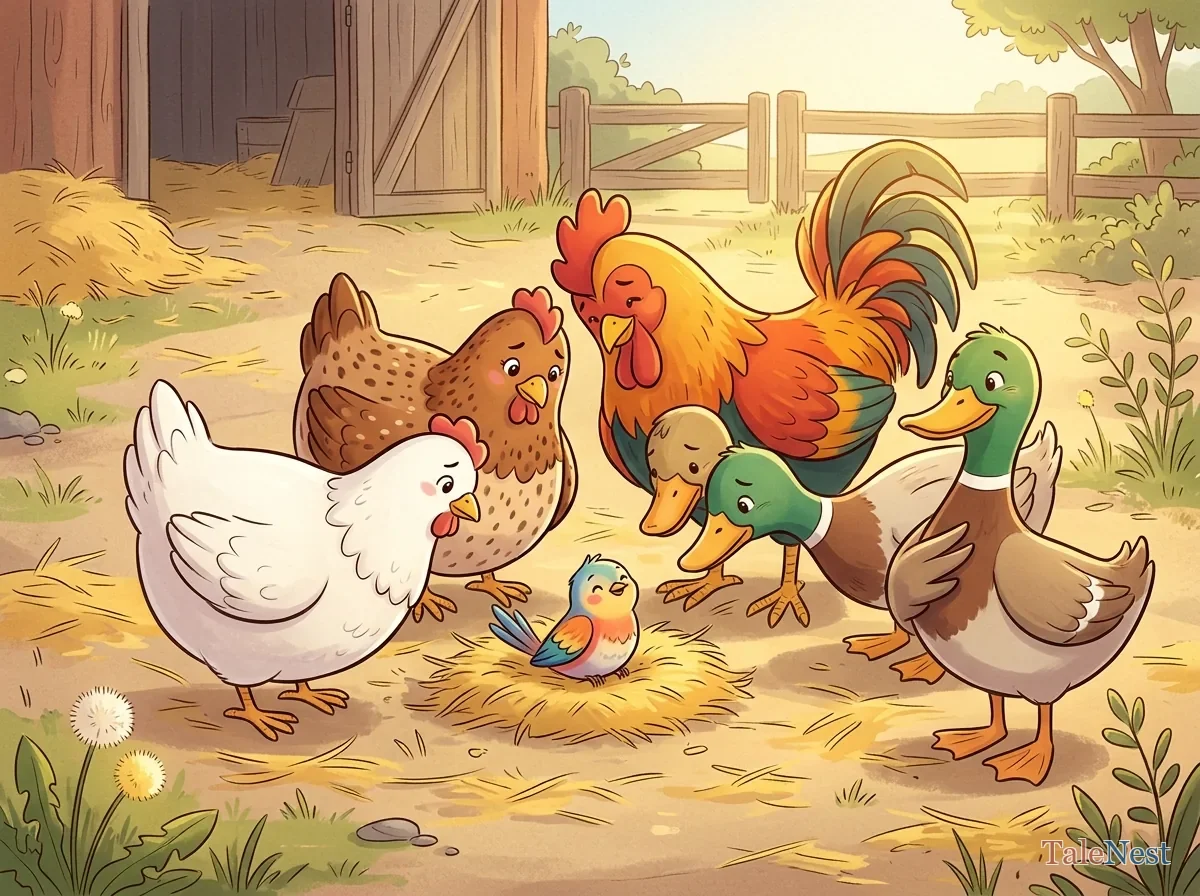
“You look at me with the same angry eyes that watched me when I fell into the yard!” “Shameless! Compare me to the cat? Not a drop of his blood is in my veins.” She pecked him on the head so fiercely that he died. “What, he could not bear one peck? He would never have adapted. I treated him like a mother, no one can say I lack heart.”
The neighbour rooster poked in and crowed like a locomotive. “You will be the death of me with your shouting!” said the duck. “This is your fault. He lost his head and I nearly lost mine.” “The little bird took up little room,” said the rooster. “Speak of him with respect,” said she. “He had a voice, could sing, and was well educated.”
All the ducks gathered round the dead bird. “Never again such a songbird, he was almost Chinese!” They wept; hens clucked. “We have heart, at least.” “Heart!” said the Portuguese. “Almost as much as in Portugal.” “Well,” said her husband, “put something in your crop. Break one toy and many remain.”
Good intentions without humility can do more harm than cruelty; real kindness is shown in gentle deeds, not in fine breeding or proud words.


