
The Flowers That Danced at Midnight
When Little Ida's blossoms droop, a curious student tells her they have been dancing at the palace all night, and that night she secretly sees for herself.
 Retold by Idalia SantosAges 6+6 min read989 words

This is a work of fiction, retold in original language for TaleNest. Names, places and events are part of the story.
Little Ida's flowers had given up. Only yesterday they had stood bright and proud; now every head hung over its pot. She asked the student who had come to call what had happened.
“They were at a dance all night,” he said. “That is why they droop.” “Flowers don't dance,” Ida objected. “They do. Once we are asleep and the house is dark, they leap and whirl. Children may come too, if quiet.”
“Where?” “In the palace garden where the King spends his summers; wonderful balls are held there.” “I was there with Mother yesterday,” said Ida. “The leaves had fallen and not a blossom was left.” “Into the palace,” he said. “As soon as the King returns, the flowers come running in and make merry.”
“Does nobody scold them?” “Nobody knows. The old keeper comes at night with his keys, but the instant the flowers hear the lock creak they stand still.” “Might I see them?” “Look through the window when you go out.”
“Could the Botanical Garden flowers come too, so far away?” “Of course, they can fly. Have you seen the bright butterflies? They look like flowers, and once were flowers. Tell one of the professor's flowers about the ball; it will tell the rest and away they'll fly. The professor will find hardly a flower and be quite puzzled.”
“But flowers cannot speak.” “Not in words,” he admitted, “but they talk by signs: when a breeze passes, they bow and stir their leaves.” “Does the professor understand?” “I think so. He once saw a nettle signalling to a red carnation, ‘You are so beautiful, I love you.’ But he cannot bear nettles, so he slapped the plant; it stung him so fiercely that he never meddled again.”
Ida laughed aloud. But the sour old Counsellor on the sofa scowled. “Silly fancies to fill a child's head!” he grumbled. He had never liked the student.
“A little kindness and a willing imagination can turn ordinary things into wonders, and even a farewell can be beautiful when we care enough to remember.”The little lesson
Ida found the tales delightful. The flowers were tired, she decided, and sick from dancing. She set them, with her toys, on a little table with a drawer full of treasures. Her doll Sofia slept in the doll's bed. “Wake up, Sofia,” she said. “Sleep in the drawer; the flowers are ill and must have your bed.” Sofia said nothing, so annoyed was she.
Ida tucked the flowers in and promised them tea by morning. At bedtime she looked behind the curtains at her mother's hyacinths and tulips and whispered, “I know you mean to dance tonight!” The flowers did not stir a leaf, but Ida knew what she knew.
In bed she pictured the flowers dancing in the palace. “Perhaps my own will dance too.” She fell asleep, but woke at midnight, after dreaming of the student being scolded. The room was silent, the lamp burning, her parents asleep. Softly, from the next room came a piano. “They are dancing,” she thought, but she dared not get up.
“If only they would come in here!” she whispered. They did not. She slipped to the door and looked in, and such wonders met her eyes.
The hyacinths and tulips stood in two rows; the pots were empty. On the floor every flower danced in a ring, twining green leaves like clasped hands. At the piano sat a great yellow lily Ida had seen in summer.
No one noticed Ida. A blue crocus sprang onto the toy table and drew back the doll's bed curtains. There were the sick flowers, and up they got at once, looking anything but ill. The china chimney sweep bowed, and they leaped about, gay and lively.
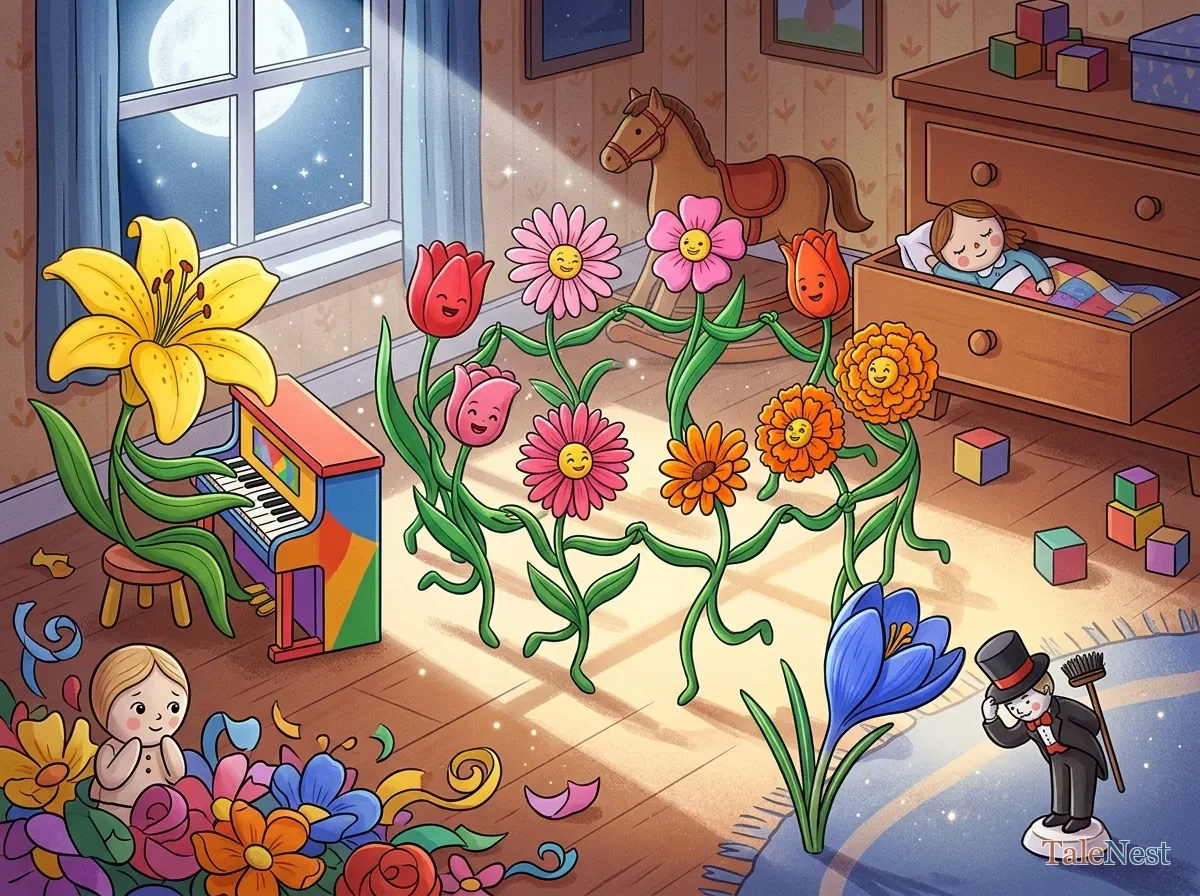
Something fell, the little whip from carnival. The wax doll on it swelled and grew, and turning over on the paper flowers, cried, “What a way to fill a child's head with silly fancies!” It was the very image of the Counsellor. But the paper flowers twined about its legs and it shrank back into a wax doll. Ida laughed, and the Counsellor had to go on dancing.
Then a voice called from the drawer, where Sofia lay. The chimney sweep hauled it open and she rose. “So there's a dance! Why was I not told?” “Will you dance with me?” asked the sweep. No flower paid him attention. Sofia dropped to the floor with a crash; the flowers rushed to see if she were hurt, especially those that had used her bed. Unharmed, she was led into the moonlight and danced in their ring. Delighted, she said they might keep her bed.
“Thank you,” they said, “but we die tomorrow. Tell Ida to bury us in the garden beside the canary, and in summer we shall come back lovelier.” “No, you must not die!” cried Sofia, kissing them.
Just then the door opened and a crowd of flowers came dancing in, from the palace, Ida supposed. Two roses with golden crowns led them, a king and a queen; behind came fine stocks and carnations, bowing. Poppies and peonies blew into pea-pods, their faces red as peppers, while bellflowers and snowdrops rang like bells. Violets, amaranths, daisies and lilies of the valley followed, kissing one another.
At last they said good night and Ida crept back to bed. In the morning she drew the curtains of the little bed. The flowers lay there, withered far more than the day before. Sofia was still in the drawer, looking sleepy. “Do you remember?” Ida asked, but the doll looked muddled. “You are ungrateful,” said Ida. “You don't remember the dance.” She put the dead flowers in a bird-painted paper box. “This shall be their coffin,” she said. “My Norwegian cousins will help me bury them, so they will grow again in summer.”
The Norwegian cousins were two merry boys. They marched with their bows over their shoulders, Ida following with the box. They dug a small grave; Ida kissed the flowers and laid them in their coffin.
A little kindness and a willing imagination can turn ordinary things into wonders, and even a farewell can be beautiful when we care enough to remember.


