
The Girl Who Measured the Universe
A girl who counts stars grows up to study the heavens from a table at Harvard, where patient attention reveals a pattern that measures the whole universe.
 Retold by Idalia SantosAges 6+7 min read762 words
Retold and rewritten by Idalia Santos for TaleNest. This version is original prose in English; the illustrations and accompanying text were created for this site.
This is a work of fiction, retold in original language for TaleNest. Names, places and events are part of the story.
Every night, a little girl named Henrietta leaned out her window and counted the stars. She lived in a small house near a wide open field, and counting them was the thing she loved most before sleep. “One, two, three...” she would whisper into the dark. From somewhere down the hall her mother would call, “Henrietta, it's time to sleep.” But Henrietta would go on counting. Some stars blazed brightly; others were so faint she could barely see them at all. And she could not stop wondering why some shone so much more than others. She made a game of it, picking a new corner of the sky each night and trying to count farther than she had the night before. The field beyond her window was dark and still, but the sky above it never repeated itself.
The years went by. Henrietta grew up and studied hard, because more than anything she wanted to understand the sky. At last she found herself in a place of great importance: the Harvard Observatory, in America. It was a large building crowded with great telescopes under tall domes, and after dark the men there peered through the lenses and wrote down carefully what they saw.
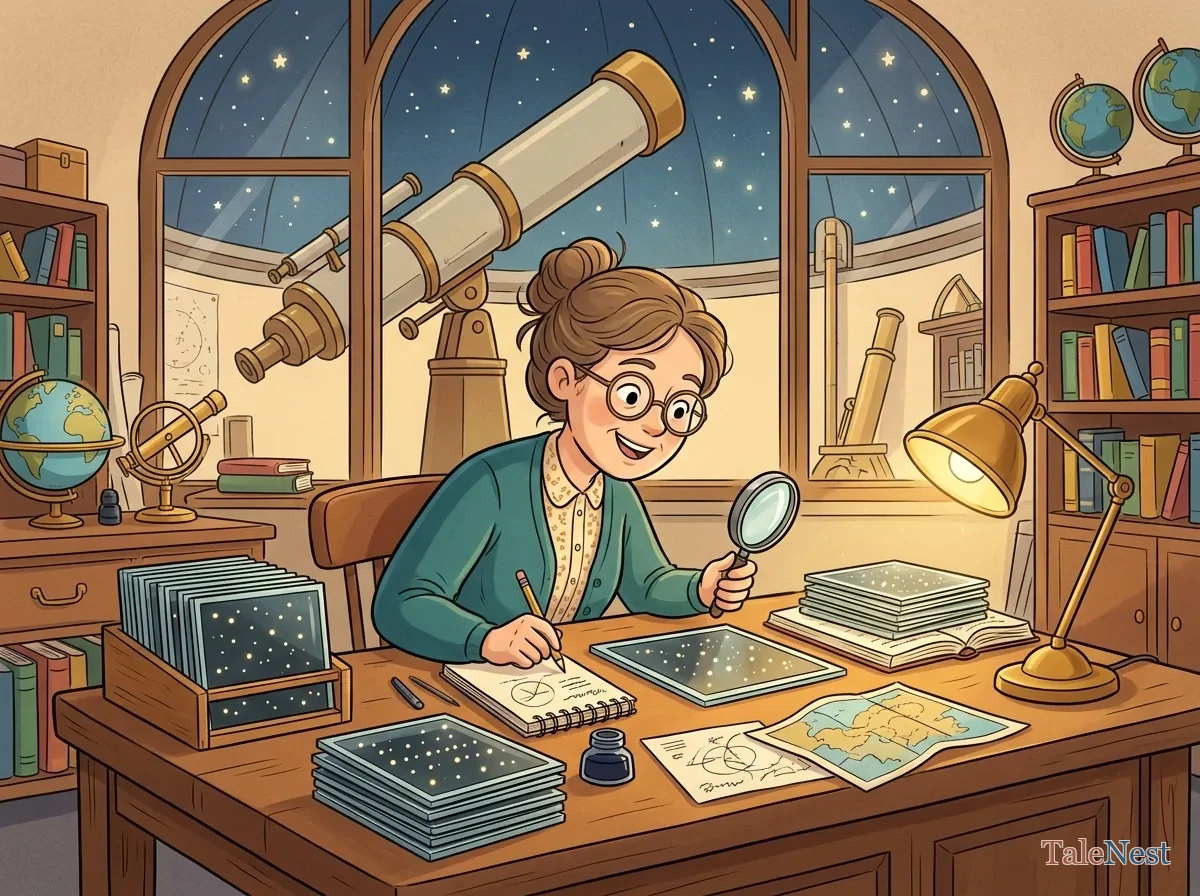
Henrietta longed to look through a telescope too. But she was told no. “Women do not use the telescope,” they explained. “You work in here.” And so they gave her a table, a chair, a magnifying glass, and a great stack of glass plates, photographs of the sky, thousands of tiny white dots scattered across a dark background. Every single dot was a star. She was careful with the plates, holding them only by their edges, because each one held a piece of the sky that could never be photographed again.
Her task was to study the plates, note how bright each star appeared, and compare them, one by one. Some of her fellow workers grew bored. The work was slow and endlessly the same: look, write, look, write. But Henrietta never grew bored. She looked with enormous care, and she kept careful notes of every dot. She wrote the numbers in neat columns and then copied them out again, so that nothing would be lost. Her eyes ached, but she would not stop.
“Great discoveries begin with patient, careful attention, and talent and determination have no gender, no matter what anyone says.”The little lesson
One day she noticed something peculiar. She was studying stars in a part of the sky called the Magellanic Clouds, and she saw that some of these stars changed their brightness. They swelled and faded, swelled and faded, like a candle flickering in a draft. Such stars were called Cepheids. Henrietta carefully wrote down how long each one took to blink, and exactly how bright it shone.
Days passed, then weeks, then months. Then one morning Henrietta looked over her notes and her heart gave a leap. The stars that shone the brightest took the longest to blink. “That can't be right,” she murmured. She checked her figures, once, twice, three times. It was right. A pattern was hiding in those numbers, and she had found it.
She ran to tell anyone who would listen. “If we know how long a star takes to blink,” she said, “we can work out how brightly it truly shines. And if we know how brightly it truly shines, yet it looks small to us, then it must be very, very far away.” Some people listened. Others hardly paid attention. After all, she was only a woman with a magnifying glass and a stack of glass plates.
But Henrietta was right. Her discovery was like a magic ruler for measuring the heavens. Thanks to her numbers, other scientists were able to work out distances so vast that no one had ever imagined them. They learned that the far-off stars lived in other galaxies, and that the universe was far bigger than anyone had ever dreamt. One discovery led to another, and before long the whole scientific world was using Henrietta's ruler to measure the distance to the stars.
And it had all begun because one woman looked carefully. Henrietta never received a famous prize, and few people knew her name. Yet every time someone gazes up at the night sky and wonders what lies beyond it, the answer traces back to that table, that magnifying glass, those plates crowded with dots. Her quiet patience had given the world a way to measure the infinite.
And so a little girl who counted stars from her bedroom window grew up to find a way to measure the entire universe. It was a small beginning for so enormous an answer.
Great discoveries begin with patient, careful attention, and talent and determination have no gender, no matter what anyone says.


