
The Golden Swan's Gifts
The Wind and the Rain bicker over who may tell a tale, but the Sun wins with a story of a golden swan whose gifts turn humble lives into sunbeams.
 Retold by Idalia SantosAll ages6 min read989 words
This is a work of fiction, retold in original language for TaleNest. Names, places and events are part of the story.
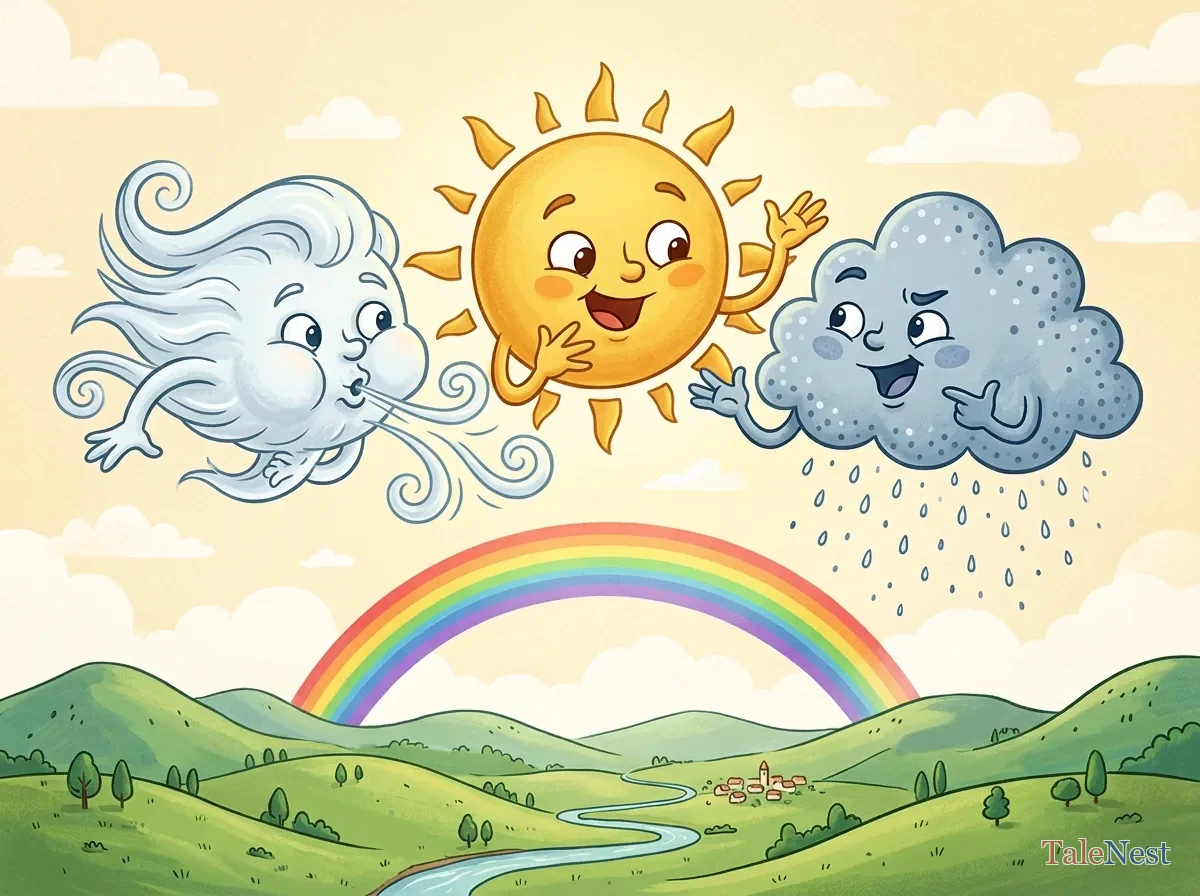
The Wind came storming round the corner one evening, full of himself. “Now it's my turn to tell a story,” he said. “Not so fast,” said the Rain. “You've spent long enough howling in the street, showing off.” “Is that my reward?” cried the Wind. “I brought back your umbrellas for you, and broke them too, when nobody wanted anything to do with you!”
“Let us keep the peace,” said the Sun, and he said it with such warmth and majesty that the Wind lay flat as a reed in a calm. The Rain gave him a shake. “Are we really going to put up with this?” she muttered. “The Sun always pushes in where he isn't wanted. We won't listen. His stories aren't worth a button.” But the Sun had already begun.
A swan, he said, flew above a heaving sea, his feathers flashing like hammered gold. One feather loosened and drifted down onto a great merchant ship running before the wind with every sail spread. It settled in the curled hair of the young officer who watched over the cargo. The feather of the lucky bird touched his brow, brushed his hand, and before long that young man was a wealthy merchant, buying himself golden spurs and a nobleman's shield. “I shone upon him,” said the Sun.
The swan flew on over a green meadow where a boy of seven lay in the shade of the only old tree for miles. As the bird passed, it kissed a leaf, and the leaf dropped into the boy's open hand. From that single leaf sprang three, then ten, then a whole book, and in it the boy read of the wonders of nature, of his own mother tongue, of faith and of science. At night he tucked the book beneath his head so that nothing he had read would slip away. That book carried him to school and set him at the table of learning. “I have read his name among the wise,” said the Sun.
The swan entered the hush of the forest and settled on a still, dark lake, where water lilies floated and wild apple trees leaned over the water, and where the cuckoo and the wood pigeon made their home. A poor woman was gathering fallen boughs, stacking them on her back, and carrying her smallest child in her arms as she trudged homeward. She saw the golden swan rise from the reeds at the shore.
“True happiness grows in humble hearts; a little wonder, lovingly received, can turn the plainest life into a sunbeam.”The little lesson
Something glittered where the bird had been. A golden egg! She slipped it inside her blouse, and it stayed warm against her; surely there was life in it. Yes, something stirred within the shell. She felt the movement and thought it was her own heart beating.
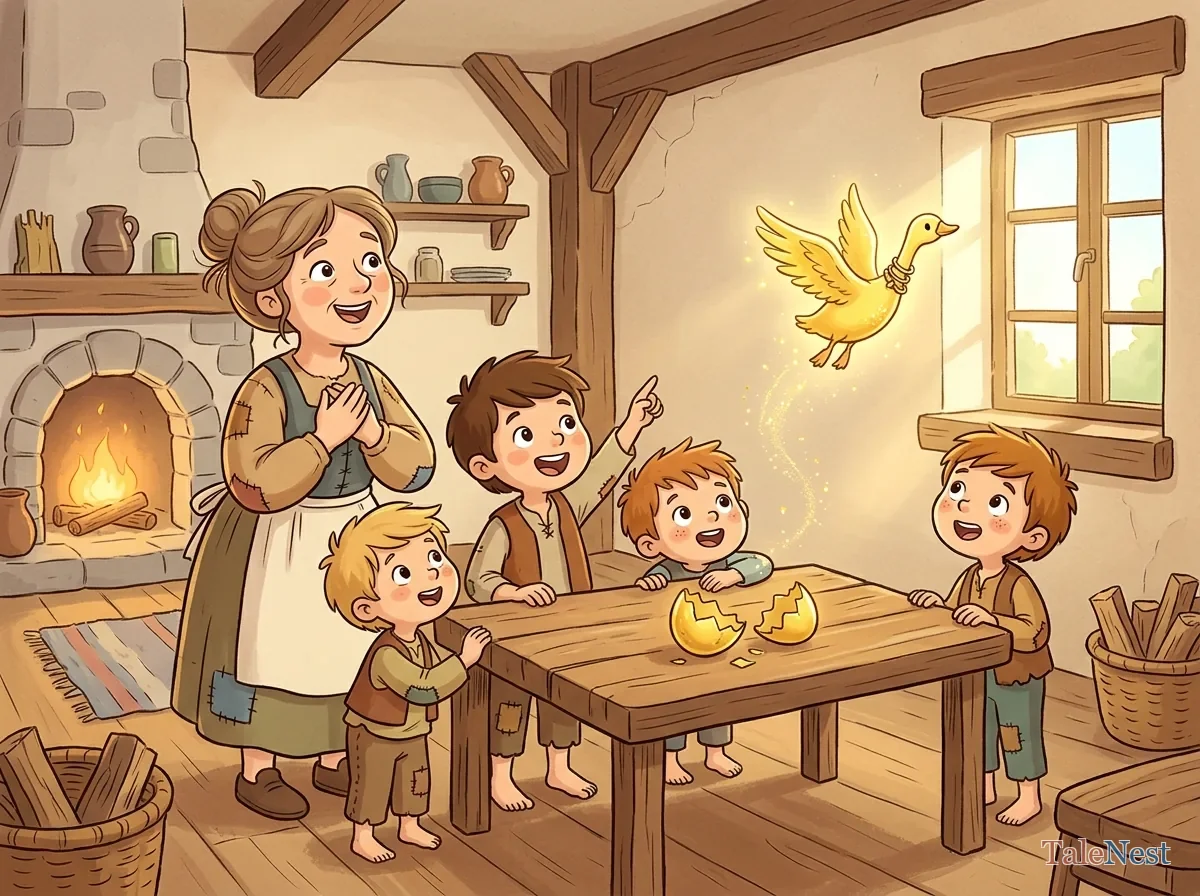
In her humble hut she drew the egg out. “Tick, tock,” it sounded, like a precious little golden watch, and yet it was an egg with a life inside. The shell cracked, and out peeped the head of a tiny swan, its down seemingly spun from pure gold. Around its neck were four little rings. The woman had exactly four sons, three at home and the one she had carried into the forest, and she understood at once that each ring belonged to one of them. The moment she understood, the little golden bird spread its wings and was gone.
She kissed the rings, and made each boy kiss one, then pressed them to her heart and finally slipped them onto their fingers. “I saw all that,” said the Sun. “And I saw what happened afterwards.”
One boy took a lump of clay from the bank and rolled it between his fingers until it became Jason, the man who won the golden fleece. The second ran into the meadow, all ablaze with flowers of every colour, and squeezed a handful so hard that the juice leapt into his eyes and soaked his ring. A strange tingling ran through his thoughts and his hands, and in time the great city talked of a great painter.
The third boy clenched his ring between his teeth and made a sound that seemed to rise from the very bottom of his heart. Feelings and ideas turned into chords, rose like swans singing, and then sank like swans into the deep lake, the lake of thought. He became a composer, and every country can say of his music, “It is ours.”
The fourth boy was like Cinderella. “He has the snuffles,” people said. “He needs pepper and tending like a sickly chick.” Others said, “Pepper and a cuff for him!” “And cuffs he certainly got,” said the Sun, “but from me he received a kiss, ten kisses for every blow.” He became a poet. He was dealt cuffs and kissed besides, but he owned the lucky ring, the ring of the golden swan, and his thoughts flew off like golden butterflies, the emblem of immortality.
“What a long story!” yawned the Wind. “And a dull one,” said the Rain. “Blow on me, do, and wake me up!” The Wind blew, and the Sun went on.
The lucky swan flew over a deep gulf where fishermen had spread their nets. The poorest of them had been thinking of marrying, and marry he did. The swan brought him a piece of amber. Now amber draws things to itself, and it drew hearts to that man's house; amber is the sweetest of incenses. A fragrance came into the room like the smell of a church, of the good earth under God's sky. The pair knew the happiness of a home and the quiet joy of a humble life, and their days were a single long sunbeam.
“That's quite enough,” said the Wind. “The Sun has told us plenty. I am bored to bits.” “So am I,” agreed the Rain. “And what do we say, we who have listened to the stories?” Why, we say: The end.
True happiness grows in humble hearts; a little wonder, lovingly received, can turn the plainest life into a sunbeam.


