
The Mermaid Who Gave Up Her Voice
Far beneath the waves a curious mermaid saves a prince, trades her beautiful voice for legs, and discovers that love asks for more than a happy ending.
 Retold by Idalia SantosAges 8+8 min read781 words
This is a work of fiction, retold in original language for TaleNest. Names, places and events are part of the story.
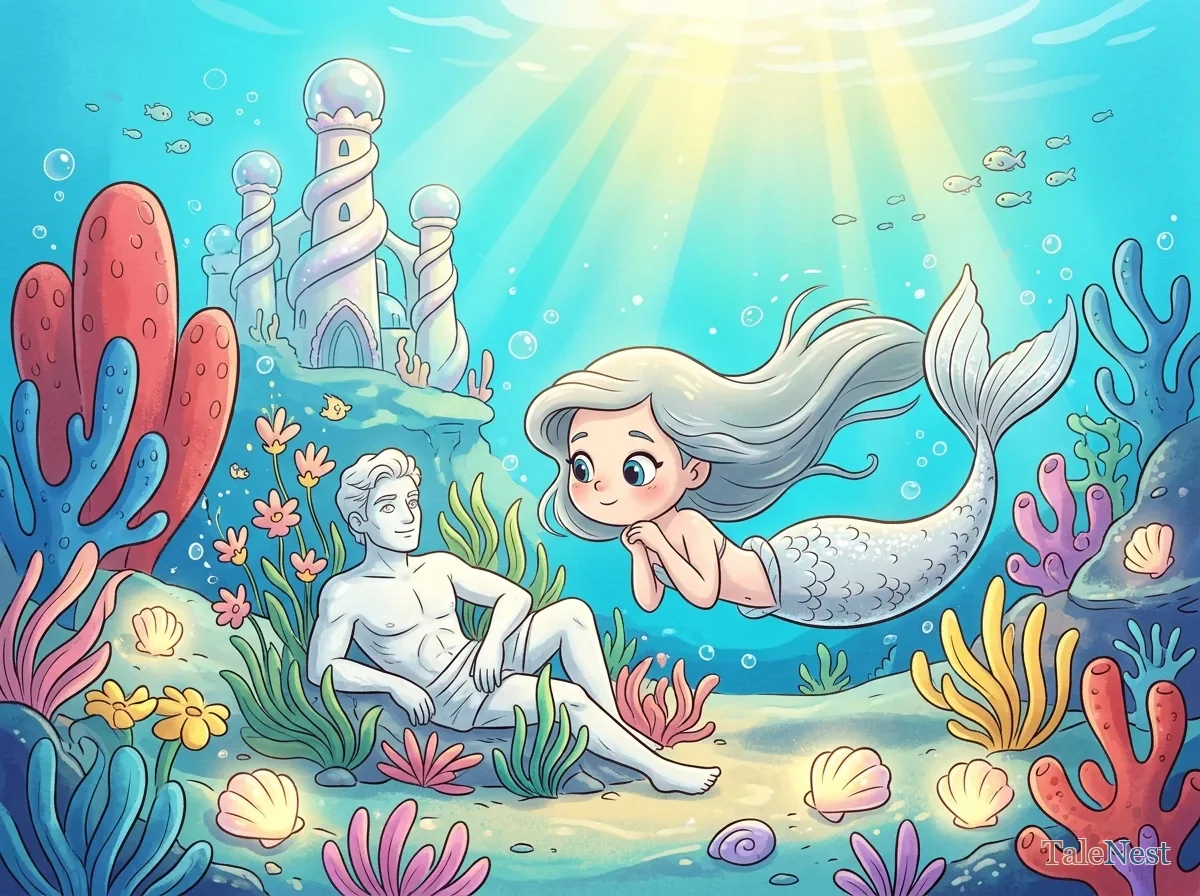
Deep beneath the sea stood a magical kingdom, brighter and more beautiful than anything above the waves. Coral gardens glowed, strange flowers swayed in the current, and the sea king's castle rose from the seabed with towers of pearl. The king lived there with his six daughters. The youngest of them was the most special: her skin was pale and smooth, her eyes were large and blue, and like all mermaids she had a fish's tail instead of legs. Of all the sisters, she kept the castle garden brightest, weaving sea flowers into her hair and marvelling at every new shell the tide brought in.
The little mermaid loved her sisters' company, but her favourite stories came from her grandmother, who spoke of the world of humans. She listened to every word and longed to see a human face that was real, not carved in stone. When she found a marble statue of a man among the wreckage of a sunken ship, she carried it home and planted it in her garden. “One day you'll see the surface for yourselves,” the grandmother told them. “On your fifteenth birthday you may rise and look at the forests and cities above. Until then, it is forbidden.”
The little mermaid counted the years. Each time one of her sisters turned fifteen and came back chattering about the world above, she listened eagerly, and her longing grew.
At last her own birthday came. She swam up and saw a great ship glittering with lights and ringing with music. Curious, she drew close to a window and looked in, and there stood a handsome young prince. She could not look away.
“Love is measured not by what it takes, but by what it is willing to give, even when the giving costs everything.”The little lesson
Suddenly the sky turned black. A storm lashed the sea, and the great ship groaned and broke apart like a paper boat. The little mermaid plunged into the churning water, found the prince, and dragged him safely to the beach. Then she heard girls approaching and, afraid of being seen, slipped back into the waves. From a distance she watched him wake and struggle to his feet.
After that she rose to the surface every day, hoping to see him again, but he never came, and each evening she returned to the deep more sorrowful. At last she went to the sea witch. “I will give you legs,” said the witch, “but the price is your most precious gift, your voice.” “My voice?” cried the mermaid. “How will I win his love if I cannot speak?” “You will manage,” said the witch. She warned that she could never return to the sea, and that if the prince married another, she would die and become sea foam at dawn. The mermaid was terrified, but she agreed.
She drank the potion. Next morning she awoke on the sand: her tail was gone and two slim legs had taken its place. At first she stumbled, but she practiced in secret until she could walk without falling. The prince found her and asked who she was and how she had come there, but she could only stare, her voice was gone. He took her to his castle anyway, and a gentle friendship grew between them. They spent every hour together.
She learned to move on her new legs, though every step felt like walking on knives. The prince admired her grace when she danced, never guessing what it cost her. He told her of his search for the girl who had saved him, and she longed to cry out that it was her, but no sound would come.

Then came the day the prince announced his wedding to the daughter of a neighbouring king. The little mermaid's heart broke, yet she wore a bright smile for him and joined the celebration with everyone else, knowing it was her last night on earth.
As dawn neared, her sisters appeared. They had given the witch their hair in exchange for a magic knife. “Kill the prince,” they whispered, “and you may be a mermaid again.” She crept to his sleeping form and raised the blade, but she could not strike the man she loved. Instead she threw herself into the sea, and as the sun rose she felt herself turning into foam.
Then soft voices surrounded her. They were the daughters of the air, spirits who care for mortals. “You may still earn an immortal soul,” they told her. “Serve others with kindness for three hundred years, and at the end you will fly to heaven.” As she listened, she saw the prince searching for her on his ship. Far off, she watched him, and the first tear of her life slid down her cheek.
Love is measured not by what it takes, but by what it is willing to give, even when the giving costs everything.


