
The Mystery of the Broken Clock
When the classroom clock lies shattered on the floor, two sharp-eyed friends follow a trail of white dust to a quiet boy with a secret worth telling.
 Retold by Idalia SantosAges 6+6 min read872 words
Retold and rewritten by Idalia Santos for TaleNest. This version is original prose in English; the illustrations and accompanying text were created for this site.
This is a work of fiction, retold in original language for TaleNest. Names, places and events are part of the story.
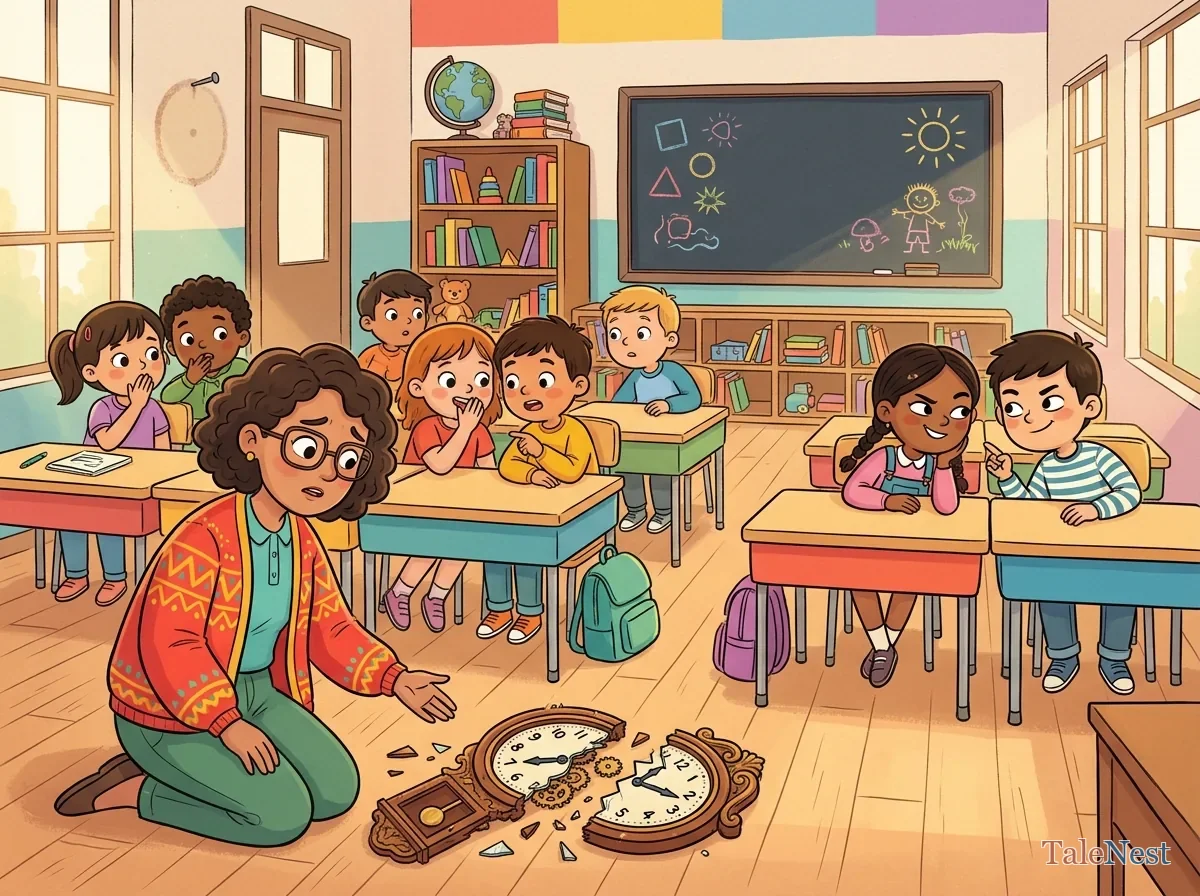
The classroom was quiet that morning, far too quiet. The old wall clock had vanished from its place. It now lay on the floor in three pieces, its bent little hands still frozen at a quarter past nine, the hour the mystery began.
“Does anyone know what happened here?” asked Miss Carmen.
Not a soul answered. Some pupils stared at the floor, others fixed their gaze on the ceiling, but nobody looked at their teacher.
Martina watched her classmates closely. Noticing everything was her favourite game. Beside her sat Hugo, her best friend, who was busy scanning the room too. “This is a mystery,” he whispered.
“And mysteries are meant to be solved,” Martina whispered back.
Martina loved a puzzle more than anything. She noticed the scuff marks on doorframes, the way people hid their hands behind their backs, the tiny changes in a room that everyone else missed. Hugo, who was quieter but just as sharp, always spotted the things she pointed out. Together they made a fine team.
At break time the two friends claimed their favourite bench and put their heads together. “The clock was fine yesterday,” said Martina. “It broke this morning, before Miss Carmen arrived.”
“Who always gets here before she does?” asked Hugo.
Martina counted on her fingers. “Ana, Pedro, Lucas and Sofia.”
“Four suspects,” said Hugo, in his most detective-like voice.
They questioned Ana first. She had been painting at her desk the whole time, and her hands were still smeared with blue. “I never touched the clock,” she said. “I was painting a sea full of dolphins.”
Next came Pedro, who had arrived late because his mother couldn't find the car keys. “When I got here, the clock was already broken,” he said.
Sofia knew nothing either. She sat at the back of the room, far from the clock.
“Telling the truth takes courage, but honesty and friendship can turn a clumsy mistake into something good.”The little lesson
Ana's blue paint was still wet. Pedro's excuse about the car keys had the ring of truth. Sofia's desk was too far away for her to have reached the wall unnoticed. One by one the possibilities fell away, leaving a single figure in the corner of the yard.
That left only Lucas.
Martina scanned the playground until she spotted him, sitting alone in a corner, playing with no one, his eyes heavy with sadness. “Look at his shoes,” she murmured.
Hugo looked. Lucas's shoes were dusted with a fine white powder, the very same white dust from the wall where the clock had hung. The two friends walked over.
“Hello, Lucas,” said Martina gently.
Lucas didn't answer. He only lowered his head.
“We know it was you,” said Hugo. “But it's all right. We want to help.”
Lucas looked up, his eyes brimming with tears. “It was an accident,” he whispered. “I only wanted to see the hands up close.”
“Why?” asked Martina.
“Because I want to learn to tell the time. My grandma's birthday is next week. I want to tell her the time without getting it wrong. She always asks me, and I never know.”
Hugo rested a hand on Lucas's shoulder. “That's a lovely reason,” he said. “But you have to tell the truth.”
Martina crouched down until she was level with Lucas. “My little brother broke a vase once,” she told him quietly. “He was terrified. But when he admitted it, everyone's face changed, not into anger, but into relief. People are kinder than you expect, if you let them in.”
“I'm frightened,” said Lucas. “What if everybody gets angry?”
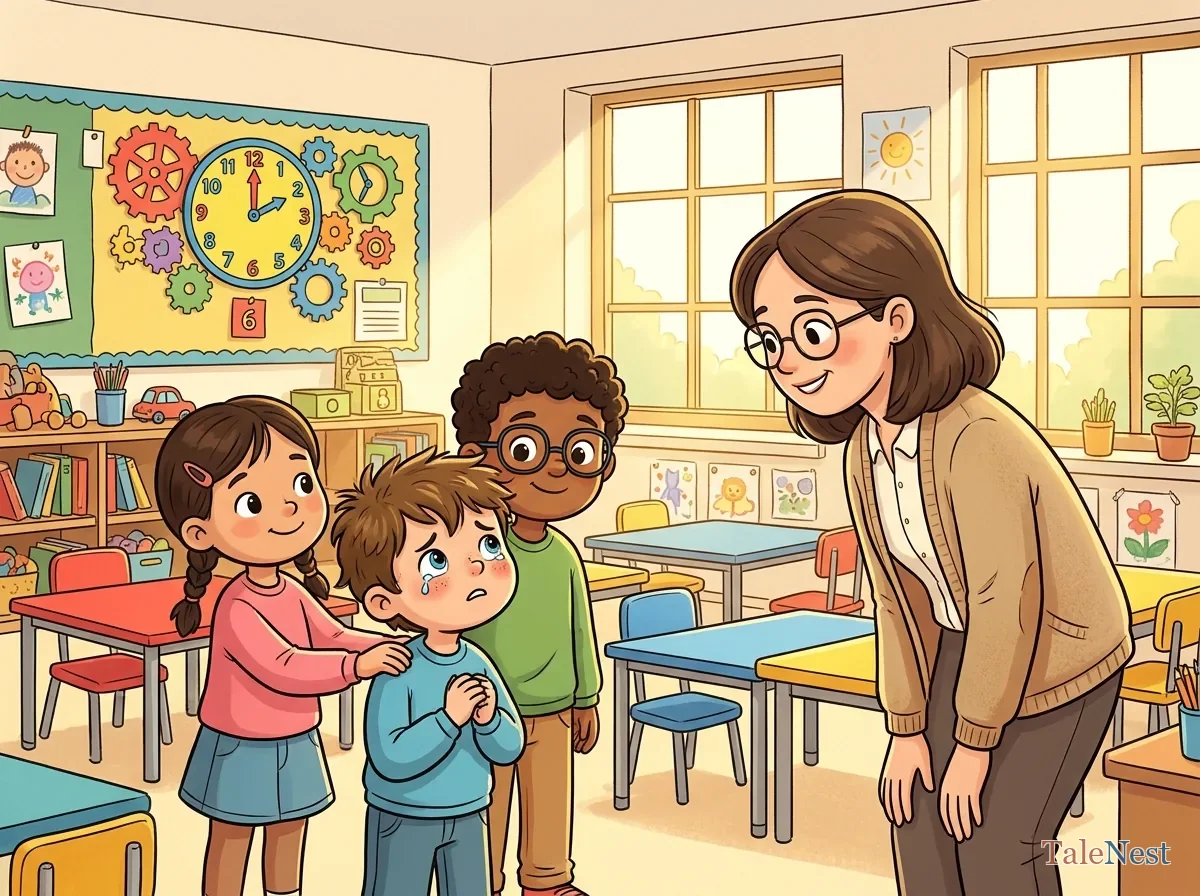
“Keeping a secret is worse,” said Martina. “Bad secrets weigh you down. But we'll go with you.”
The three walked into the classroom together. Lucas moved slowly, but he did not walk alone.
“Miss Carmen,” he said in a small voice, “it was me. I broke the clock by accident. I'm very sorry.”
The teacher knelt down to look him in the eye. “Thank you for telling the truth, Lucas. That was very brave.”
“You're not angry?” he asked.
“Accidents happen,” said Miss Carmen. “What matters is being honest, and you were.”
Lucas managed a smile. It was a small smile, but a real one.
The rest of the class had gone silent during the confession, and now a few children shifted in their seats, exchanging glances that were gentle rather than cruel. Someone gave a tentative clap, and soon others joined in. Lucas's shoulders, which had been hunched up around his ears, slowly dropped.
That afternoon Miss Carmen taught the whole class how to read a clock. Lucas paid closer attention than anyone, and Martina and Hugo sat right beside him. When the bell rang, he turned to his two new friends. “Thank you,” he said, “for helping me be brave.”
“That's what friends are for,” said Hugo.
Martina smiled. The mystery was solved, but the best part wasn't that. The best part was gaining a new friend. And Lucas, at last, knew how to tell the time.
On the way home that afternoon the three walked together, Lucas in the middle, chattering about hours and minutes as though he had been reading clocks all his life. Martina and Hugo listened and grinned. The broken clock was forgotten; the new friendship was just beginning.
Telling the truth takes courage, but honesty and friendship can turn a clumsy mistake into something good.


