
The Pages That Forgot How to Speak
When the talking sheets in a riverside mill fall silent, a girl who cannot yet read or write discovers that the best stories are the ones we live.
 Retold by Idalia SantosAges 4+5 min read758 words
Retold and rewritten by Idalia Santos for TaleNest. This version is original prose in English; the illustrations and accompanying text were created for this site.
This is a work of fiction, retold in original language for TaleNest. Names, places and events are part of the story.
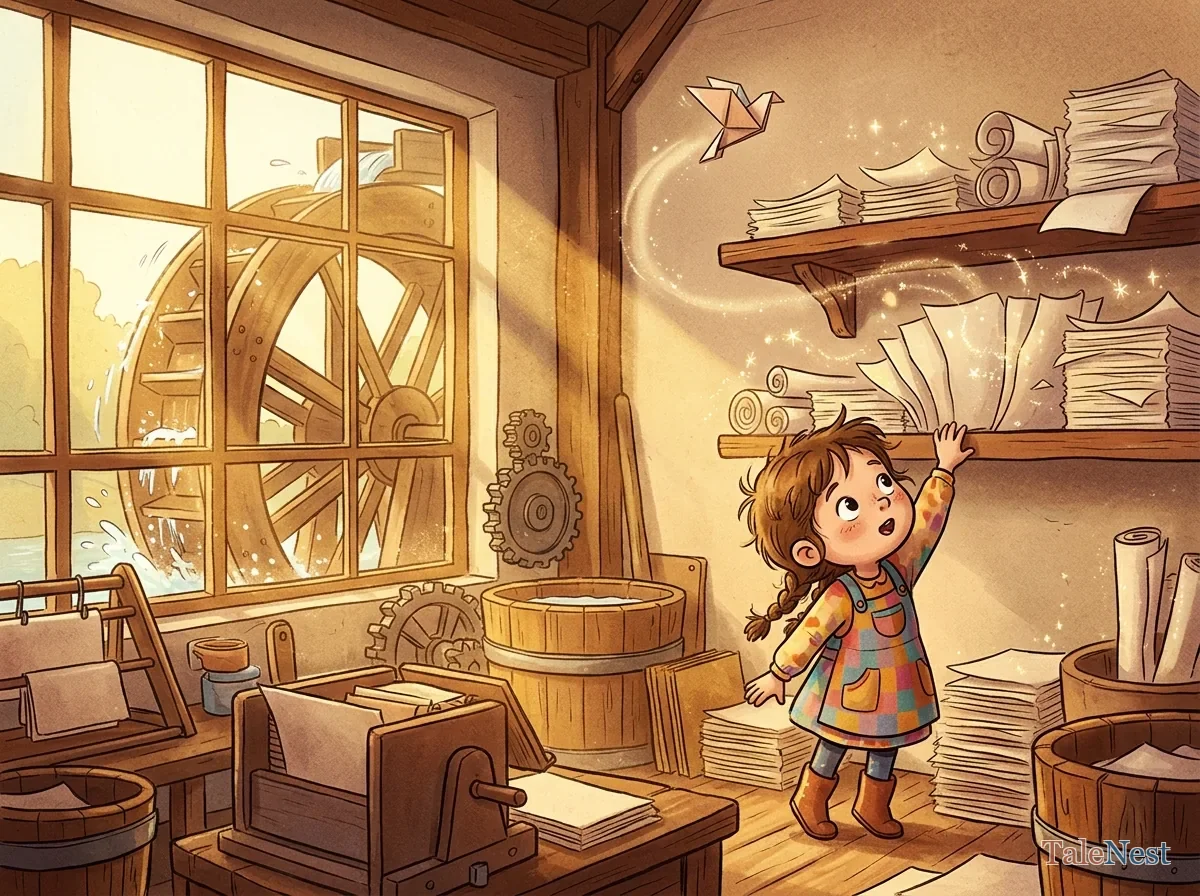
Beside the river stood Donato's mill. Inside, the air smelled of clean water and fresh-made paper, and the great wheel turned with a soft, endless sigh. Sunlight fell in golden bars through the dusty window, and the floor was dusted with a fine white powder.
Every afternoon Mila came running down the path and pushed open the door. “I'm here!” she would call.
And the shelf would answer her.
For on Donato's shelf lived sheets of paper that could speak. They were ordinary sheets, nothing special to look at, but every one of them held a story inside.
Mila would take one down, and the page would clear its throat and begin. One roared like a lion. One sang like the sea. One whispered so softly you had to press your ear close to hear. Mila loved them all, but the roaring one was her favourite.
“Choose any you like,” Donato would say. “Just bring it back when you're done.”
Mila always chose two, one for herself and one for Grandma Rosa.
Grandma Rosa lived next door. Her eyes were not good enough for small print anymore, so she sat in her kitchen and waited.
“Grandma, look what I've brought.” And the page would speak, and Grandma would smile. Some afternoons the old lady laughed until the tears ran down her cheeks.
A paper bird named Plume fluttered about the workshop. It never said a word. But whenever something was wrong, it circled and circled above the shelf.
One afternoon Plume circled for a very long time.
Mila took down a page. It spoke, but faintly. She took another; it was barely a whisper.
“Donato, what's happening to them?” It was as if the words were slipping away.
Donato climbed his ladder and peered at the shelf. The pages were there, still and silent.
“You don't need to read or write to have a story worth telling, the lives we live are the stories that matter most.”The little lesson
The next day only five remained. Then three. Then a single sheet.
It was blank. There was nothing inside it at all.
Mila picked it up with both hands. “Speak, please.”
The page said nothing.
She shook it gently. She held it to the sunlight. She tickled one corner. Nothing.
Then she sat down on the mill floor and bowed her head. “They've all gone.” A single tear rolled down her cheek and landed on the blank paper.
Donato sat beside her. It was a while before he spoke. “I must tell you something. My pages don't make up stories.”
Mila looked up. “They don't?”
“No. They only keep them. Someone has to tell them the stories first.”
He pointed at the empty shelf. “Those stories were mine. And I've told them all.”
Mila looked at the blank page, then at Donato. “But I can't read. I can't write.”
“You don't need letters to speak.”
Plume flew down and perched on Mila's knee. The mill fell quiet.
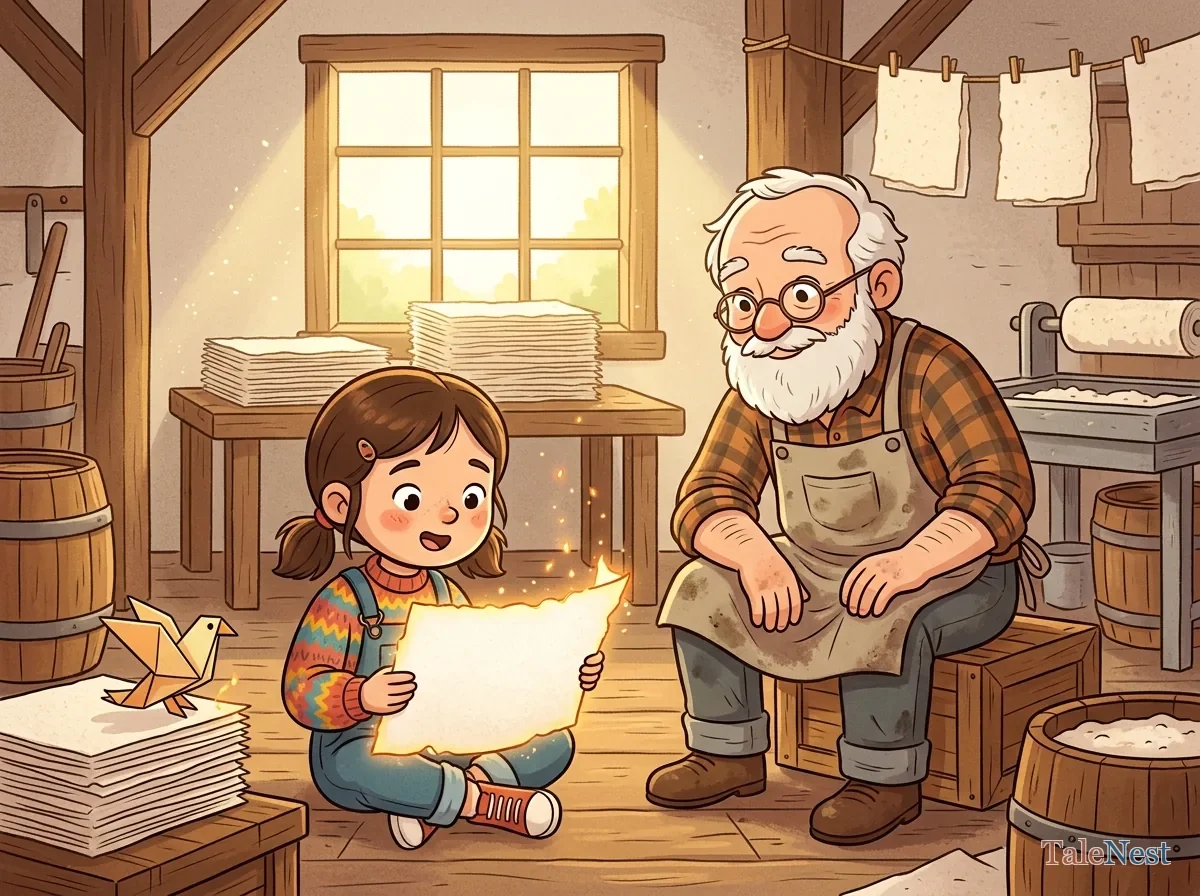
Mila laid the page in front of her and took a deep breath. “I'm going to tell you something.” And she began. Her voice shook at first, then grew steady.
She told it about the river, which sounded different in winter. She told it about her grandma, who made soup on Tuesdays. She told it about the day she got lost at the market and found her own way home.
The page listened. Very slowly, its edges began to glow.
Mila went on. She told it about the neighbour's cat, and about the tooth that fell out while she was eating bread.
When she finished, the page was no longer quite white. It had a warm colour, like fresh-baked bread. It smelled faintly of the river and of home.
Donato lifted it carefully. “Listen.” And the page spoke, in Mila's own voice, telling of the river, the soup, the market.
Mila clapped her hands over her mouth. “That's me!”
Plume looped once through the air and settled back on the shelf.
The next morning Mila ran to Grandma Rosa's house, the page pressed to her chest. She could hardly wait to get there. “Sit down, Grandma. I've brought a new one.”
Grandma settled into her usual chair. The page began to speak, and Grandma closed her eyes and listened to her granddaughter tell of the market, the soup and the winter river.
That afternoon the two of them went back to the mill. Grandma Rosa sat down before a blank sheet. “I have a few stories of my own,” she said.
And Donato's shelf filled with voices once more. Some roared, some sang, some whispered, and Grandma's were the softest of them all.
You don't need to read or write to have a story worth telling, the lives we live are the stories that matter most.


