
The Reel That Remembered Alice
Under a dusty theatre stage, a boy finds a film reel whose forgotten maker needs help giving her cabbage fairy an ending, and getting her name back.
 Retold by Idalia SantosAges 6+6 min read846 words
Retold and rewritten by Idalia Santos for TaleNest. This version is original prose in English; the illustrations and accompanying text were created for this site.
This is a work of fiction, retold in original language for TaleNest. Names, places and events are part of the story.
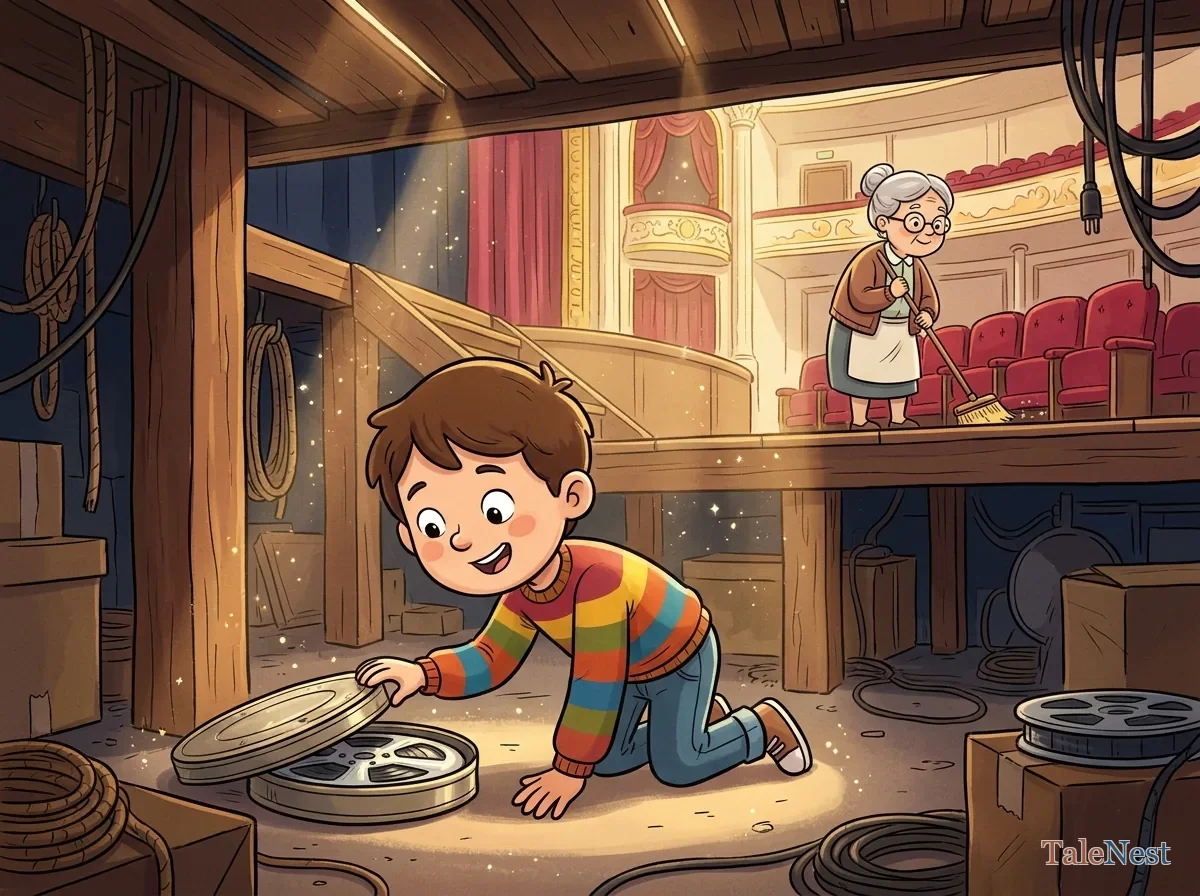
In the town where Leo lived there stood an old theatre with rows of dusty red seats. The seats were the colour of old berries, and the velvet had worn smooth where generations of children had sat. Every Saturday Grandma Snow swept the floors and polished the rail, and Leo stayed to help, partly because he loved the place and partly because she always had a biscuit in her pocket.
One Saturday Leo crawled under the stage to fetch a lost marble and found a metal box tucked in the shadows. Inside lay a reel of film, its label rubbed nearly blank. It smelled of dust and old wood down there, and of something else he could not name, something like a secret kept a very long time. “Grandma! Look what I found!” She blew the dust away and peered at it. “This is very old,” she said. “Let us see what it holds.”
They climbed the narrow stairs to the projection booth. Grandma threaded the reel into the machine. Clack, clack, clack went the projector, and a beam of white light leapt toward the screen. The little room smelled of warm metal, and the beam was thick with dancing dust.
A garden patch appeared, crowded with cabbages, all in black and white and grey. Among the leaves hopped a little fairy with wings of paper. Then a woman in an enormous hat stepped into the picture. She looked straight at Leo and waved. “Hello!” she called. “My name is Alice. Can you hear me?” Leo's mouth fell open. “The film is talking!” “I am talking,” she laughed. “I made this picture in Paris, a very long time ago.”
Alice shared a secret. In those early days, pictures did not tell stories; they only showed things that happened, a train pulling in, workers leaving a factory. She spoke of the first audiences, who ducked when a train appeared to come straight at them. “I thought, what if the screen told a tale instead?” she said. “With characters, and magic, and an ending.” “And did you?” asked Leo. “I did. I was among the very first, and for a while the only woman making films. This was my first story: the cabbage fairy.”
“Curiosity can restore a forgotten name, and the most memorable stories are the ones we create together.”The little lesson
On the screen the fairy bowed, and one of her paper wings fell off. Alice's face fell too. For a moment nobody moved, and the machine went on clacking above their heads. “There is the trouble,” she said quietly. “My film has no ending. It was lost, and now nobody remembers who made it.” Leo looked at Grandma, and Grandma looked at Leo. “We will help you,” he said.
“Do you know how to do cinema tricks?” asked Alice. “No,” said Grandma, “but we have a cupboard full of things.” They opened it and found a white sheet, coloured papers, and an old electric fan. “First, a curtain,” said Alice. “Every story begins with a curtain.”
Leo hung the sheet in front of the screen and Grandma pulled a rope. The sheet rose, then dropped right onto the fairy, who ran this way and that like a little ghost. “Oooooh!” she wailed, tangled in the cloth. Leo laughed until tears ran down his cheeks, and Alice laughed hardest of all.
“Now colour,” said Alice. “I painted my films with the tiniest brushes.” Leo held a sheet of red paper in front of the lamp, and the whole screen turned crimson, the cabbages looked like tomatoes. “Too red,” said Grandma. Leo tried green. The cabbages became cabbages again, and the fairy clapped. They tried blue next, but that made the leaves look cold, so green it was.
“And last, wind,” said Alice, “so it seems that the fairy is flying.” Grandma switched on the fan. The cabbage leaves danced, and the fairy spread her arms and rose, and rose, and rose, but Alice's great hat sailed off too. “My hat!” she cried. The fairy caught it out of the air. Alice clapped her hands. “Cut! We have our ending.”
Then she showed them more pictures: a great ship, a faraway country, a studio crowded with cameras. “After that I went to America and had my own studio. It was called Solax, and I made hundreds of films.” She told them her full name, and made Leo promise he would say it out loud one day. “Hundreds?” said Leo. “And I never knew your name!”
The projector light flickered and the screen went white. Leo drew out the reel. On the faded label, black letters had appeared as clear as the day they were written: Alice Guy.
The next Saturday Leo invited his whole class to the theatre. Grandma hung the sheet and Leo readied the green paper. Leo felt the pride of it like a warm light in his chest. Before he switched on the projector he said, loudly, “Look carefully. This film was made by Alice.” When the fairy sprang out among the cabbages, everyone applauded, and from the screen a woman in a great hat winked at them.
Curiosity can restore a forgotten name, and the most memorable stories are the ones we create together.


