
The Rose Who Believed She Was Lucky
The sun, dew and briar all claim to be a rose's parent; as each blossom meets a different fate, every one believes it has drawn the happiest lot.
 Retold by Idalia SantosAll ages4 min read972 words
This is a work of fiction, retold in original language for TaleNest. Names, places and events are part of the story.
'What lovely roses!' said the sun. 'Every bud will open as beautiful as these. They are my daughters; I gave them the kiss of life.'
'They are my daughters,' said the dew. 'I gave them my tears to drink.'
'I should say I am their mother,' cried the rosebush. 'You two are only godparents, offering a gift according to your means and good will.'
'Roses, our lovely daughters!' said all three, wishing each the greatest happiness a rose can know. Yet only one could be the happiest and one the least happy of all, it could not be helped. Which would it be? 'I will find out,' said the wind. Every open rose heard, and every bud too.
A mother in black picked a half-open rose, the loveliest she could find, and carried it to her room, where days before her little girl had skipped about and now lay sleeping forever. She kissed the rose and laid it on the girl's breast, hoping its freshness and a mother's kiss might start the still heart.
The rose seemed to swell and every petal trembled. 'What a fate full of love is mine! I have become almost human: a mother's kiss, words of blessing, and a journey to the unknown kingdom dreaming against the breast of the dead. Surely I am the happiest of my sisters.'
Next came the old garden woman with her hoe. Her eyes settled on the biggest, fully open rose. One more drop of dew and one hot day and its leaves would fall; it had given beauty, now it must give use. She cut it and tucked it in a newspaper to preserve it in salt with dried roses and little blue flowers. Only roses and kings, you see, are preserved. 'What an honour!' said the rose. 'They are going to preserve me. I must be the happiest.'
“Happiness is largely a matter of belief: each rose found joy in its own particular fate, and contentment with one's lot is the truest kind of happiness.”The little lesson
Two young men strolled in, a poet and a painter, each picking a rose. The painter set his flower on canvas so faithfully it looked like its reflection. 'In this way I shall live for generations, while millions of its kind wither and die.' 'I shall have been the most favoured,' said the rose.
The poet wrote a poem of the mysteries he read in his flower's petals, called it 'A Picture Book of Love', and passed into immortality. 'I have been made immortal!' cried the rose. 'I am the happiest of all!'
Almost hidden grew a crooked rose: its leaves did not match, and a misshapen green leaf sprouted from its centre. Such afflictions spare not even roses. 'Poor thing!' said the wind, kissing its cheek. But she took it for a tribute, felt different from the others, and decided the odd leaf was a distinction.
A butterfly kissed her petals, a suitor, and she let him go. Then a grasshopper settled on another rose and rubbed its false leg, how grasshoppers declare love. That flower did not understand, but the crooked rose saw his eyes saying, 'I could eat you up for love.' What greater proof of affection? Still she would not yield. The nightingale sang in the starry night. 'That is surely for me,' she said. 'Why have I been singled out above my sisters?'
Then two smokers entered, talking of roses and tobacco. A flower touched by smoke loses its colour and turns green, they said, and they wanted to test it but hated to spoil a lovely bloom, so they cut the crooked rose. 'A new distinction!' she cried. 'I am the happiest of all.' And she turned green with pride and smoke.
A half-open bud, perhaps the finest on the bush, was given the place of honour in a bouquet sent with the young master as he drove off in his carriage. It shone like a pearl among the greenery. At the grand party, music played under blazing lights in the theatre, and when the celebrated ballerina stepped onto the stage, bouquets flew to her feet like rain. Among them fell ours, its rose gleaming like a jewel.
The flower felt immense happiness in all that glory, and as it touched the boards it began to dance and leap too, for its stem had snapped. It did not reach the dancer but rolled behind the scenes, where a stagehand picked it up. Seeing it lovely but stemless, he slipped it into his pocket and at home put it in a glass of water.
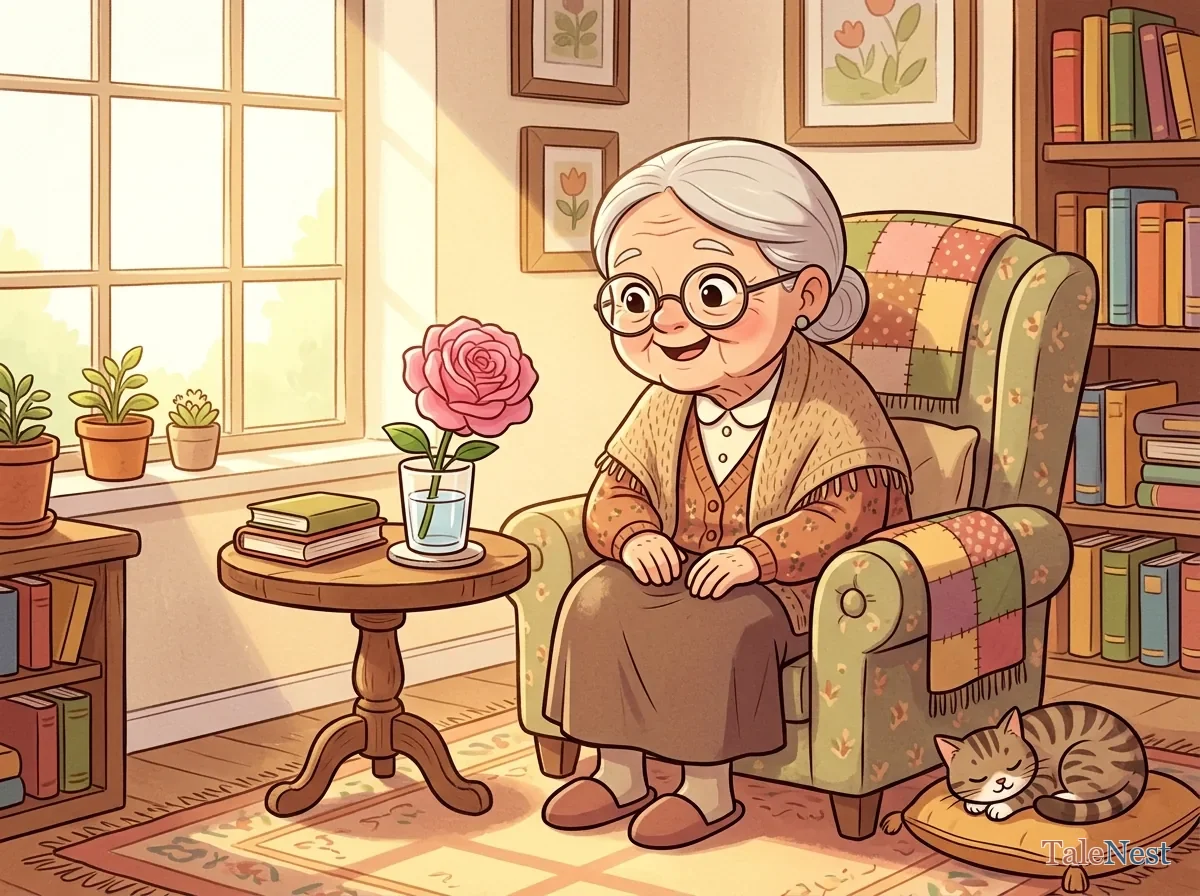
Next morning they set it before the grandmother in her armchair. She sat long gazing at the magnificent broken rose, delighting in its look and scent. 'You did not land on the rich young lady's table, but on this poor old woman's, yet here you are like a rose in a vase. How beautiful you are!' she said, with the joy of a child.
'I came in through a hole in the windowpane,' said the wind, 'and saw the old woman's bright, youthful eyes and the lovely broken rose in its glass. The happiest of all! I know it; I can declare it.'
Every rose had its story and each believed itself happiest, for belief brings happiness. The last flower was certain she was the luckiest. 'I have outlived the others; I am the last, the only, the favourite daughter of our mother.' 'And I am their mother,' said the rosebush. 'I am!' said the sun. 'And I!' said the wind and time.
'We each have our share,' said the wind, 'and each will have a part in their beauty.' He scattered the leaves over the plant where the dew lay and the sun shone. 'I too have had my share. I have seen every rose's story and will carry it across the world. Now you must tell me which was happiest, I have said enough.'
Happiness is largely a matter of belief: each rose found joy in its own particular fate, and contentment with one's lot is the truest kind of happiness.


