
The Snow Was Full of Secrets
A boy who only wants to build the biggest snowman discovers the quiet mountain is crowded with hidden lives, and that his own careless trash can hurt them.
 Retold by Idalia SantosAges 4+6 min read963 words
Retold and rewritten by Idalia Santos for TaleNest. This version is original prose in English; the illustrations and accompanying text were created for this site.
This is a work of fiction, retold in original language for TaleNest. Names, places and events are part of the story.
The car climbed a winding road and everywhere Lucas looked the world seemed dipped in white, snow on fences, roofs and rounded hills. He pressed his nose to the cold glass. “Look how much snow!” he cried. “I'm going to build the biggest snowman in the world. Taller than Daddy. Taller than our house.”
His sister Sara, tucked beside him in a puffy yellow coat, smiled. “I want to see the animals,” she said. “Animals are boring,” Lucas scoffed. “They just stand around. I want to roll snow and throw it and make something enormous.” Sara did not argue; she only studied the white world with patient, curious eyes.
When the car crunched to a stop in the mountain lot, the air that rushed in was sharp and clean, smelling of pine. Lucas tumbled out before anyone could unbuckle him and flopped into a drift, scooping great armfuls. He packed a ball, hurled it up, caught it badly, and laughed until his cheeks ached.
Dad lifted the backpacks down. “Come on,” he called. “There's a trail through the pines, with lovely things to see if you slow down.” Lucas rolled his eyes, seeing things was not the plan, but he scrambled up and followed between the trees.
The forest was so hushed that Lucas wanted to whisper. The only sound was the crunch of boots packing snow, a soft squeak with every step. Snow hung on the pine boughs in white clubs. He was about to call this the dullest walk ever when Sara stopped and held up one mitten.
“Look,” she breathed. Ahead ran a line of small neat marks, each no bigger than a coin. “Footprints,” Lucas said, surprised. Mom knelt. “Fox prints. Like a little dog's. He came through this morning.” Lucas crouched beside them; the prints dipped away between the trunks, and he had never guessed a trail could be a story.
“And these?” Sara asked, pointing to a larger set sunk deep in the snow. “A deer,” said Dad. “Out looking for food.” The mountain, empty a moment ago, suddenly felt busy. Foxes, deer, creatures he could not name had all walked here while he slept in the car.
“Paying attention to the small lives around us turns a place from boring into alive, and respect means leaving it as clean and peaceful as we found it.”The little lesson
He began to look properly. Everywhere were more marks, the scratchy scrawl of a bird, the neat double line of something quick, a trough where a heavier animal had plowed through. The snow was not a blank sheet at all. It was a page covered in writing, if you knew how to read it.
They walked on, and Lucas no longer ran ahead. He kept his head low, studying the ground, then the trees. A rustle in a branch became a creature shifting its weight; a dip in the snow, a place to rest. Even the silence seemed full, as if the forest held its breath.
Then they heard a small soft sound from the low branches of a pine, a faint fluttering, a tap. Sara saw him first: a little bird huddled among the needles, one wing folded crookedly. “He's hurt,” she said, her voice thin with sadness.
Mom moved slowly, the way you approach something frightened. “We mustn't touch him,” she said. “But we can leave water and seeds, then give him room. Nature knows how to look after itself when we don't interfere.” They set out a cap of water and a pinch of seeds. The bird tilted its head and watched with bright, curious eyes.
“Will he get better?” Lucas asked, no shout in his voice now. “If he rests and eats, yes,” said Dad. “But he needs quiet more than anything.” Lucas nodded. A while ago he had wanted to charge through the trees; now he wanted the whole mountain perfectly still so the small bird could heal.
Later, in a sun-striped clearing, they ate sandwiches. Lucas drained his juice and was about to toss the can into the snow when something moved among the stones, a tiny hedgehog. It wandered up to an old can someone had left and poked its nose inside, and then it could not get out.
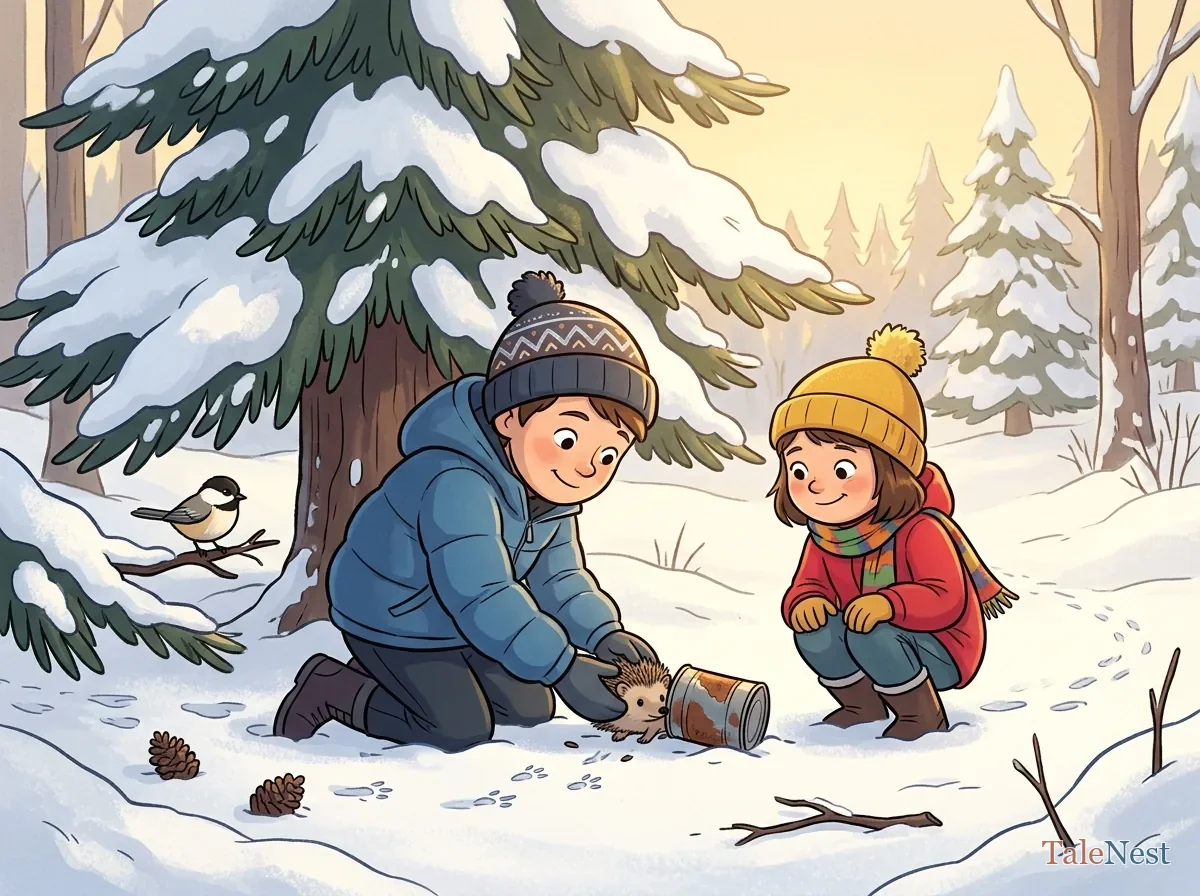
“Dad! The hedgehog is stuck!” Dad was already moving. He knelt and worked gently, tipping the can, coaxing, until the little animal wriggled free and scurried toward the bushes. Lucas stared at the can in his hand, then at the clean white snow, then at the trees. The difference between them suddenly seemed enormous.
“I'm putting mine in the backpack,” he said. “I don't want another animal hurt because of me.” Sara broke into a smile. “Me too,” she said, lifting the old can from the ground. Lucas felt a small warm pride, not the loud kind from winning, but something quieter and steadier.
They walked back with Lucas unusually silent, lining them up in his head: the fox's delicate trail, the deer searching for food, the injured bird in the pine, the hedgehog in the old can. He had come looking for a snowman and instead found a whole neighbourhood of neighbours he never knew were there.
“Can we come back another day?” he asked. “Of course,” said Mom. “The mountain isn't going anywhere.” “And neither are the animals,” added Sara. Lucas smiled, the mountain was not just a place to play, but a home full of lives needing gentle care. At the car he saw his own small footprints, not so different from the fox's. He belonged here too.
“Next time I'll walk more slowly,” he said, “so I can see more.” Dad ruffled his hair. “That's the spirit, champion.” As they drove off, Lucas watched the white mountain slip behind him. It looked quiet, but no longer boring. It looked alive, and he had learned to see it with new eyes.
Paying attention to the small lives around us turns a place from boring into alive, and respect means leaving it as clean and peaceful as we found it.


