
The Song That Saved the Emperor
An emperor treasures a jeweled mechanical bird above the plain little nightingale that once moved him to tears, until illness teaches him which song can truly save him.
 Retold by Idalia SantosAges 8+5 min read957 words
This is a work of fiction, retold in original language for TaleNest. Names, places and events are part of the story.
Years ago the Emperor of China's palace was the most splendid in the world. Its gardens were so vast that the head gardener did not know where they ended. Walk far enough and you reached a magnificent forest that ran down to the deep blue sea, and there lived a nightingale whose song was exquisite.
Travelers from every land admired the palace and gardens, but the moment they heard the bird they cried, 'This is the best of all!' They told their countrymen; wise men wrote books about the city, the palace, the gardens, always remembering the nightingale. The books spread across the world, and one reached the Emperor.
Sitting on his golden throne, he read: 'But the best of all is the nightingale.' 'What?' he thought. 'I have never heard of it.' He summoned the lord high steward.
'There is a remarkable bird here called the nightingale,' said the Emperor. 'They say it is the finest thing in my empire. Why was I not told?' 'This is the first I have heard of it,' said the steward. 'Then bring it to sing for me tonight.' 'I shall find it,' he promised.
Nobody he asked had heard of it, until a poor scullery girl in the kitchens cried, 'The nightingale? Of course I know it!' 'Bring me the bird,' said the steward, 'and you shall have a permanent position. It is expected tonight.'
They went to the woods. 'There it is! Listen!' whispered the girl. 'My little nightingale,' she called, 'our gracious Emperor wants you to sing.' 'Gladly,' said the bird, and poured out a glorious melody. 'That will be a sensation at court.'
'Shall I sing again for the Emperor?' asked the bird, supposing him present. 'My fine nightingale,' said the steward, 'I invite you to a grand banquet tonight to delight His Imperial Majesty.' The bird went willingly.
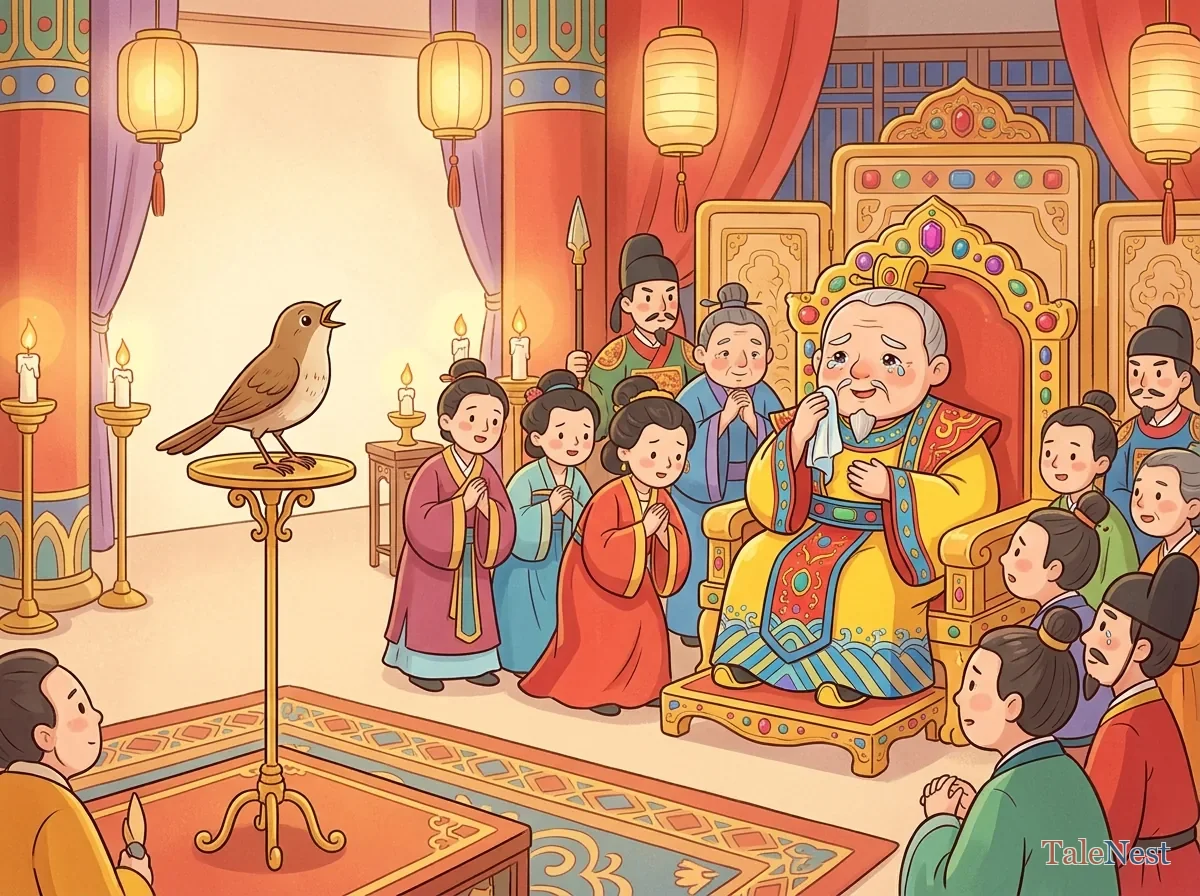
In the great hall a golden perch awaited, and the whole court gathered. The nightingale sang so sweetly that tears rose to the Emperor's eyes; seeing them, it sang better still, until the music reached his soul.
The Emperor offered his golden slipper as a reward, but the bird said it was already repaid. 'I saw tears in your eyes; that is my finest prize. A ruler's tears have special power. God knows I am rewarded', and it sang again.
“Genuine beauty and a grateful heart outlast the brightest imitation; the songs that move us to tears are the ones that stay with us.”The little lesson
The nightingale became the sensation of the court, housed in its own cage with freedom to fly out twice by day and once by night, and ten servants to wait on it.
One day a great parcel arrived labeled THE NIGHTINGALE. 'A new book about our bird!' said the Emperor. But it was a clockwork imitation in a cage, covered with diamonds, rubies and sapphires. Wind it up and it sang one of the real bird's tunes, tail bobbing, flashing silver and gold. A ribbon read: 'The Emperor of Japan's nightingale is poor beside the Emperor of China's.'
'Splendid!' cried the court. 'Let them sing together!' But it went badly: the real bird sang freely, the machine by clockwork. 'No fault of his,' said the Orchestra Director. 'He keeps perfect time and follows my method exactly.'
Thereafter the machine sang alone, as successful as the other and far prettier, glittering like bracelets and brooches. Thirty-three times it repeated its tune; the courtiers wanted more, but the Emperor said the real nightingale should sing too.
Where was it? No one had seen it slip through the open window back to its green forest. 'What is this?' demanded the Emperor. The courtiers called the bird ungrateful. 'Luckily we have the better one,' they said, and the machine sang a thirty-fourth time, so hard a tune that nobody could learn it.
The Director praised it as superior not only in jewels but inwardly. 'With a flesh-and-blood bird you never know what it will sing. With this one everything is fixed: you hear this, then that, and nothing more. Open it and see the wheels arranged, how they turn and mesh, the work of human cleverness.'
'We agree,' said the courtiers. The Director was permitted to show the bird to the people on Sunday. 'All must hear it,' said the Emperor; and they did.
'Not bad,' people said. 'The tunes are similar, but something is missing, I cannot say what.'
The real nightingale was banished; the machine stayed by the Emperor's bed.
For a year the Emperor, the court and all China knew the machine's trill by heart, and because they knew it so well they loved it the more, imitating it endlessly.
Then one night, mid-song, a crack sounded inside the mechanism. The Emperor leapt up and sent for the watchmaker, who said the pivots were worn and could not be replaced. After that the bird sang only once a year, and even that was risky.
Five years later the Emperor lay dying. His successor was chosen; pale and cold he lay in his great bed, and the court thought him dead, but he had not breathed his last.
Suddenly a wonderful song came through the window: the little living nightingale on a branch, told of his plight, had come to bring comfort and hope.
'Thank you!' cried the Emperor. 'I banished you, yet your song has chased evil spirits from my bed and Death from my heart. How can I repay you?'
'You already have,' said the bird. 'I brought tears to your eyes the first time I sang; a singer's heart is gladdened by such jewels, and I shall never forget. Now sleep and recover while I sing on.'
It sang; the Emperor fell into a sweet sleep. Servants entered to look on their dead Emperor, and he said, 'Good morning!'


