
The Tailor and the Long Road
A genial tailor packs light for a forest journey and pays dearly, until a handkerchief of dew, a duck, some bees, a stork and a horse repay his kindness.
 Retold by Idalia SantosAges 8+5 min read966 words
This is a work of fiction, retold in original language for TaleNest. Names, places and events are part of the story.
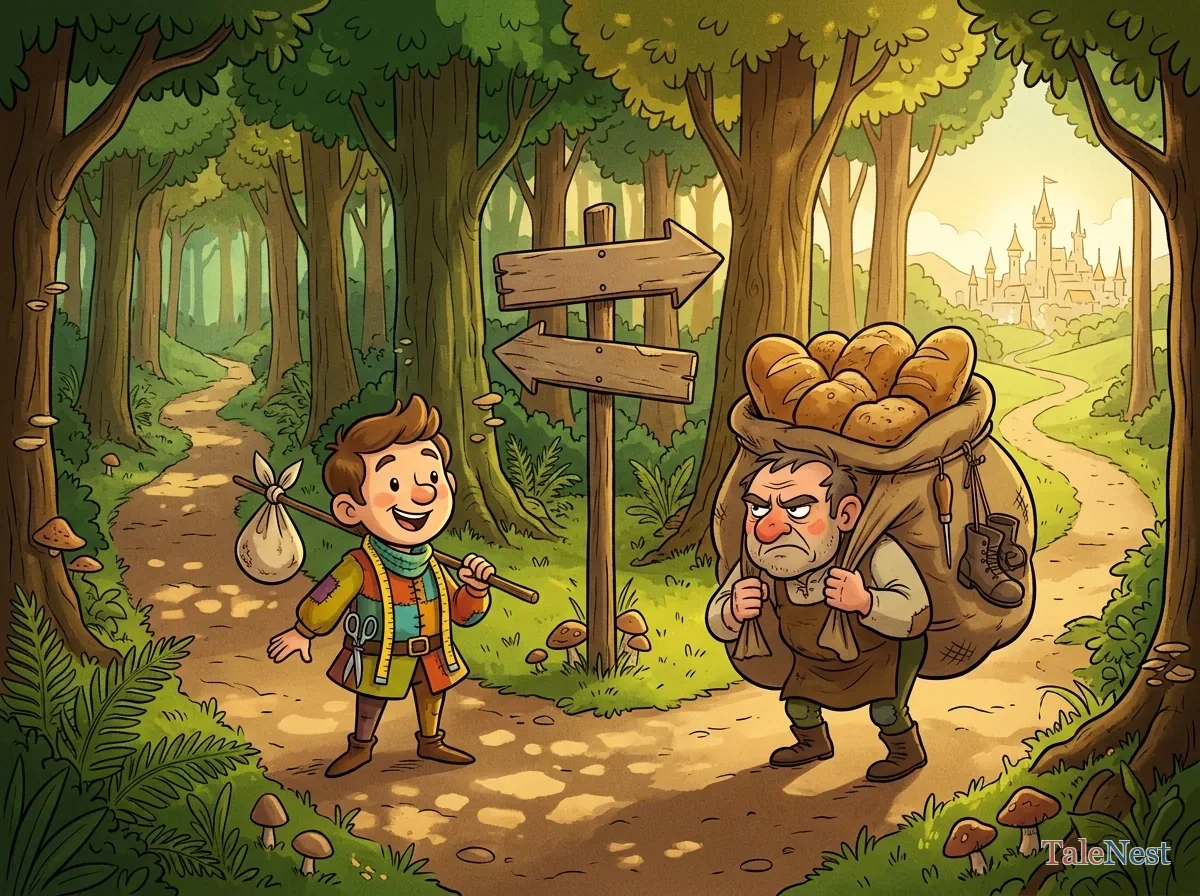
A tailor and a shoemaker travelled the world, calling in each town on the masters of their trades. Cheerful and quick to laugh, the tailor was welcomed and sent away laden with gifts; his friend scowled. He never crowed, but laughed and divided everything with him.
After months they reached a vast forest on the road to the capital. Two paths crossed it, seven days or two, but nobody had said which was which. They sat down to decide on bread.
'Better too much than too little,' said the shoemaker. 'I'll take seven days' worth.'
'What, and stagger like a donkey under all that?' cried the tailor. 'Why not strike the short road? Two days is plenty.' Each bought what he thought best and they entered the trees.
On the third day his bread ran out deep in the wood. His heart sank, but he trusted his luck, sleeping hungry and waking hungrier.
On the fourth day the shoemaker ate atop a fallen trunk while the tailor watched. Begged for a crust, he laughed: 'You've always been merry; learn what sadness is.'
By the fifth morning the tailor could not stand. 'Bread today,' said the shoemaker, 'but you must give me an eye.' To save his life he agreed, then rose on the costly morsel, consoling himself that one eye would do.
On the sixth day hunger returned. At dusk he collapsed at a tree's foot, and by the seventh dawn he could not rise. 'Another crust for your remaining eye,' said the shoemaker.
'Do as you will,' whispered the tailor. 'But in our good days I shared all I had with you. Only don't abandon me when I'm blind.' The shoemaker's heart stayed hard: he took the second eye, gave over the bread, pushed a staff into his hand and told him to follow.
“Kindness freely given returns in unexpected ways, while greed and betrayal leave a person with nothing but their own bitterness.”The little lesson
At sunset they left the forest. In the field ahead stood a gallows. The shoemaker led the blind man to it and walked off. Spent with pain and hunger, the tailor slept soundly.
At daybreak he woke not knowing where he was. Two poor wretches hung from the gallows, a crow on each head. 'Awake, brother?' croaked one. 'Yes,' said the other. 'The dew that fell on us from the gallows restores sight to whoever washes with it.' If the blind but knew!
The tailor pressed his handkerchief to the wet grass and bathed his empty sockets. At once the words came true. He slung on his bundle and went on singing, his hardships forgotten.
He tried to mount a young colt. 'Let me be; I am too young,' it pleaded, and he let it go. But he had not eaten since yesterday. 'The first edible thing I meet,' he said, 'I shall eat.'
A stork appeared. 'Stop!' he cried, seizing a leg. 'I don't know if you are good to eat, but hunger gives no choice. I must cut off your head and roast you.'
'Spare me; I am a sacred bird,' said the stork. 'Respect my life and one day I may repay you.' 'Then be off!' he cried, releasing it. Still starving, he reached for a duckling, but its mother begged him to take her child, and pity stayed his hand.
He found a hollow tree alive with wild bees and thought of the honey. But the queen bee bristled: 'Touch my people or break our nest and our stings will pierce you. Leave us in peace and one day we will help you.'
He entered the city fasting; the inn set a place for him. When he had eaten he said, 'Now to work.' He found a job, earned a fine name, and the King named him court tailor.
That day his old companion was made palace shoemaker. Seeing the tailor could see again, his face darkened and he wove a trap. 'The tailor brags he could recover the golden crown lost years ago,' he told the King. 'Then let him,' said the King, summoning the tailor: bring it or leave the city.
At the pond, a duck he had befriended asked why he was downcast. He told his tale. 'The crown lies at the bottom; we'll have it up in a moment,' said the duck. He brought it to the King, who hung a gold chain about his neck.
Foiled, the shoemaker tried again: 'Sire, he boasts he could model the whole palace in wax, inside and out.' The King ordered it exact, or lifelong imprisonment. At the hollow tree the queen bee heard his trouble and every bee lent a hand; the amazed King gave him a stone house.
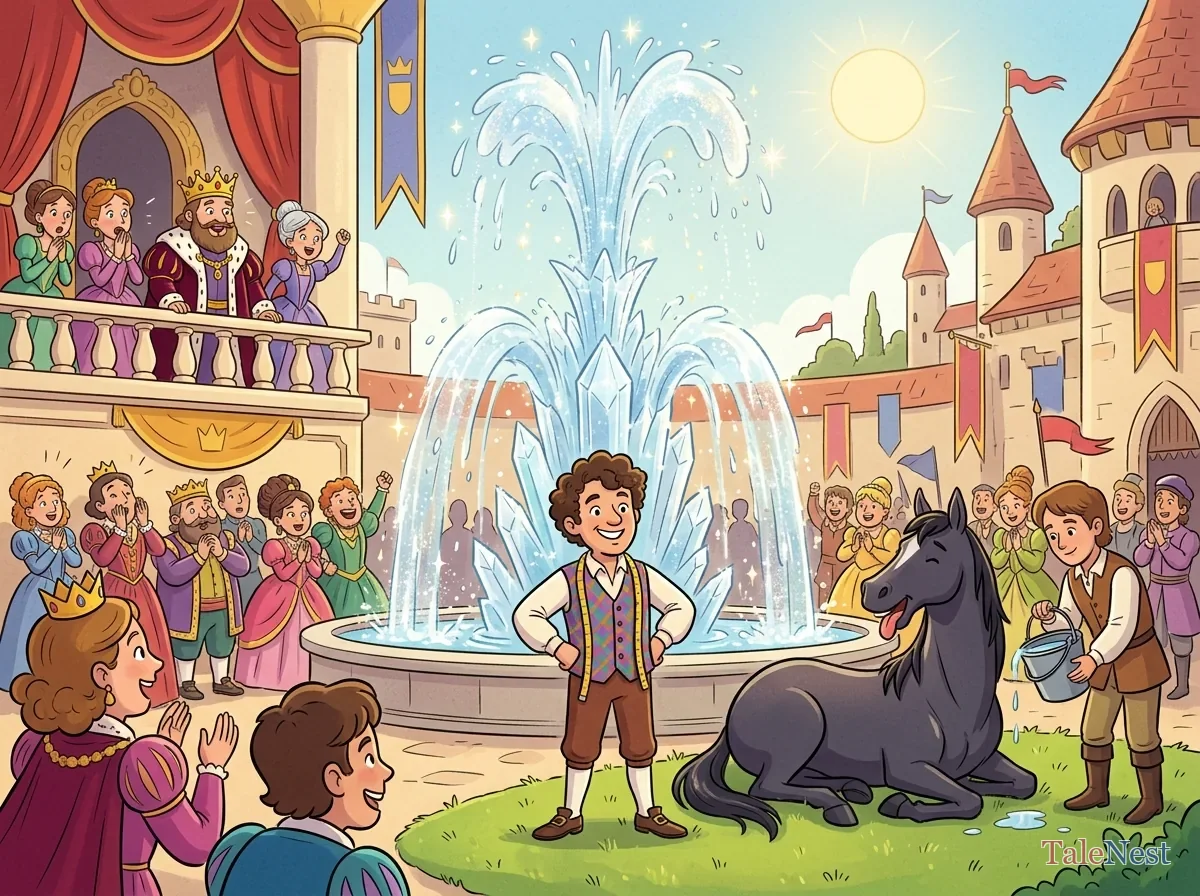
Still he persisted. 'Sire, the tailor says no water will spring in the palace yard, yet he could raise a crystal fountain as tall as a man.' 'If none rises tomorrow, your head comes off,' said the King. The tailor fled the city and met the spared colt, now a fine horse eager to repay him.
He leapt up and the horse galloped to the palace yard, swept three times around it at lightning speed, then collapsed. A great crack sounded and a crystal jet shot up as high as a rider, sunlight dancing in the drops. The King cried out and embraced the tailor before the court.
But joy was short-lived. The King had beautiful daughters and no son. The shameless shoemaker went a fourth time. 'Sire, the tailor says he could have a son brought flying through the air.' 'In nine days,' said the King, 'and you shall marry my eldest.'
He did not know how, and left the city. In a meadow he met the stork, who heard his tale and carried a newborn to the King. He married the eldest princess; the shoemaker was driven out to face the road.


