When a Child Is Afraid of the Dark: A Calm, Practical Plan
Fear of the dark is one of the few childhood worries that returns at the same hour every evening. A child who is bold in the playground becomes uncertain the moment the lamp goes off, and the pattern wears down even a patient parent.
This article offers general information for families. It is not medical, psychological or developmental advice; ask a qualified professional about your own child.
Fear of the dark is one of the few childhood worries that returns at the same hour every evening. A child who is bold in the playground becomes uncertain the moment the lamp goes off, and the pattern wears down even a patient parent. Start with a plain fact: the dark itself is not what frightens them. What frightens them is what their mind puts into it, and the fact that you are leaving the room. Both are real. A plan that takes both seriously stays calmer than one built on repeated assurances that there is nothing to fear.
Why the dark is hard
Imagination outruns knowledge
For a young child the space between seeing and knowing is wide. A coat on a chair is a shape first and a coat second. In a dim room the mind works faster than the facts and borrows its worst images from whatever was heard that day. The floorboard creaks, and the creak becomes a reason. This fear is not a conclusion reached by thinking; it is a picture that arrived before the thinking started. Speak to the picture. Name what is in the room, in a low voice, and let the ordinary details do the work.
Separation and bedtime
Bedtime is the longest stretch of the day a child spends without you, and the difficulty has little to do with darkness. For someone who has spent the earlier hours close to a parent's voice and hands, the gap is felt before it is understood. Many children who say they are afraid of the dark mean: I am not ready for you to go. That is not manipulation, even when repeated nightly. It is a mismatch between a child's need for contact and an adult's need to finish the day. Recognising it changes the response. The goal becomes helping the child tolerate the distance.
What helps on the first night
A predictable wind-down
A frightened child is often already overstimulated by bedtime, and the last twenty minutes can be shaped to lower the temperature. Keep the order the same: wash, clean clothes, a short read, a short talk, lights down. The repetition is the point, not the content. When the sequence is predictable, attention moves from what might happen to what comes next, and that is an easier place to be. Do not add new elements on a bad night; add fewer. If a child has taken to delaying, a fixed, brief routine removes the negotiation, because there is nothing left to bargain over. Say what happens next once, gently, and then do it. Warmth and firmness are not opposites here.
A light that stays low
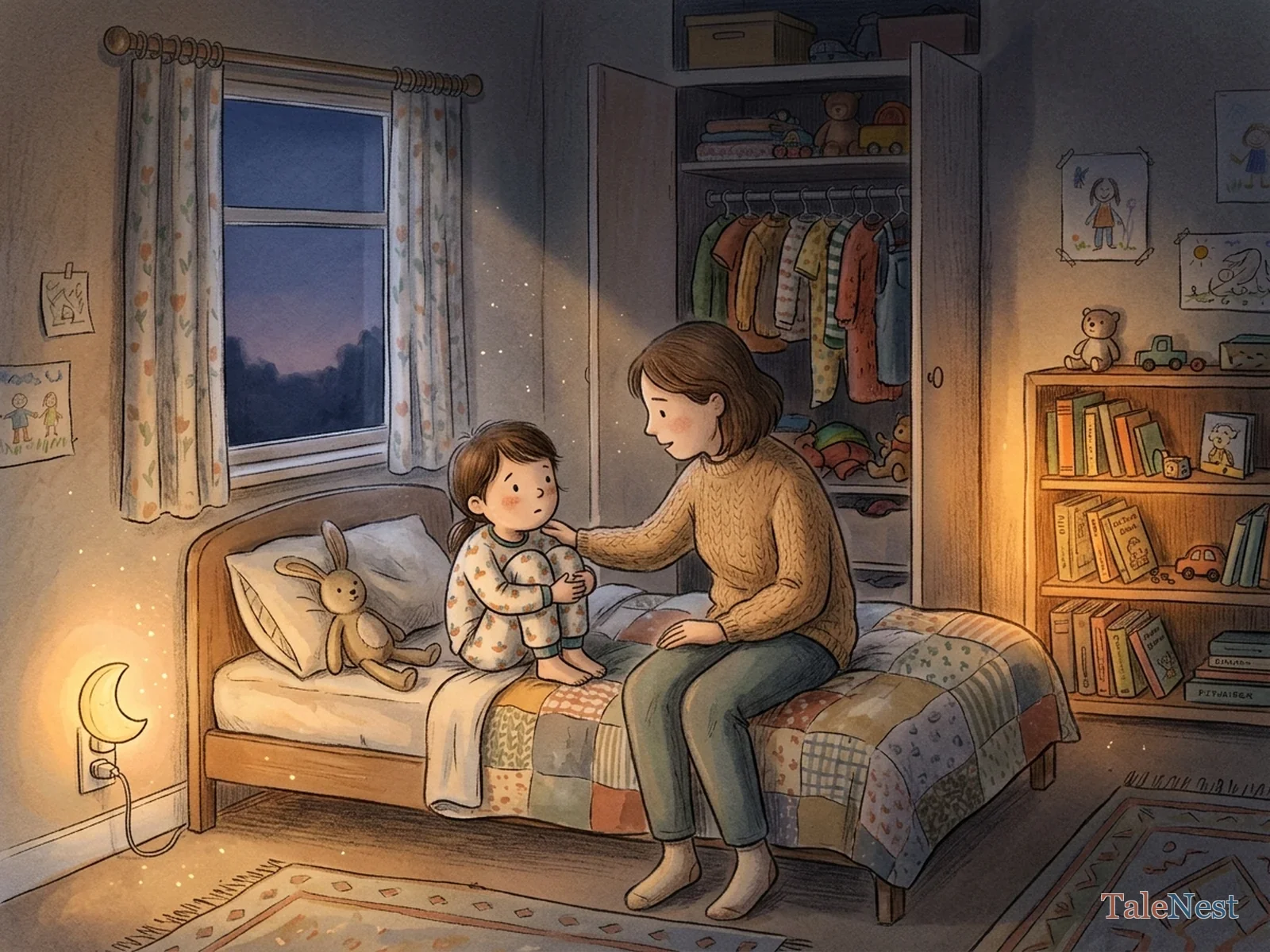
A night light is not a surrender. It lets a child see the edges of the room, and edges are what the imagination needs in order to settle. Choose one that is dim, warm in colour and steady, not a bright overhead source. Put it where it shows familiar shapes: the chair, the door. The aim is not to light the whole room but to give the eye enough information to correct the mind. If you plan to remove it later, treat that as a separate step, after a run of settled nights. Announce the change ahead. A light that vanishes without warning teaches a child the room is less safe than they thought.
What tends to make it worse
Endless reassurance loops
The most common mistake is understandable. A child calls out; you go in, check the room, say there is nothing there, and leave. Ten minutes later the same call comes. Each round of reassurance feels like care in the moment, but it can teach the opposite: that the fear is confirmed by the number of visits, and that safety requires summoning an adult again. Go in the first time, keep it short, say the same few words, and make the leaving calm and definite. Long explanations about shadows or elaborate searches under the bed keep the fear alive by giving it an audience. Check once. Then trust the routine you built.
Screens right before bed
The other common problem is a screen in the hour before sleep. This is a matter of timing, not moral judgement. Fast images, bright light and a story that stops at a cliff-hanger all push the mind toward alertness just when you are asking it to slow down. A child who has watched something tense may seem calm, then feel afraid the moment the screen goes dark. Give the last stretch to quieter input: a lamp, a low voice, a book whose ending you know. Keep the boundary every night rather than making an exception on difficult days. Those are the exceptions a child remembers.
Stories as a tool
Choosing a tale about courage
A story can give a child a way to talk about fear without making them the centre of it. Choose one in which a character is frightened and acts anyway. That is more useful than a hero who feels nothing, because it matches what the child is being asked to do. Avoid tales whose frightening images are vivid and unresolved, and avoid a story where magic rescue removes the fear. Read it before bedtime, not in the middle of the night. You are offering a picture of someone who coped, not a test of whether your child will.
Talking after, not during
The conversation belongs after the last page, not in the middle of the scary part. Stopping to explain a tale while a child grips the blanket breaks the spell and turns the story into a lesson they did not ask for. Let the ending arrive, let the book close, and then, if the child wants to talk, ask something small and concrete. Which part was hardest? What would you have done? If they say nothing, that is a complete answer. Do not mine the tale for a moral. A frightened character got through the night.
Common questions
When is it more than a phase?
Most night fears come and go over months. Ask for help when the fear is sudden and severe, when it follows a frightening event, or when it persists into the daytime. If your usual responses are not helping, a conversation with a paediatrician or a qualified child mental health professional is reasonable. Describe what you have seen and when it began; let them decide what it means.
Should we leave a night light forever?
No rule requires a child to sleep in full darkness. The useful question is whether the light has a job. If it lets your child settle without a long struggle, it is doing one. If you simply dislike the idea, that is a preference, not a problem to solve. Once bedtimes have been easy for weeks, try a dimmer bulb, then a lamp further away. If a change causes a relapse, put it back without comment. There is no prize for doing it early.