Why Honesty Stories Need a Real Consequence
Children's stories often wrap up quickly. A wrong deed is followed by a gentle lesson, everyone smiles, and the book closes.
This article offers general information for families. It is not medical, psychological or developmental advice; ask a qualified professional about your own child.
Children's stories often wrap up quickly. A wrong deed is followed by a gentle lesson, everyone smiles, and the book closes. It is a comfortable pattern, but it can leave out the part that makes honesty meaningful: the moment after. When a tale shows that a lie costs something real, trust, comfort, a friendship, it gives children a safe place to see cause and effect. The point is not to frighten them. It is to make the connection visible, so that the choice to tell the truth is grounded in what actually happens between people.
Why consequences matter
The tale as safe practice
A story is a rehearsal space. A child can watch a character tell a lie and see what follows without having to live through the fallout themselves. That distance is valuable. It lets them notice the small steps, the avoided eye contact, the worry, the moment a friend stops believing, and connect them to the choice that started it. Real life rarely gives such a clean view. In a story, the chain of events is short enough to follow. Children who see that chain repeatedly begin to expect it, and expectation is the beginning of judgment. They are not being told what to think; they are being shown how one action leads to another.
What a fake happy ending teaches
When a story pretends that dishonesty has no cost, the lesson children take away is not that honesty is good. It is that the adult reading the story does not really mean it. A child is quick to notice the gap between what we say and what the page shows. If the liar is rewarded or simply forgiven in the final paragraph, the earlier warning loses its weight. This does not mean the tale needs a grim ending. It means the ending should be truthful to the world the story built. A quiet consequence, a friend who needs time, a task that must be redone, teaches more than a cheerful reset that could never happen at home.
What “real” means in fiction
Loss of trust, not magic punishment
A real consequence in a story does not need lightning or a curse. The most believable ones are social and human. Someone stops believing the character for a while. A door that used to be open stays closed. A favour is not offered. These outcomes are within a child's understanding because they resemble what happens in families and classrooms. Magic punishment can be exciting, but it puts the cause outside the relationship. When the consequence is a change in how another person treats the character, the lesson stays grounded: our words affect other people. That is the connection honesty is meant to protect, and a story that shows it does the most work.
Repair taking time
Many children assume that a sorry said quickly should make everything better at once. Stories can gently correct that. A character who has lied may need to do more than apologise: they may have to return something, admit the truth to someone else, or wait before a friendship warms again. Showing repair as a process is honest without being harsh. It tells children that a mistake does not make them bad, and also that trust is rebuilt through actions over time. This is a comforting message in disguise. It means a child who has lied is not stuck with that single moment forever; there is a path back, and the story can show what it looks like.
Reading the moment together
Asking who was affected
When you reach the point in the tale where the lie lands, pause and ask who was hurt. Not in an accusing way, just a curious one. Children are often quick to name the obvious person and slower to notice the wider circle: the friend who felt confused, the group that had to change plans, the character themselves, who now carries a secret. This question trains a kind of attention that matters far beyond the book. It asks a child to look outward from the act to the people around it. Over time, that habit becomes a way of thinking before acting, which is the practical goal of any honesty story.
Asking what repair looks like
A second question follows naturally: what could the character do now? Let the child suggest answers before offering your own. They may propose something simple, like telling the truth or giving something back, and those proposals are worth taking seriously. The point of the question is not to produce a perfect answer but to rehearse the idea that damage can be addressed. When children imagine repair themselves, they are practising a skill they will need in their own lives. You can steer the conversation back to the page if it wanders, keeping the focus on what the character actually did and what it cost.
Bringing it home
Small everyday truths
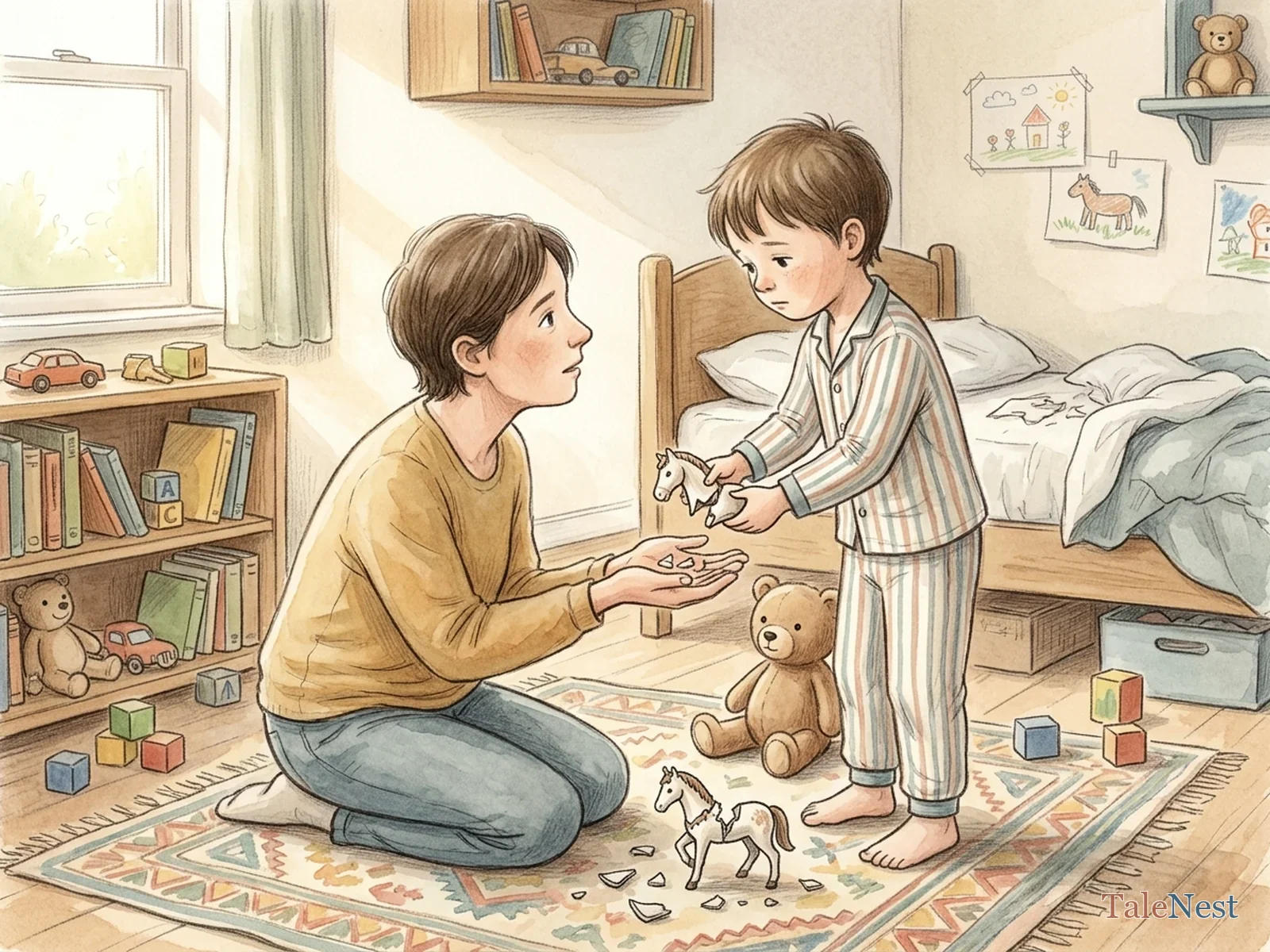
Honesty at home is usually about small things: who finished the biscuit, whether the homework was done, what happened to a toy. These moments are not dramatic, but they are where the habit forms. A story about a real consequence gives you a neutral reference point to return to later. You can mention the character weeks after reading without turning the moment into a trial. Keeping the tone light matters. Children tell the truth more readily when the atmosphere around a mistake is calm. The story has already done the heavy work of showing that actions have effects; your role is to keep that idea present without making it a threat.
Modelling an apology
Children learn the shape of an apology by hearing one. When an adult says, plainly and without performance, that they were wrong and will do something differently, it gives the child a model no story can match. It also shows that apologising is not a loss of status. A fiction character's repair can open the conversation, but a real apology at the kitchen table makes it concrete. Keep it short and specific. Name what was done, name the effect, and say what will change. Children notice the difference between a formula and a genuine acknowledgement, and they are more likely to repeat the second.
Common questions
Are scary consequences too much?
It depends on the child and the story. A consequence that is sad or uncomfortable is often fine; one that is frightening in a way the tale cannot contain is another matter. Watch how your child responds rather than relying on the age on the cover. If the mood after reading settles back to normal within a few minutes, the story has probably done its job. If fear lingers, choose a gentler version next time.
Should we change a harsh ending?
It is reasonable to soften wording without changing meaning. You can describe a loss in calm language while keeping the fact of it. What to avoid is rewriting the ending so that nothing cost anything, because that removes the reason for the story. If the original ending feels too sharp, set that book aside and find another tale that carries the same truth in a gentler way.