Reading Aloud to a Baby: What Actually Helps in the First Year
Reading to a baby looks nothing like reading to an older child. The book may spend more time near the mouth than in your hands, and the story rarely reaches the last page.
This article offers general information for families. It is not medical, psychological or developmental advice; ask a qualified professional about your own child.
Reading to a baby looks nothing like reading to an older child. The book may spend more time near the mouth than in your hands, and the story rarely reaches the last page. Parents often wonder whether any of it counts. It does, but not for the reasons advertised on the back of the box. In the first year the reading is mostly about presence, rhythm and repetition, with the words playing a smaller part than adults expect. This guide keeps the advice practical: what a baby can follow, a routine you can actually maintain, and what to do when the sitting goes badly.
What babies can follow
Voice before vocabulary
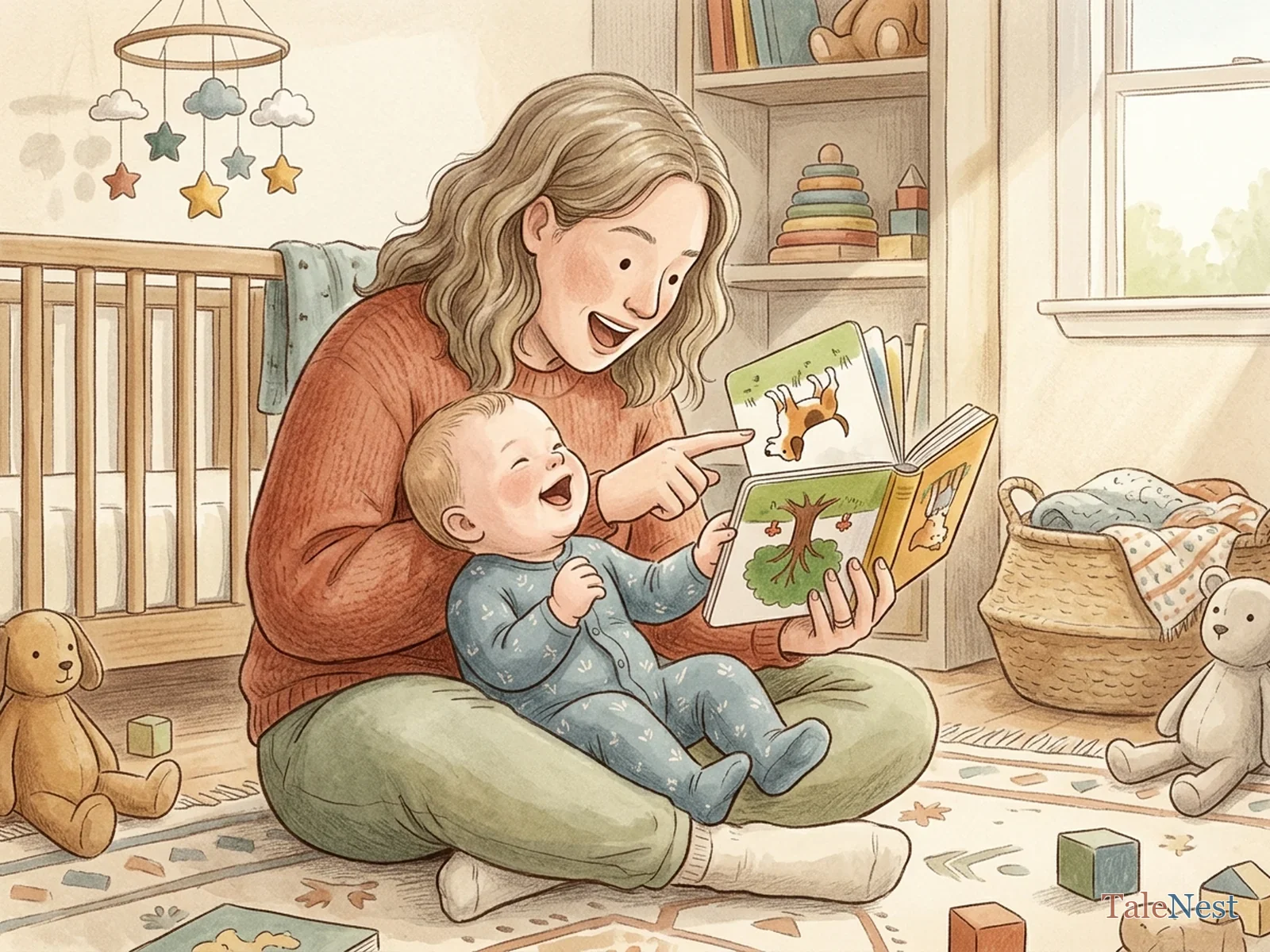
A baby responds to the sound of a familiar voice long before the words mean anything. The rise and fall of speech, the pauses, the change in tone when something surprising happens: these are what hold attention in the first months. That is why a plain book read with warmth can work better than a clever one read flatly. You are not performing a story so much as offering your voice in a steady, pleasant shape. It helps to read slowly and to let yourself sound interested in the pictures, even when the text is only a few words. The words will come in time. For now, the voice is the part doing the work.
Short attention, repeated often
A young baby's attention comes in brief stretches, and that is ordinary. One or two minutes may be all you get before the baby turns away, arches, or wants to eat. Treat that as the length of a reading rather than a failure to reach the end. Frequent short sittings suit this age better than occasional long ones. A page looked at together, a voice heard for a moment, then a stop: that is a complete reading for now. Parents who expect a whole book often give up too early. Parents who accept two minutes usually find the habit survives the month, which is the thing worth protecting.
A ten-minute routine
Same time, same place
A routine does not need to be elaborate. Choose one point in the day that already happens without negotiation, such as after a feed or before the change into sleep clothes, and attach the reading to it. Use the same spot whenever you can: a chair, a corner of the sofa, the edge of the cot. The repetition of time and place becomes part of the signal, so the baby starts to recognise what is coming. This is not about discipline. It is about making the reading easy to remember and easy to repeat on tired days, when deciding whether to read is the hardest part.
One book, read twice
Keep the choice small. Pick one book for the week and read it again and again, even when you are bored of it. Repetition suits this age, and a familiar book is easier to follow than a new one every night. Read it once straight through, then go back to the pages your baby lingers on. There is no rule against skipping the text and talking about the picture instead. If the same book is requested for the tenth evening, that is a good sign. Use the second reading to slow down, point, and let your baby reach for the page.
Choosing the first books
High contrast and few words
Early books work best when the pictures are clear and the page is not crowded. Bold shapes, strong light and dark differences, and one idea per page are easier to look at than a busy scene with small details. A line or two of text is plenty. The point is not to fill the page with language but to give you something to say while your baby looks. Books with a single clear image and a short phrase give you room to repeat, to pause, and to follow the baby's gaze. Simple here is not a compromise; it is the right size for the listener.
Books that survive being mouthed
Babies explore with their mouths, and a first book should expect that. Board books are the obvious choice because they tolerate chewing, sticky hands and being dropped from a height. Cloth and soft books work too, though the pictures are often less distinct. Keep a couple of sturdy books in regular rotation and save the delicate ones for later. Washable matters more than beautiful at this stage. A book you are relaxed about letting your baby handle will be picked up far more often than one you have to guard, and that willingness is worth more than the finish on the pages.
When it does not go well
Fussing is not failure
Some sessions end in tears or squirming, and no adjustment on your part will save them. A baby may be tired, hungry, overstimulated or simply uninterested in the book you chose. None of this reflects on you or on the habit you are building. The useful response is to stop without making it a moment: close the book, set it down, and move on to the next part of the day. Avoid turning the reading into a test of endurance. A baby who learns that the book ends when they are distressed is more likely to approach it calmly next time.
Stopping before the last page
Finishing is not the goal. If your baby loses interest on page three, stop on page three. Ending while the child is still engaged leaves the book associated with a pleasant moment; pushing to the end often leaves it associated with being held too long. You can always begin again from the start the next time, and for this age that is normal. Think of the last page as optional. A reading that ends early and often is more sustainable than one that finishes once and then gets avoided for a week.
Common questions
How early is too early?
There is no useful starting age to aim for. Reading in the first weeks is less about the book than about the sound of your voice and the closeness of the holding. If you enjoy it, begin whenever the days are settled enough to fit it in. If the first months are chaotic, start later. Nothing is lost by waiting until the routine feels possible. The habit is built on repetition you can keep, not on how soon you begin.
Do board books count?
Yes. A board book with one word and a clear picture is a real book, and reading it counts as reading. The thick pages and small text are there because they suit the listener, not because the content is lesser. Use them without apology, and let your baby turn the pages even if the order goes wrong. At this age the interaction around the book matters more than the exact words printed inside it.