How to Retell a Traditional Tale Without Losing Its Roots
A traditional tale arrives with no owner's manual. It has been shaped by many tellers, and none of them left a definitive copy.
This article offers general information for families. It is not medical, psychological or developmental advice; ask a qualified professional about your own child.
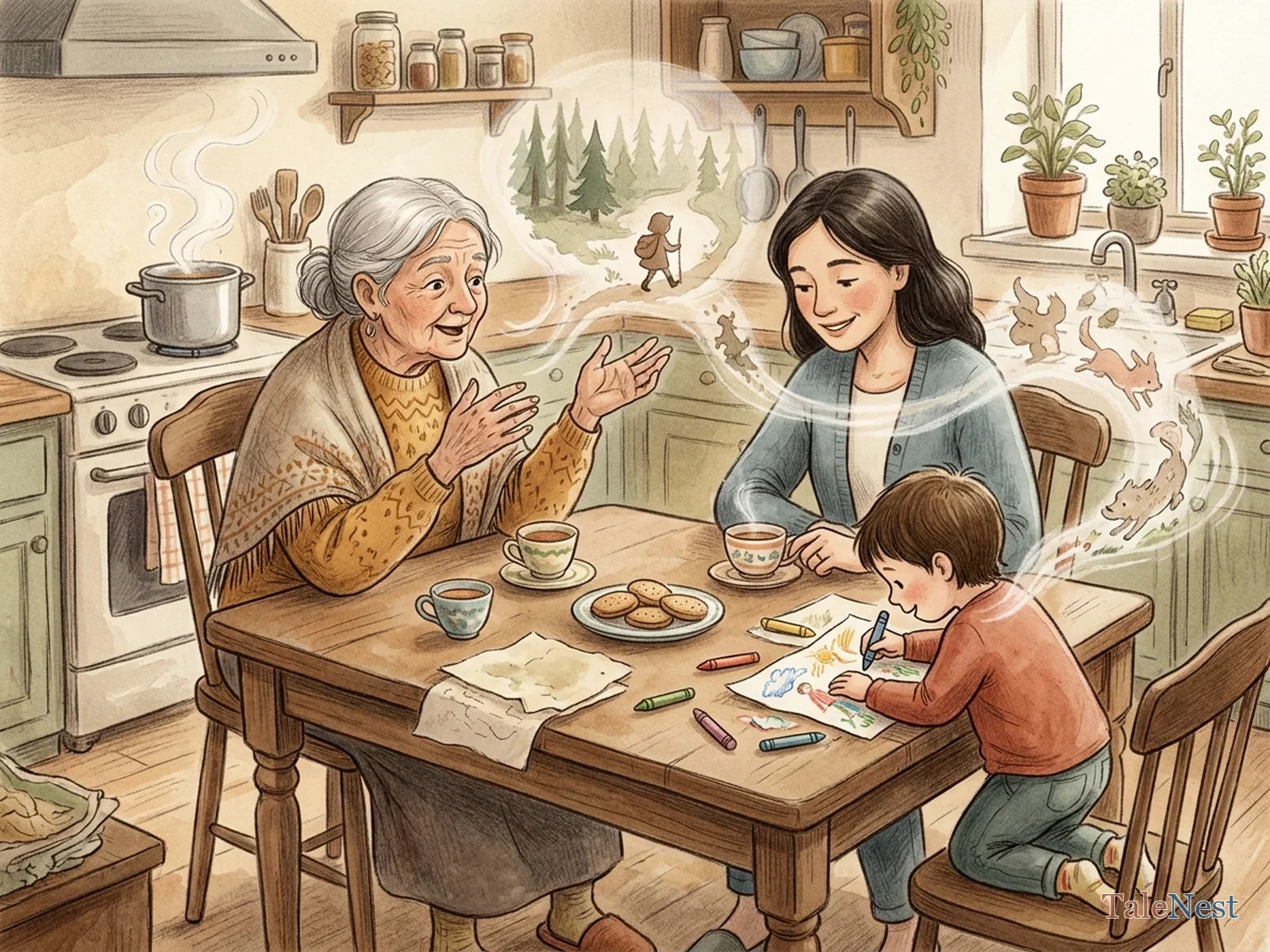
A traditional tale arrives with no owner's manual. It has been shaped by many tellers, and none of them left a definitive copy. That freedom is inviting: you can shorten it, smooth it, make it speak to the child in front of you. The same freedom makes it easy to damage. Retelling well is less about adding flourishes than about knowing which parts of the story are load-bearing. This guide sets out what to hold onto, what you may reasonably change, and where the line sits. It is meant for parents and teachers working from a book or a family story, not for anyone claiming to replace the original.
What to keep
The spine of the plot
Every tale has a spine: the small number of events that, if removed, leave you with a different story. Before you change a word, work out what those events are. In a story about a child who wins a contest through cleverness rather than strength, the contest and the clever solution are the spine. The number of siblings, the colour of the coat and the name of the village may all be flexible. A reliable test is to imagine telling the tale to someone who has never heard it. If they cannot retell the same sequence afterwards, you have cut too much. Keep the spine straight and the rest can bend.
The reason the tale was told
Stories were not kept for their plots alone. Each one carried a reason: a warning, a joke, a way of explaining something, a model of behaviour worth copying or avoiding. That purpose is part of the roots you are trying to preserve. If a tale existed to show that the smallest character can be the sharpest, and your version ends up simply praising obedience, you have kept the events but lost the point. Ask what the story was doing for the people who told it, then make sure your retelling still does that work. The reason may be serious or playful; either way it deserves to survive the rewrite.
What you may change
Language and pacing for today's reader
The words on the page are yours to choose. Older tellings often include phrases that no one says now, long descriptions that slow a read-aloud, and dialogue that sounds stiff to a modern ear. Replacing these is fair ground. You can shorten a paragraph, break a long speech into shorter turns, and pick words you are comfortable saying aloud. The measure is whether the changed passage still does the same job in the story. If a description existed to make a forest feel threatening, your new version should still make it feel threatening. Change the pace and the vocabulary, but keep the effect intact.
Reducing frightening detail
Some tales are darker than the children hearing them. You may soften a scene without pretending it never happened. Cut the graphic description, keep the danger. A child can understand that a character was in trouble without a detailed account of what the trouble involved. This is a matter of degree, not a rule: the right amount depends on the child sitting with you. Trust your sense of what this particular listener can hold. If you do trim a frightening moment, check afterwards that the plot still makes sense, since fear often drives a character to the next decision.
What you should not change
The source and the credit
A retelling that hides its source is a smaller thing than one that names it. Even when a tale belongs to no single author, it came from somewhere, and that place deserves to be acknowledged. Keep the credit line in your version, or add one if it is missing. Say which collection, region or community you worked from. This is not a courtesy reserved for formal publication; it matters in a homemade booklet or a classroom reading too. For a child, seeing the credit teaches that a story has a life before this copy of it. Losing that line is one of the easiest roots to cut by accident.
The cultural setting
The setting carries meaning. A story rooted in a cold northern village, a dry plain or a particular coastline draws on that landscape for its details and its logic. Moving it to a generic modern town strips away context and can turn a specific tradition into something bland. You can explain unfamiliar details, but keep the world the tale came from intact. If a custom seems strange, let it be strange on the page and address it in a sentence of your own rather than rewriting it away. Preserving the setting is a way of respecting the people who shaped the story, and it keeps the retelling honest.
A working method
Read two versions first
Before writing anything, read at least two tellings of the same tale. Two is the minimum that reveals what is fixed and what is flexible. The differences between them show you which events every teller keeps and which details are open to choice. Take a short note on the spine, the purpose and the setting as you go. This step is quick and saves a great deal of second-guessing later, because you will know what you are working with instead of guessing from a single remembered copy.
Write, then check the credit line
Draft your version first, without stopping to perfect each sentence. When the retelling is down, go back and check the practical details: the source named, the setting preserved, the frightening moments judged, the spine unbroken. This second pass is where a good retelling is made. Read the result aloud once, since a story meant to be heard will reveal awkward phrasing on the tongue. If a passage stumbles, fix the wording rather than the structure. Finish by confirming that the credit line is present and accurate, so the finished piece stands on its own.
Common questions
Can I merge two tales?
You can, but do it deliberately. Merging works when the two tales share a spine and a purpose, so the result still reads as one story with one reason for being. If you combine two tales with different points, the result often feels uneasy and may lose what made each worth telling. Name both sources in the credit line, and check that the cultural setting remains coherent. A merger that borrows freely from unrelated traditions is weaker than one careful retelling.
Do I need permission?
For a tale in the public domain or one told orally within a tradition, you do not need permission to retell it. The obligation is to acknowledge the source, not to ask leave. A modern book or a recent illustrated edition is different: its specific wording and pictures are protected. Work from the older tale rather than copying a contemporary author's phrasing, and credit the version you actually consulted. If in doubt about a particular text, check the book's front matter.