What Makes a Story “Original”? How We Write New Tales for TaleNest
Parents ask this more often than you might expect, usually after a child brings home a story that sounds familiar. If every tale is built from older tales, what does it mean to write a new one?
This article offers general information for families. It is not medical, psychological or developmental advice; ask a qualified professional about your own child.
Parents ask this more often than you might expect, usually after a child brings home a story that sounds familiar. If every tale is built from older tales, what does it mean to write a new one? The question is reasonable, and the answer is less mysterious than it sounds. Stories have always borrowed from other stories, and children's literature is no exception. What matters is how a writer handles that inheritance: whether the words are their own, whether the source is named, and whether the tale is treated with care. This is the standard we hold ourselves to here, and it is worth setting out plainly.
Three kinds of stories on this site
New fiction written here
Some tales are invented from scratch. A writer begins with a character, a place or a problem, and builds a story that has no older version behind it. These are the pieces we can call original in the fullest sense: the plot, the language and the illustrations all begin in our own work. That does not make them better than a retelling, only different in origin. A new story still draws on the shapes that readers know, because a completely unfamiliar story is hard for a child to enter. The difference is simply that there is no earlier text to acknowledge, so the page belongs wholly to the writer who made it.
Retellings, with the source on the page
Other pieces begin with a story that already exists. A folktale, a classic fairy tale or a legend collected somewhere else can be retold in fresh language for a new reader. We do this openly, and we say where the story came from on the page itself. A retelling is not a copy, but it is also not a claim of invention. The plot may follow the older version closely while every sentence is newly written. The point is that the reader should never have to guess whether a familiar tale has been rewritten. When we retell, we name the tradition or the book that came before, and we let the new words stand on their own.
From a first line to a full tale
Where ideas come from
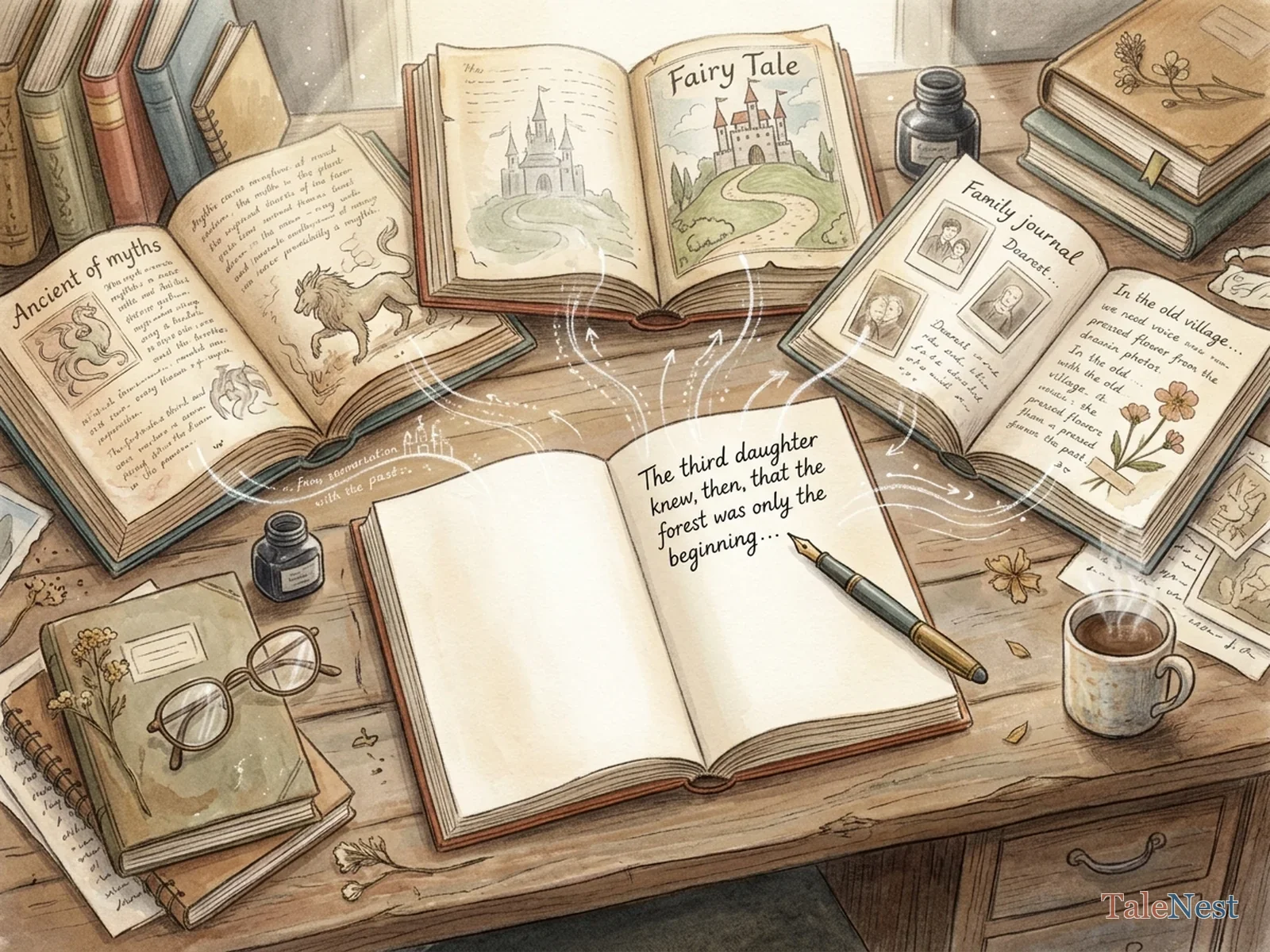
Ideas arrive from many places: a phrase overheard on a walk, an old tale, a child's question about the moon. Very few stories begin with a complete plan. More often there is a single image or a voice that will not leave, and the rest is found by following it. We keep notebooks of these fragments: a setting, a name, a bit of dialogue, a shape of a problem. When we sit down to write, we choose one and test it against a simple question. Is there a story here that a child can follow, with someone to care about and something at stake? If the answer is no, the fragment goes back in the notebook.
Keeping the middle honest
The hardest part of any story is the middle, the stretch between a promising opening and a clear ending. This is where a retelling can drift into decoration and a new tale can lose its shape. We keep the middle honest by returning to the character's problem. What do they want, what stands in the way, and what do they do about it? If a scene does not answer one of those questions, it usually goes. For retellings, there is a second check: are we still faithful to the turn of the original plot, or have we quietly replaced it with something easier? We would rather keep a difficult middle than smooth it into a lesson.
How credit works
What the reader sees on the page
Every retelling on this site carries a short note about its source. It sits with the story rather than being buried elsewhere, because a parent reading aloud should be able to see it at a glance. The note says, in ordinary words, that the tale comes from a particular tradition or book and that the wording here is new. We avoid vague labels like “an old tale” when something more precise is known. If a story comes from a specific collection or a named storyteller, we say so. This is a courtesy to the reader and a matter of basic honesty about where the work came from.
Why we link back to the source
Where an original text or collection is available, we point the reader toward it. A link is more than a formality; it lets a family read another version and see for themselves what changed. A child who hears two tellings of the same tale learns that stories are shaped by the people who pass them on, which is a quiet and lasting lesson. We are not presenting an old story as a new discovery or hiding its origins behind fresh illustrations. If a source cannot be linked because it is held by a publisher or lives only in an oral tradition, we name it as clearly as we can instead.
What “original prose” does and does not mean
New wording, new rhythm
When we say a piece has original prose, we mean that the sentences are written here. The cadence, the word choices, the order in which details appear: these belong to the writer of this version, not to the person who first told the tale. This is the part of originality we can honestly claim, and we are careful not to claim more. Fresh wording takes real work. It means reading the source, setting it aside, and then writing a version that reads naturally to a child today rather than copying the phrasing of an older translation.
No claim of owning a tradition
A story that comes from a community does not become ours because we retold it. We make no claim to own a folktale, a legend or the way a culture tells it. Traditions belong to the people who carry them, and a retelling is a visitor in that house. That is why our notes name the tradition and why we keep the setting honest when the setting carries meaning. We also avoid presenting a retelling as if it were the definitive version. There is rarely one definitive version of a tale that has travelled.
Common questions
Can I reuse a story for my class?
If you are reading a published piece aloud to your own class, that is what the story is for. If you want to copy the text into handouts, a display or a school anthology, ask first, because the wording and illustrations belong to specific people. The underlying folktale is another matter and can generally be retold freely, but our version of it is our work. If you are unsure, write to us and describe what you plan to do.
How do I report a missing credit?
If you find a piece here whose source is not named, or named incorrectly, tell us. Include the title and what you believe the source to be, along with any detail that helps us check. We will look at the page, confirm the origin and correct the note. If you are a storyteller or a member of a community whose tale appears here, your word on its origin carries weight, and we will treat it with respect.