
Europe in Eight Days
A thousand years from now, young Americans fly on wings of steam to tour the old continent, racing through its monuments and ruins in a single whirlwind week.
 Retold by Idalia SantosAges 10+5 min read909 words
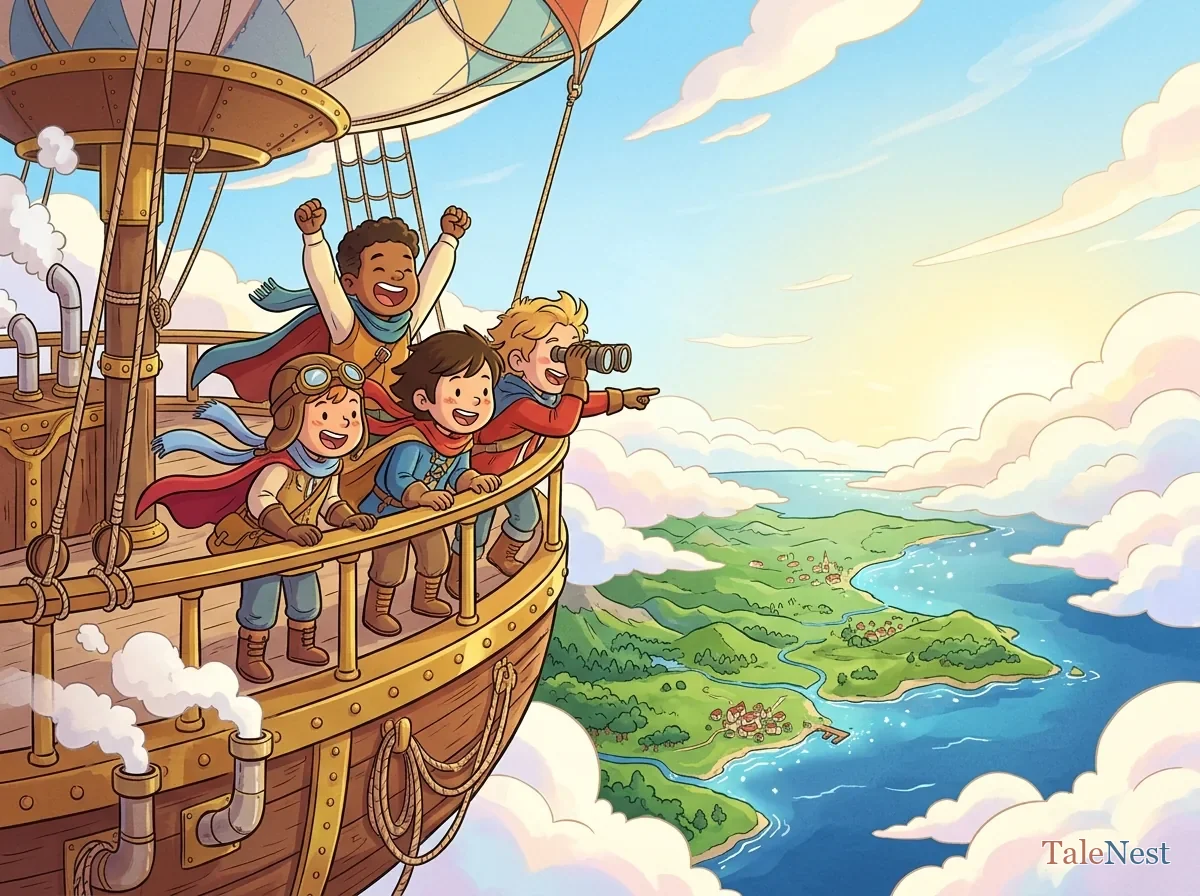
This is a work of fiction, retold in original language for TaleNest. Names, places and events are part of the story.
A thousand years from now, people will cross the ocean without a ship, riding through the open sky on wings of steam. The bold young pioneers of America, grandchildren of those who once sailed west into the unknown, will come back to visit the old continent, to walk among its monuments and gaze upon its crumbling, drowsy cities. A thousand years from now, they will come. Twice the world will have turned itself upside down before they do.
The Thames will still wind through the old capital; the Danube will keep its slow green course; the Rhine will carry its patient barges past vineyards and castles. Mont Blanc will lift its snowy crown above the clouds, and the northern lights will spill their pale fire across the frozen skies of the far north. These things will remain. But the men who built the cities will have crumbled into dust, generation after generation of them, layer upon layer. Whole dynasties of brief importance will have sunk into forgetting, just like the lords who sleep beneath that grassy mound yonder: the rich miller who had himself carried to its summit and a bench set there, so that he could sit for hours and watch his wheat rolling in golden waves at his feet. His name is gone. His mound is still here.
Where are the men who raised those cities? They are vanished as utterly as the foam on last winter's wave. Their palaces have become quarries; their proudest names are now only syllables in a schoolroom lesson. Even the mightiest empire is no more than a brief summer's day in the long memory of the earth. The rivers do not care. They flow on, indifferent as time itself, bearing the reflections of a thousand vanished worlds.
“To Europe!” the young Americans will cry to one another, leaning over the rail of the great machine. “To the land of our forefathers!”
The airship comes down at last in Ireland, crowded with passengers wrapped in cloaks and bubbling with talk. Already the cable lying silent on the ocean floor has flashed word ashore about every soul aboard the flying caravan. Europe rises into view beneath them, green and small and strangely familiar, though the travelers still sleep on, worn out by the crossing. By and by they will stir, and stretch, and set foot on the old soil at last, on the soil of Shakespeare, on the soil of statesmen and of clanking machines. One short day they will give to this island, and then away to Great Britain and to Scotland.
“Cherish the culture and achievements you inherit, for every generation's grandeur is brief while the rivers of time run on.”The little lesson
No one on board yet suspects that their coming has already been announced. Under the cold water the great cable has carried the news from shore to shore faster than any gull could fly, and in the harbors of Europe clocks have been set and rooms made ready for a visit that, to the sleepers above the clouds, is still only a dream.
On goes the journey, through the tunnel bored beneath the Channel and into France, the land of Charlemagne and of Napoleon, where the name of Molière is still spoken with a smile. The airship sails above the country that Columbus sailed from, above the birthplace of Cortez, above the very ground where Calderon once sang his plays in ringing, harmonious verse.
Then Italy opens beneath them, the seat of old Rome, eternal and imperious, with its broken arches and its dust of emperors, and after Italy, Greece, where the sea still holds the color of old wine. The caravan follows the Bosphorus, where poor fishermen in tiny boats cast their nets over the same water where, men say, the gardens of the harem once bloomed in the days of the Turks.
Still the flight goes on, passing over the scattered ruins of mighty cities that once stood on the banks of the broad Danube, proud cities our own age has never even heard of, now reduced to a few stones in a field. Here and there the airship settles for a breathing space, and travelers step down to stretch their legs; but soon it lifts again, eager to be gone.

Away in the distance lies Germany, the land where Luther thundered against the old order, where Goethe sang, where Mozart held the scepter of music in his hands. A day is spent in Germany, and another day is given to the North, to the homeland of Orsted and of Linnaeus, who counted and named the living world, and to Norway, the country of the ancient heroes and of those ever-young men of the winter midnight. Iceland, too, is written into the route, on the way back.
So it is that the travelers race across a continent that once took a lifetime to cross. They touch Ireland, England, Scotland, France, the lands of Columbus and Calderon, Italy, Greece, the cities of the Danube, Germany, and the far North; and everywhere the same eager question rises: what is left to see? They have come so far only to discover, at the end of their eight days, that the whole of history can be folded into one hurried glance.
And at the end of it all, the youngest of the voyagers will stretch his arms above his head and say, “There is a great deal to see in Europe, and we have seen the whole of it in eight days.”


