
From a Window in Vartou
An old woman watches barefoot children on Copenhagen's rampart and sees, in their play, the bright brief story of her own youth.
 Retold by Idalia SantosAges 12+5 min read778 words
This is a work of fiction, retold in original language for TaleNest. Names, places and events are part of the story.
Just outside Copenhagen, where the green rampart runs its long circuit round the city, there stands a great red house with many windows. Flowers climb and bloom in those windows, and fine trees with leaves the colour of amber lean their branches against the glass, catching the afternoon light. Yet the house itself is shabby and sun-faded, its paint peeling, and within its walls live poor old people, creeping gently toward the end of their days. This place is called Vartou.
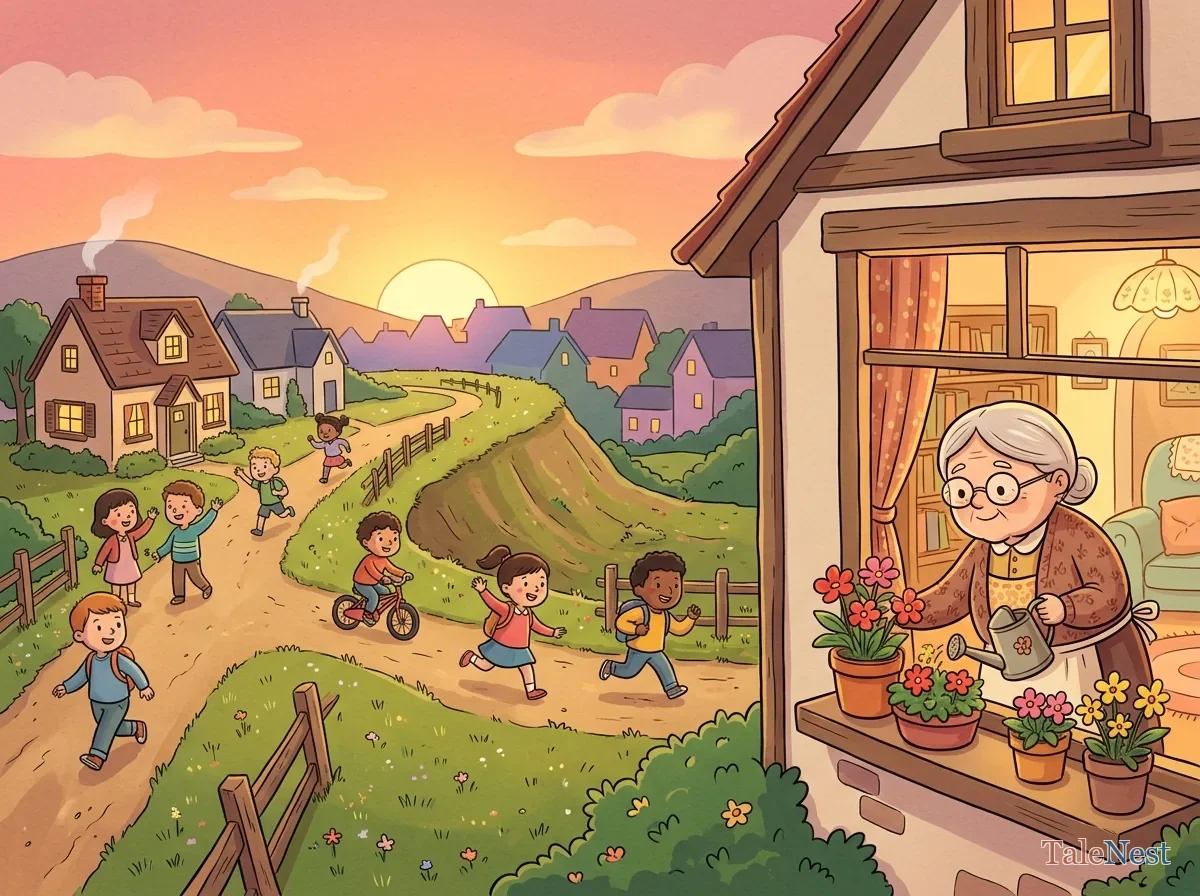
On the ledge of one of the windows an elderly spinster rests her arms. She passes the time plucking the dead leaves from the flowers and watching the children who run and dance along the rampart. She has watched them for years, these barefoot little ones, and as she watches she thinks of a drama played out in her own life, a long and quiet tragedy that no one else ever knew, and that she has carried about with her ever since like a secret pressed between the pages of a book. The flowers on her sill are her only companions now, and she tends them with a care she once gave to finer things.
The children are very happy. They dance and shout and skip, and they wear neither shoes nor stockings. A legend says that not many years ago the ground in this place kept caving in, until one day an innocent child fell, together with its flowers and its toys, into a hole that opened where the rampart now stands. The hole was soon covered over with grass, and the little one was forgotten. But the children playing here know nothing of the legend. Nor do they know of the King of Denmark who planted himself on this spot to face the invader, and swore that he would stand firm to the last alongside the people of his city. They know nothing of the men who fought and fell here in the smoke, nor of the women who poured boiling water down upon the enemy as they climbed the outer face of the wall.
“Cherish the simple joys of the present, for youth is brief and the heart, unlike the trees, does not always grow green again.”The little lesson
The poor little ones simply go on playing, as though the world had never known a sorrow, as though the grass had never grown over a grave and the old stones had never run with blood. Their bare feet flash over the turf, and their laughter rises as light and careless as the sparrows above them. She could join them once; now she can only watch the dance go on without her, and wonder how quickly a life can turn.
“Play on, play on, little girl,” the old woman thinks. “The years will pass quickly enough. Soon you will walk hand in hand with the other young people up to the green rampart for your confirmation. You will wear a beautiful white dress, fine as any in the city. They will give you a red handkerchief, and it will hang down so far, far too far; but that is how everyone will see how big it is. You will think of your fine clothes and of God. How beautiful it will be to walk upon the rampart with the whole world looking on!”
“And the years go by, dark days, and bright days of youth. And you will find a friend, and when spring draws near you will walk together on the rampart while all the bells of the city toll, calling the people to penitence and prayer. The violets will not be out yet, but in front of the old, beautiful palace of Rosenborg a tree will show its first green buds, and you will stop and stand there together. Every year that tree puts forth new green branches. But the human heart does not do so; dark clouds pass over it and leave their shadow. Poor girl! The bridal chamber of your sweetheart will be a coffin, and you will be left an old maid. From Vartou you will look out through the flowers at the children at their play, and you will understand that your own story is being lived over again, word for word.”
And this is the drama of life that unrolls before the old woman as she sits at her window. She looks out at the rampart where the sun is shining, and at the children without shoes or stockings, who play and rejoice as freely as the birds of heaven, while she, who once ran among them, can only watch and remember. The sun moves slowly down the wall, the children scatter homeward through the dusk, and the old woman turns back at last to her withered flowers.
Cherish the simple joys of the present, for youth is brief and the heart, unlike the trees, does not always grow green again.


