
The Secret Life of Lorena's Silkworms
A responsible little girl adopts a box of silkworms and, day by day, discovers the astonishing journey from tiny egg to spinning chrysalis to delicate moth.
 Retold by Idalia SantosAges 3+5 min read793 words
Retold and rewritten by Idalia Santos for TaleNest. This version is original prose in English; the illustrations and accompanying text were created for this site.

This is a work of fiction, retold in original language for TaleNest. Names, places and events are part of the story.
Nearly every boy and girl at Lorena's school kept silkworms, and she was eager to have some of her own. Because she was careful and dependable, her parents agreed and went with her to a neighbour who was giving the creatures away. They knew she would look after them properly and treat them with respect, and that set their minds at ease. They were sure as well that her new charges would teach her a great deal about the living world, more than any lesson book could.
The first thing Lorena learned was that before we can enjoy the elegance of the moth, for a silkworm becomes a small pale moth, we must first pass through the lowly worm stage and watch it closely. Beauty, she discovered, does not appear all at once; it has to be earned, patiently, by careful hands. She was determined to get it right.
“It is an arthropod, originally from Asia,” her father explained, kneeling beside the box and smiling at her eagerness.
He told her that, like other caterpillars, a silkworm's life unfolds in four stages: egg, larva, chrysalis, and moth. Through the heat of summer, the chill of autumn, and the quiet of winter, the eggs lie dormant, as though waiting for a signal. Her father promised to help her every step of the way.
“We must wait for spring to see the larvae hatch,” said her father. “That is when the tree whose leaves they feed on wakes from its sleep, the mulberry.” Lorena listened with the closest attention, picturing the tiny creatures stirring in the warmth.
She learned that it mattered greatly to keep the worms in a box set away from the direct sun and from creatures that might devour them, such as birds or ants. A friend at school had foolishly left his worms on a sunny windowsill and had lost every one of them. In their worm stage the silkworms spend about six weeks, munching mulberry leaves, and as larvae they shed their skins five times. Each morning Lorena checked the box before she even washed her face.
“Caring patiently for living things teaches us respect for nature, and the quiet rewards of responsibility are as lovely as a newly opened moth.”The little lesson
“Why do they shed their skins?” Lorena asked, quite intrigued.
“Because they keep growing,” her father replied. “They start at a mere three millimetres and end up seven or eight centimetres long when they are fully grown. A skin that fits a tiny worm will not fit a big one.”
To plump them up, Lorena replaced the dry leaves with fresh ones every day. At first the worms were tiny and ate very little, but soon they were crunching steadily through the green leaves. She kept the box in a quiet corner, away from the noisy kitchen. She also worked hard to keep it clean, so that no mould or bacteria could appear. Sure enough, her silkworms ate without stopping until, all at once, they went quite still and became what are called sleeping worms.
“At the end of their growing life they begin spinning a silk cocoon over three or four days,” Lorena read aloud from a book she had bought to learn how to care for them. “They do it by producing a silk thread and winding it round and round themselves until they have made what we call a chrysalis.” She marvelled that something so small could weave such a neat little house.
“Inside the cocoon is where metamorphosis happens, the change into a moth. After two or three weeks, the moth breaks out and emerges.” Lorena thought of the quiet weeks inside that tiny silk room, and could hardly believe the transformation taking place there. Every day she peeped in, wondering whether anything had changed.
She felt rather sad to learn that once the moths emerged they lived only eight to twelve days. But the comfort was that during that short span a female could lay as many as three hundred eggs, so the story would begin again.
She read the final chapter of her book, which explained that the silk the larvae make before completing their transformation is a natural fibre composed mainly of proteins, a thread spun by a living creature.
“The silk produced by the caterpillars of the moth Bombyx mori is what is used to weave fabric,” her father told her. “That soft shirt of Mother's you like so much is made from it.” Lorena stroked the shirt later and thought of the little worms that had helped to make it.
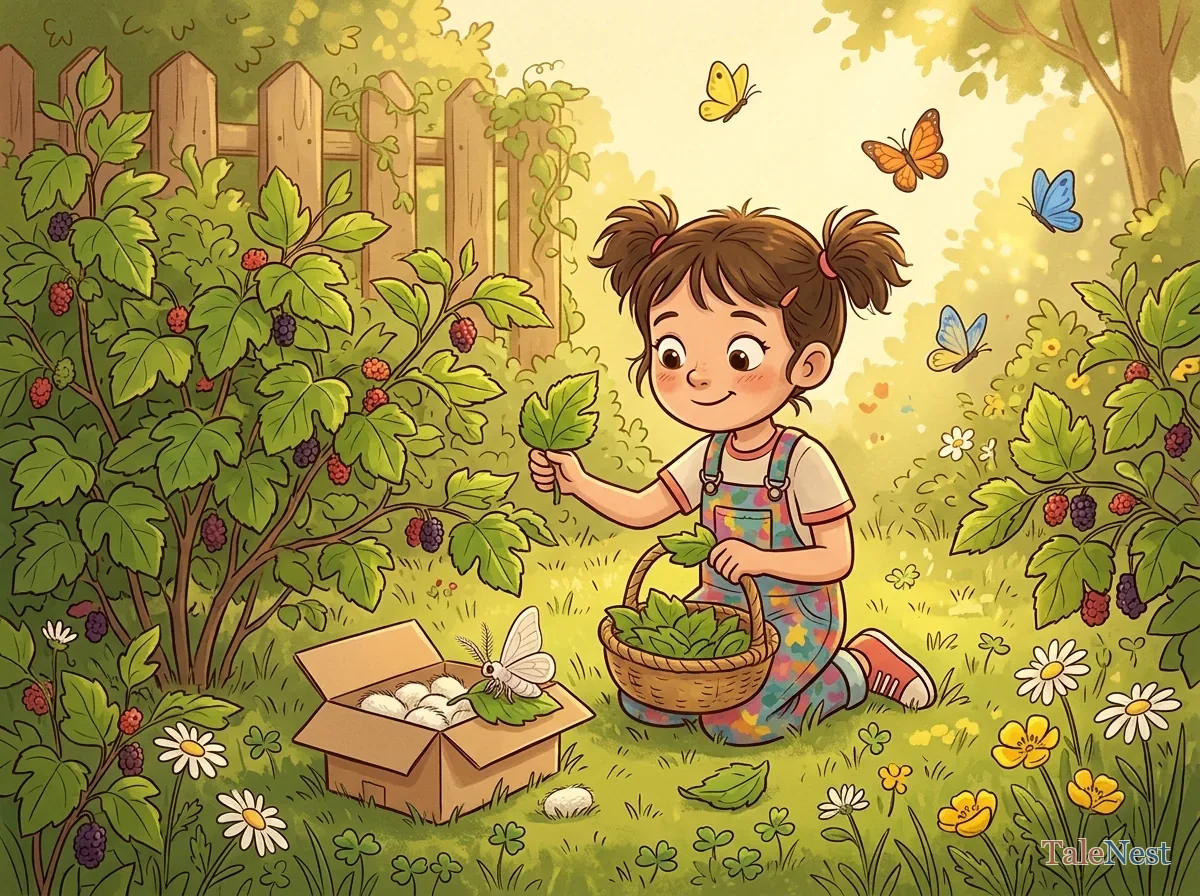
Delighted with everything she had learned, Lorena took a basket and went out into the garden to pick fresh mulberry leaves for her hungry worms, already looking forward to the day when a pale moth would spread its wings. The garden was alive with birdsong as she worked.
Caring patiently for living things teaches us respect for nature, and the quiet rewards of responsibility are as lovely as a newly opened moth.


