
The Case of the Bottled Rainbows
The colour drains from a whole village overnight, and two young detectives track a trail of bright droplets to a frightened newcomer who must find courage to tell the truth.
 Retold by Idalia SantosAges 6+7 min read786 words
Retold and rewritten by Idalia Santos for TaleNest. This version is original prose in English; the illustrations and accompanying text were created for this site.

This is a work of fiction, retold in original language for TaleNest. Names, places and events are part of the story.
Every year the village of Villacolor held the Festival of Colours, and it was the day everyone waited for. Months beforehand the streets were scrubbed and garlands were strung from every balcony. Don Aurelio prepared his famous jars of bottled rainbow: inside each one shone a colour from the sky, red, orange, yellow, green, blue, indigo, violet, and every jar smelled of a different fruit, from strawberry to pear.
Lía could hardly sleep for excitement. Tomorrow was the great day.
But when morning came, something was wrong. Lía looked out of her window and blinked. Everything was grey. The flowers, the houses, the very sky. Even her favourite dress had lost its colour.
‘Tomás!’ she called to her friend in the street. ‘Do you see what I see?’
Tomás came out, his eyes wide. ‘Everything is grey. Like an old photograph.’
They ran to the plaza. Even the flags hanging between the houses had faded to the shade of old newspaper. Don Aurelio sat beside his empty cart, his face heavy with sadness. ‘The jars are gone,’ he said quietly. ‘And with them, all the colour of the village.’
Lía clenched her fists. Someone had taken those jars, and she was going to find them. She had once solved the mystery of a missing kitten simply by noticing its paw prints, and she felt that same sharp certainty now. ‘Come on, Tomás. We have a case.’
She crouched beside the cart. On the ground lay a few tiny drops of yellow.
‘Look! Colour drops.’
Tomás leaned closer and wrinkled his nose. ‘They smell of lemon.’
“The truth can feel frightening, but the courage to speak it turns a misunderstanding into belonging.”The little lesson
The drops made a trail, yellow first, then green, then blue, each one no bigger than a pea but shining like a tiny jewel. Lía and Tomás followed it down the street, past the dry fountain, past the silent bakery, past the bare park, their eyes fixed on the ground so as not to lose a single spot.
‘They lead to the old shed,’ said Lía.
The shed stood at the end of the lane, its door ajar and its wooden boards grey with age. Lía pushed it open gently, half expecting a shout. Inside, the rainbow jars glowed on the dusty floor, ringed by little puddles of colour that threw bright reflections onto the walls.
And beside them crouched Noa, the new girl in the village. Her hands were stained with every hue and her eyes were full of fear.
‘You stole them!’ Tomás cried.
Noa stepped back. ‘No! I did not —’ Her voice trembled.
Lía looked at Noa, then at the jars. Several lids were loose. A trail of drops ran from the door to the spot where the jars had been set carefully against the wall.
‘Wait, Tomás,’ Lía said. ‘If she had stolen them, she would have hidden them. She lined them up instead.’
Noa wiped away a tear. ‘Last night I heard a noise. I looked out and saw Don Aurelio’s cart tipped over. The jars were rolling across the ground. I ran out to gather them before they broke, and I brought them here because I did not know where else to take them.’
‘Then why did you not tell anyone?’ asked Lía.
Noa lowered her eyes. ‘Because I am new. I thought nobody would believe me.’
The shed fell silent. Lía laid a hand on her shoulder. ‘I believe you. But you have to tell them yourself. Everyone.’
Noa swallowed hard, then nodded.
Together they carried the jars to the plaza, where the whole village was waiting. Noa stepped forward, her knees shaking. ‘I gathered the jars,’ she said. ‘They fell off the cart. I only wanted to save them. But I was afraid to speak up.’
Don Aurelio studied her for a long moment, then smiled. ‘Thank you, little one. You kept them from breaking.’
But there was still a problem. A few jars had come open and their colours were escaping. The three children worked together to seal them: Noa held each jar steady, Tomás fitted the lid, and Lía pressed it tight.
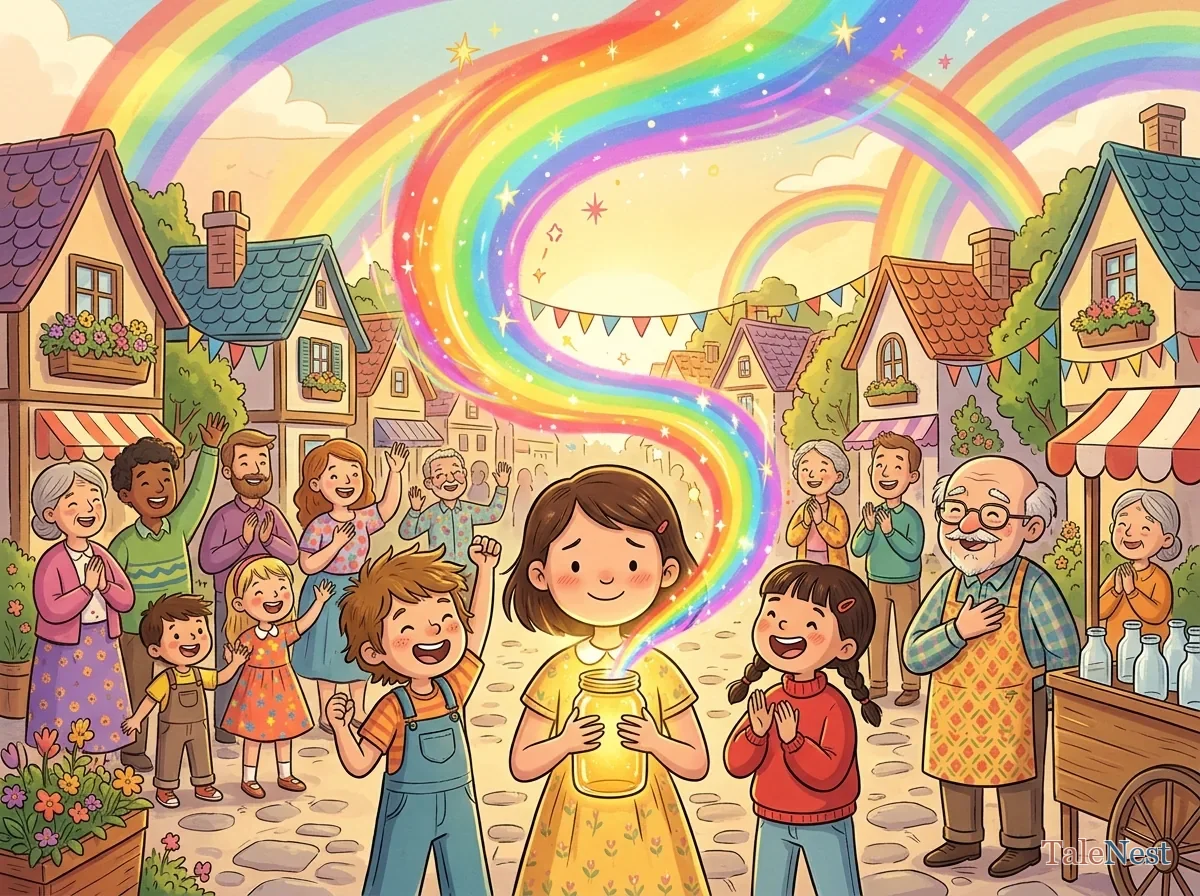
Slowly the colour returned, creeping across the world like the first light of dawn. First to the sky, then to the flowers, then to the doors and roofs of the houses. The whole plaza brimmed with life again, and the air seemed to taste of sweetness once more.
Don Aurelio placed a special jar in Noa’s hands. Inside it glowed a brand-new colour: gold. ‘That one appears only when someone tells the truth with all their heart,’ he said.
That afternoon the Festival of Colours was the loveliest anyone could remember. And Noa, for the first time, felt that this village was her village too.
The truth can feel frightening, but the courage to speak it turns a misunderstanding into belonging.


