
The Case of the Glittering Crumbs
Two trays of cinnamon cookies vanish from a locked bakery, and a pocket detective follows a trail of icing sugar to a culprit who cannot stop eating his own mistakes.
 Retold by Idalia SantosAges 6+5 min read791 words
Retold and rewritten by Idalia Santos for TaleNest. This version is original prose in English; the illustrations and accompanying text were created for this site.
This is a work of fiction, retold in original language for TaleNest. Names, places and events are part of the story.
Noa had decided, quite firmly, that she was going to be a detective. She carried a magnifying glass in her coat pocket and a little notebook in which she recorded anything that seemed even slightly out of place: a cat that crossed the same street three times in one morning, a streetlamp that blinked when nobody had touched it. To Noa the whole neighbourhood was full of clues just waiting to be noticed.
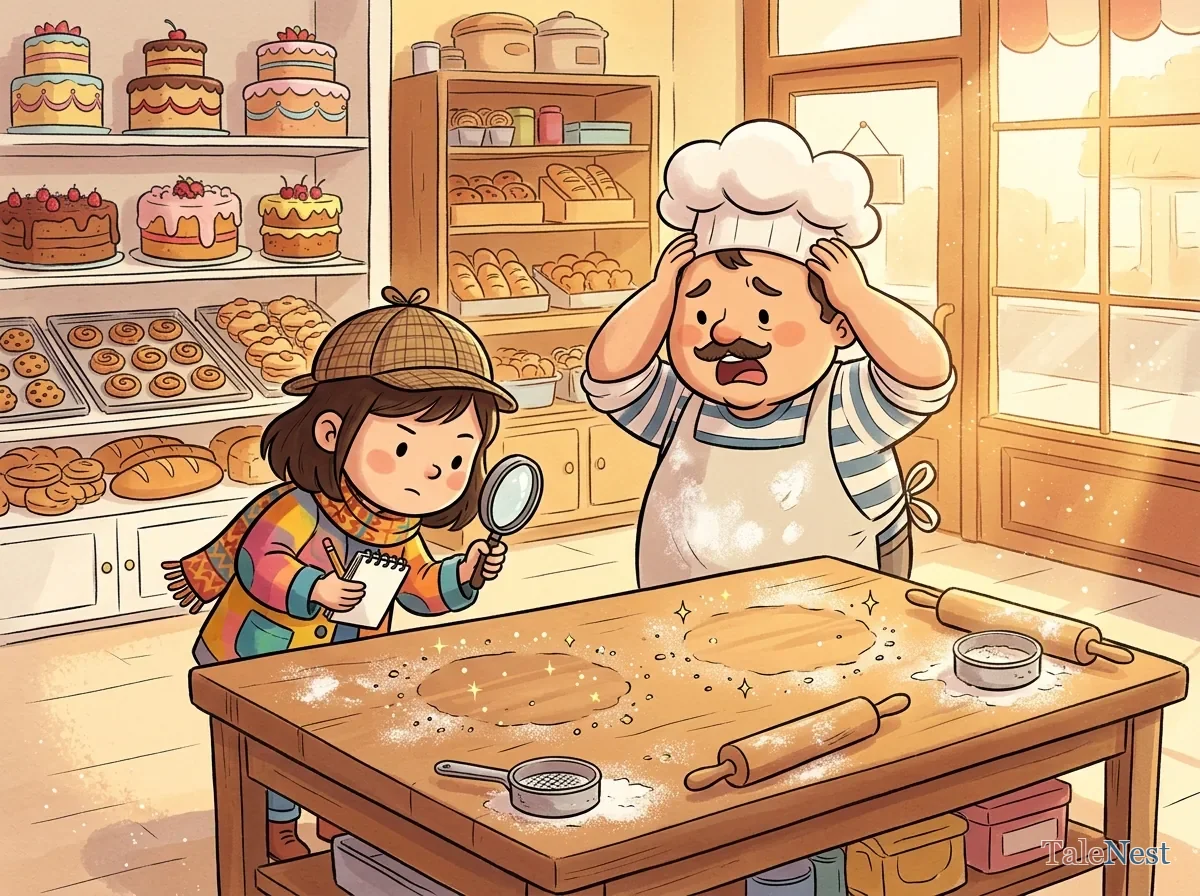
One morning, as she hurried along, Don Fermín the baker came bursting out of his shop with both hands clapped to his head.
“Noa! It's happened again!”
“Another tray?” she asked.
“Two!” he cried. “Two whole trays of cinnamon cookies. And the door was locked!”
Noa whipped out her magnifying glass and stepped inside. The shop was warm and sweet-smelling, heavy with butter and sugar. Cakes and sponge loaves crowded the shelves. But on the big worktable in the back were two bare empty patches where the cookies should have been.
“The windows?” asked Noa.
“Shut tight,” said Don Fermín. “I've looked everywhere. It's as if the cookies grew wings and flew away.”
Noa crouched and swept her lens over the floor. Nothing. She examined the table. Nothing. She drew one finger across an empty tray. Not a speck.
“Whoever did this didn't leave a single crumb,” she said.
And yet something about it did not sit right with her. She thought hard. Don Fermín's cinnamon cookies were rolled in icing sugar, masses of the stuff. If somebody had eaten them right there in the bakery, there would be traces. Powdered sugar did not simply vanish into thin air.
“Don Fermín, may I have a look in your storeroom?”
“Of course, my dear. There's nothing in there but sacks and boxes.”
“Confessing a mistake, however embarrassing, brings understanding and help, while hiding it only lets the trouble grow.”The little lesson
The storeroom was dim. Noa clicked on the light, but the bare bulb only managed a weak yellow glow. It smelled strongly of flour. Sacks were stacked nearly to the ceiling, cardboard boxes huddled in the corners, and glass jars lined one shelf. She ran her lens across the floor again. Still nothing.
Then she noticed the window. It was shut, but the curtain hanging over it was thin, and a little hole in the cloth let a narrow bar of sunlight through.
And there it was.
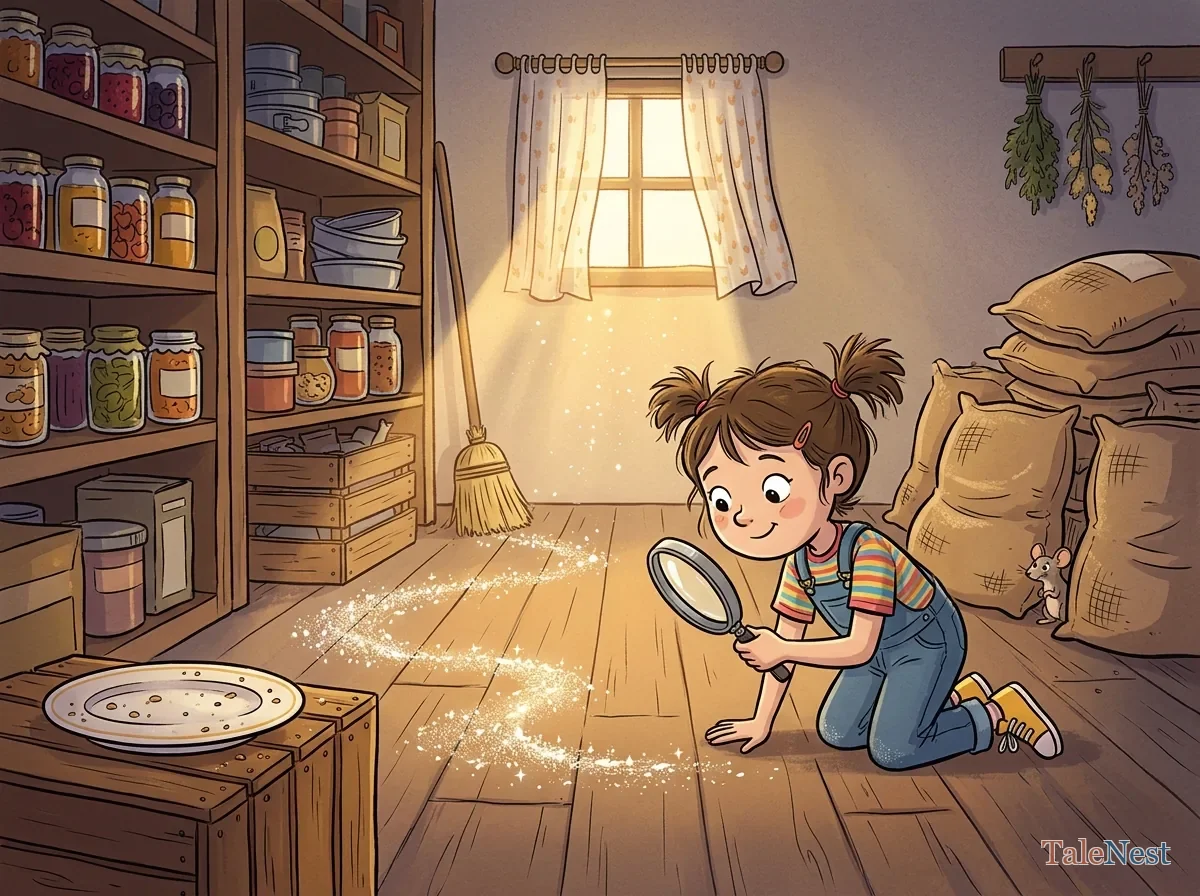
On the floor, exactly where the light fell, something glittered, tiny specks, like ground-up stars. Icing sugar. Crumbs of it.
Noa pulled the curtain right back. Sunlight poured in, and the whole floor came alive. A shimmering trail of sugar crumbs ran from the workshop door all the way to a dark corner behind the biggest sacks.
She followed it on her hands and knees. Behind the sacks she found a folded blanket, a cushion, and a plate bearing the last crumbled remains of a cookie.
“Somebody has been eating in here,” she whispered.
At that moment a noise made her turn. The back door was opening slowly. In came Tomás, Don Fermín's nephew, and his shirt was dusted with glittering sugar.
Tomás saw Noa and stopped dead. His lower lip began to tremble. “I, I...”
Noa snapped her notebook shut.
“Tomás,” she said gently, “why didn't you tell your uncle?”
“Because it started with just one cookie. One. But they were so good I couldn't stop. Then I felt ashamed. Every day I took a few more, and I never knew how to say it out loud.”
Noa sat down beside him on an overturned box.
“If you tell him yourself,” she said, “it will be far better than if he discovers it on his own.”
Tomás swallowed hard. Together they walked through to the workshop. Don Fermín listened without saying a word, while Tomás's eyes turned red.
“Uncle, I'm so sorry,” the boy blurted out. “I couldn't stop myself, and then I was frightened to tell you.”
Don Fermín let out a long sigh. Then he rested a hand on Tomás's shoulder.
“Cookies can always be baked again,” he said. “But if you never tell me, there's no way I can help you.”
That very afternoon Don Fermín showed Tomás how to bake a tray of his own. Noa stayed to help. Tomás learned to measure the flour level, to wait the exact number of minutes in the oven, and to dust every cookie with a fine snowfall of icing sugar.
When the tray came out, golden and fragrant, Tomás set one cookie on Noa's plate.
“For the best detective in the neighbourhood,” he said.
Noa beamed, and wrote in her notebook: “Case closed. The cookies stay where they belong.”
From that day on, Tomás asked for his cookie in a clear loud voice. And there were always extra left on the tray for seconds.
Confessing a mistake, however embarrassing, brings understanding and help, while hiding it only lets the trouble grow.


