
The Clock That Waited for Someone Curious
When an old tower clock suddenly starts ticking again, two friends follow a hidden note to a watchmaker who has been waiting years for someone to ask why time stopped.
 Retold by Idalia SantosAges 6+7 min read806 words
Retold and rewritten by Idalia Santos for TaleNest. This version is original prose in English; the illustrations and accompanying text were created for this site.

This is a work of fiction, retold in original language for TaleNest. Names, places and events are part of the story.
Martina settled onto the bench in the plaza on a morning so quiet it seemed to be holding its breath. Birds trilled from the rooftops. Leaves stirred in a gentle wind. A few neighbours nodded to one another from the shade, and a dog dozed in a patch of sun. Nothing in the square was in any hurry.
And then she heard it.
Tick, tock. Tick, tock.
She raised her head. The sound was coming from the old clock in the tower. That clock had been still for years, so long that nobody remembered when it had last run. Its face was speckled with dust and its paint had faded to the colour of old bones. Yet now its hands were stirring, slowly, as if they were learning to walk again.
‘Leo! Leo, come quickly!’ Martina called.
Leo arrived at a run, a book tucked under his arm. ‘What is it?’
‘The clock! Listen!’
They stood perfectly still. Tick, tock. Tick, tock. Leo’s eyes grew round. ‘That is impossible. That clock has not worked in years.’
‘Well, it works now,’ said Martina with a smile. ‘And I intend to find out why.’
They moved to the foot of the tower. The stone was cold and old, and Martina trailed her fingers along a deep crack. Something was lodged inside, a folded scrap of paper, yellowed with age.
‘Look, Leo! A note!’
Leo unfolded it carefully. A few words were written in tiny handwriting: ‘Time never stops. It only hides when nobody goes looking for it.’ Beneath them stood two initials: A.R.
“Time is precious not because it passes, but because of the people we choose to spend it with.”The little lesson
Martina traced the faded letters with one finger. ‘It sounds like a riddle,’ she said. ‘Or an invitation to somebody.’
‘Who is A.R.?’ Leo wondered.
Martina glanced around. Then she noticed a small arrow carved into the stone beside the initials. It pointed down Olive Street. ‘Come on,’ she said.
They raced along the street and at the end found a house with a blue door. An old sign hung above it: ‘Augusto Reyes. Watchmaker.’ ‘A.R.! It is the watchmaker!’ Leo exclaimed.
Martina knocked. Slow footsteps approached, and an elderly man opened the door. His hair was white, his hands creased with age, and his eyes held a mixture of sadness and curiosity.
‘And who might you two be?’
‘I am Martina and this is Leo. We found your note inside the clock.’
Don Augusto went quite still. Then, slowly, he smiled. ‘Come in. I have waited a very long time for this moment.’
Clocks filled the little house, large and small, round and square, some with brass pendants and some with painted faces, but not one of them was running. Dust lay thick on every casing, and the hush was so complete it made the children's ears ring.
‘Why are they all stopped?’ Leo asked.
Don Augusto sat down in his worn chair. ‘Years ago I took care of the plaza clock. I wound it every single morning. But gradually people stopped noticing the hour. They stopped sitting in the square. They stopped speaking to one another. Nobody seemed to have time for anything.’
‘And what did you do?’ asked Martina.
‘I stopped winding it. If no one wanted time, why should I keep giving it away?’
Martina looked at Leo. Leo looked at Martina. ‘But we want time,’ Martina said. ‘Time to investigate, to play, just to be together.’
Don Augusto gazed at her intently, and something bright came into his eyes. ‘I hid that note many years ago. I thought that one day a curious child would find it, someone who knew how to listen.’
‘And the clock,’ said Leo, ‘who wound it today?’
Don Augusto stood and went to the window, looking toward the tower. ‘This morning I woke and saw the two of you in the plaza, talking and laughing together. And I thought: perhaps the time has come.’
Something warm spread through Martina’s chest. ‘Will you teach us how it works?’
Don Augusto drew a golden key from a drawer. ‘Better than that. I will teach you how to look after time.’
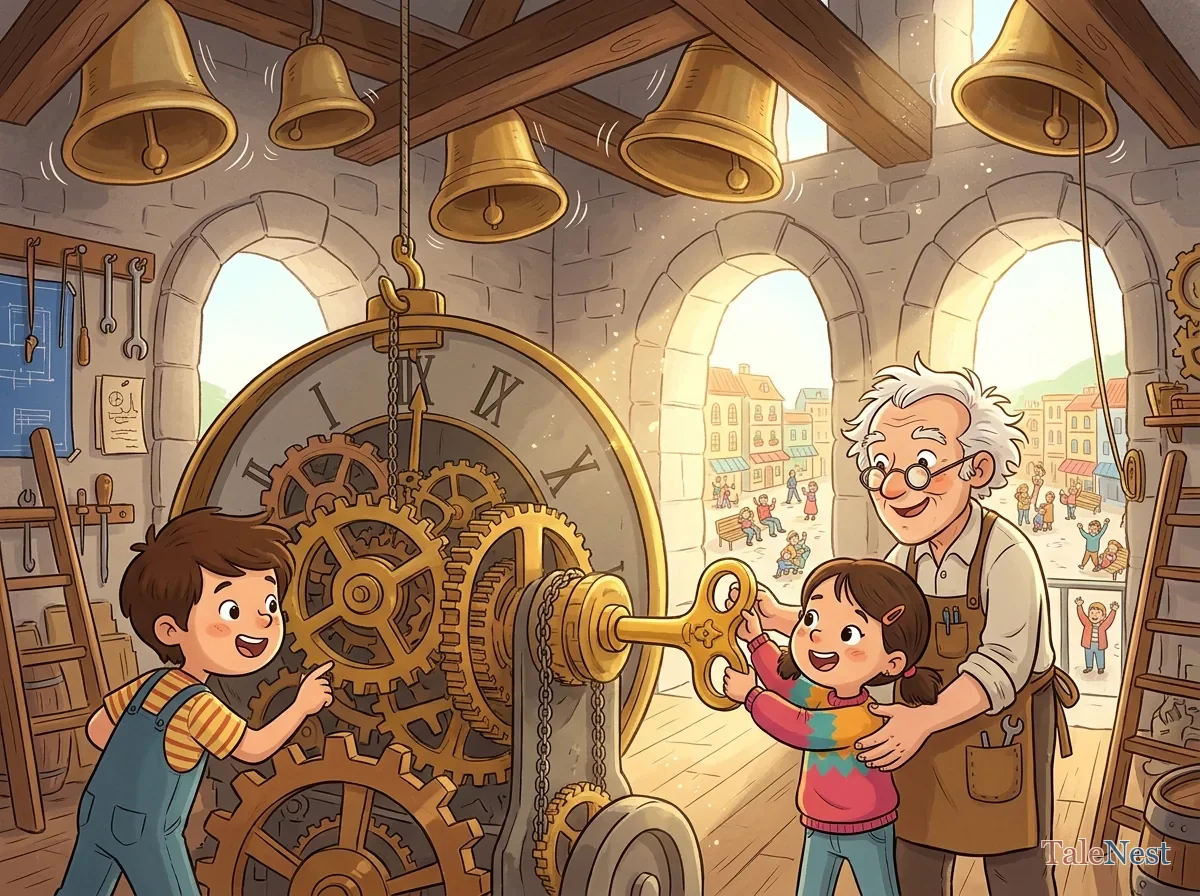
That afternoon the three of them climbed the tower together, up the narrow winding stairs to the room where the great mechanism slept. Don Augusto showed them how to wind it. Martina turned the key; Leo counted the turning gears; and the huge wheels began to move as if stretching after a long sleep. Then the bells rang out over the whole town.
People stepped out of their houses and looked up. Some smiled. Others wandered toward the plaza. Little by little the benches filled again.
And from that day on Martina and Leo climbed the tower every morning to wind the clock, because they had learned something nobody had ever told them: time is at its best when you share it.
Time is precious not because it passes, but because of the people we choose to spend it with.


