
The Fairy in the Teapot
A sick boy, a cup of elderflower tea, and an old storyteller whose tale blooms into a lifetime of wonder, love, and memory.
 Retold by Idalia SantosAges 6+5 min read993 words

This is a work of fiction, retold in original language for TaleNest. Names, places and events are part of the story.
A boy lay ill in bed with a cold; his mother brewed him elderflower tea. In came a curious old gentleman with a pocketful of tales. “Drink your tea, dear,” she said, “and perhaps someone will tell you a story.”
“I should tell you a story,” said the old man, “but I have run clean out.” “Then make one up,” cried the child. “Mother says you can turn anything you see into a tale, and anything you touch into a history.” “Ah, but those are the wrong sort,” he answered. “The real ones do not come when you call. They arrive of their own accord, tap you on the forehead, and say, 'Here I am.'” “I will, if the story chooses; they are proud and come only when they please. Wait—” he broke off. “There is a story in the teapot.”
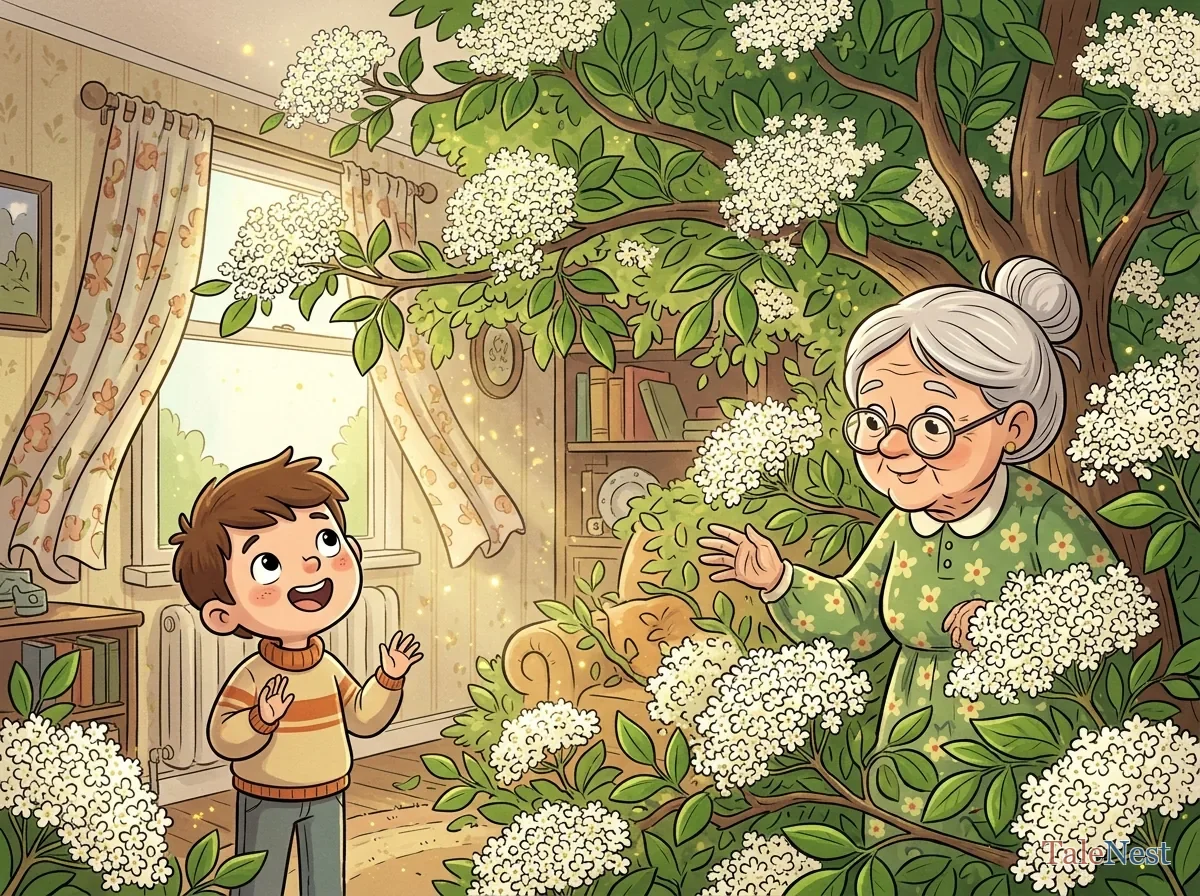
The boy stared. The lid stirred and lifted, and out poured clusters of elder blossom. A magnificent elder tree grew across the room, pushing aside the curtains. Among its sweet-smelling flowers stood a kindly-faced old woman in a strange green dress hung with great white blooms—you could not tell whether it was cloth or living leaves.
“What is her name?” the boy whispered. “The Romans and Greeks called her a Dryad,” said the old man; “in Nyboder we call her Mother Elder. Another tree like this one, all in flower, grew in the corner of a tiny field. One noon two old folks sat in its shade—an aged sailor and his wife, no younger than he. They had great-grandchildren and were about to keep their golden wedding, though they could scarcely recall their wedding day.” “I know the very day of their golden wedding,” said the woman; but the old couple never heard her.
“Do you remember?” the sailor said. “When we were children, racing and playing in this field? We stuck cuttings in the ground and made a garden.” “I do,” she answered. “We watered them, and one was an elder branch—this very tree.” “That is it,” he said. “In the corner stood a tub with my little boat. How it sailed! But soon I was to sail on other seas.” “We went to school,” she went on. “Then we were promised, and later went to Frederiksberg.” “But soon I was off to distant parts, for years.” “Ay, the tears you cost me!” she said. “I thought you dead. The day the postman brought your letter I was beside myself—it said you were in warm lands. Then someone caught me round the waist—” “And you boxed his ears.” “I did not know it was you. You had come with the letter, and looked so handsome!”
“The stories we love most are the ones that grow out of real life, and memory keeps the people we cherish green long after they are gone.”The little lesson
“Then we were married,” he said. “Do you remember? And the first child, and all the ones after?” “Yes, and they grew up.” “And their children have children now—our great-grandchildren. Was it this time of year we were wed?” “It was,” said Mother Elder softly. “Today is the very day of your golden wedding.” The old man and woman looked into each other's eyes and took hands.
Soon their children and grandchildren came bustling up, all eager with congratulations. The old pair had forgotten, yet remembered perfectly everything from so long ago. “But this is not a story,” objected the boy. “You should know better than I,” said the old man. “We will ask Mother Elder.” “It was not a story,” she said. “The story begins now. The loveliest legends grow from real life; otherwise my tree could never have come from a teapot.”
She lifted the child from bed and pressed him to her breast, and the flower-heavy branches folded round them. The fairy became a lovely young girl; she and the boy kissed, and suddenly they were the same age. Hand in hand they stepped into the glorious garden of his father's house. “Hurrah!” cried the boy. “We will run for miles—to the estate we visited last year!” They raced round the lawn, the girl shouting, “We are nearly there! On to the great house!”
They planted a little garden; she set an elderflower from her hair in the soil, and it grew as the first tree had when the old folks were children. Hand in hand they walked as the grandparents had done—but not toward the Round Tower or Frederiksberg gardens. Instead the girl put her arm about him and they flew over Denmark. Spring came, and summer, and harvest, and winter, and thousands of pictures painted themselves in his eyes. “How lovely are spring and summer and autumn and winter here!” The years slipped away.
Today they keep their golden wedding. There they sit, like a king and queen, while he tells his aged wife the tale of Mother Elder. They agreed that much of it mirrored their own lives, and loved most what matched them best. “So it is,” said the young girl from the tree. “Some call me a fairy, others a Dryad, but my true name is Memory. I live in the tree, which goes on growing for ever. I can think back on the past and tell it. Let me see if you still have your flower.”
The old man opened his hymnbook, and there lay the elder blossom, pressed flat. With crowns of gold upon their heads they sat on in the sinking sun. They closed their eyes—and there, good reader, the story ends.
The boy still lay in bed. Had it been a dream, or truly a story? “It was beautiful!” he sighed. “Mother, I have been to the warm lands!” “No wonder,” said his mother. “After a couple of cups of elderflower tea, a person always finds himself in warm lands.” She tucked the bedclothes about him. “You were asleep while he and I argued over whether it was a story or a true history.”
“And where is Mother Elder now?” asked the boy. “In the teapot,” said his mother, “and there she may stay.”
The stories we love most are the ones that grow out of real life, and memory keeps the people we cherish green long after they are gone.


