
The Laziest Heir
A king with three equally lazy sons must choose an heir, and the contest he invents produces the most astonishing answers ever heard in a royal court.
 Retold by Idalia SantosAges 4+5 min read920 words
This is a work of fiction, retold in original language for TaleNest. Names, places and events are part of the story.
There was once a king who had three sons, and he loved them all exactly the same amount. That was the trouble. He could never decide which of them should inherit the throne when he was gone, and the longer he thought about it, the more tangled the question became.
The kingdom was a pleasant one, full of orchards and slow rivers, and its people were used to a ruler who thought carefully before acting. Their king was no different - except that, in this one matter, thinking carefully had got him nowhere at all.
The eldest son was famous for a particular talent: he could lie longer and more comfortably than any man in the realm. Servants who made his bed each morning said he shifted position only when the sun moved across the floor and warmed one side of his face.
The second son was no better. He loved nothing so much as a chair by the fire. He claimed that moving was a kind of rudeness to the universe, and he had been known to sit through an entire feast without lifting a finger to his own plate, waiting patiently for someone to place food in his hand.
The third son, though the youngest, was the most accomplished of all. He had turned idleness into an art. He would watch a fly walk across the ceiling for an hour and call it a busy afternoon. His favorite saying was that if a thing was worth doing, it was worth sitting down before you did it - and, preferably, never doing it at all.
The king watched them all with a heavy heart. He was growing old now, and his health was failing. There were days when even climbing the palace stairs left him breathless. He knew his time was coming, and still he had no answer.
He asked his advisors. He asked the queen. He even asked the court jester, who suggested they simply draw straws. But a kingdom cannot be settled by straws, and the king shook his head.
“I have tried fairness,” he said. “I have tried wisdom. I will try one last thing.”
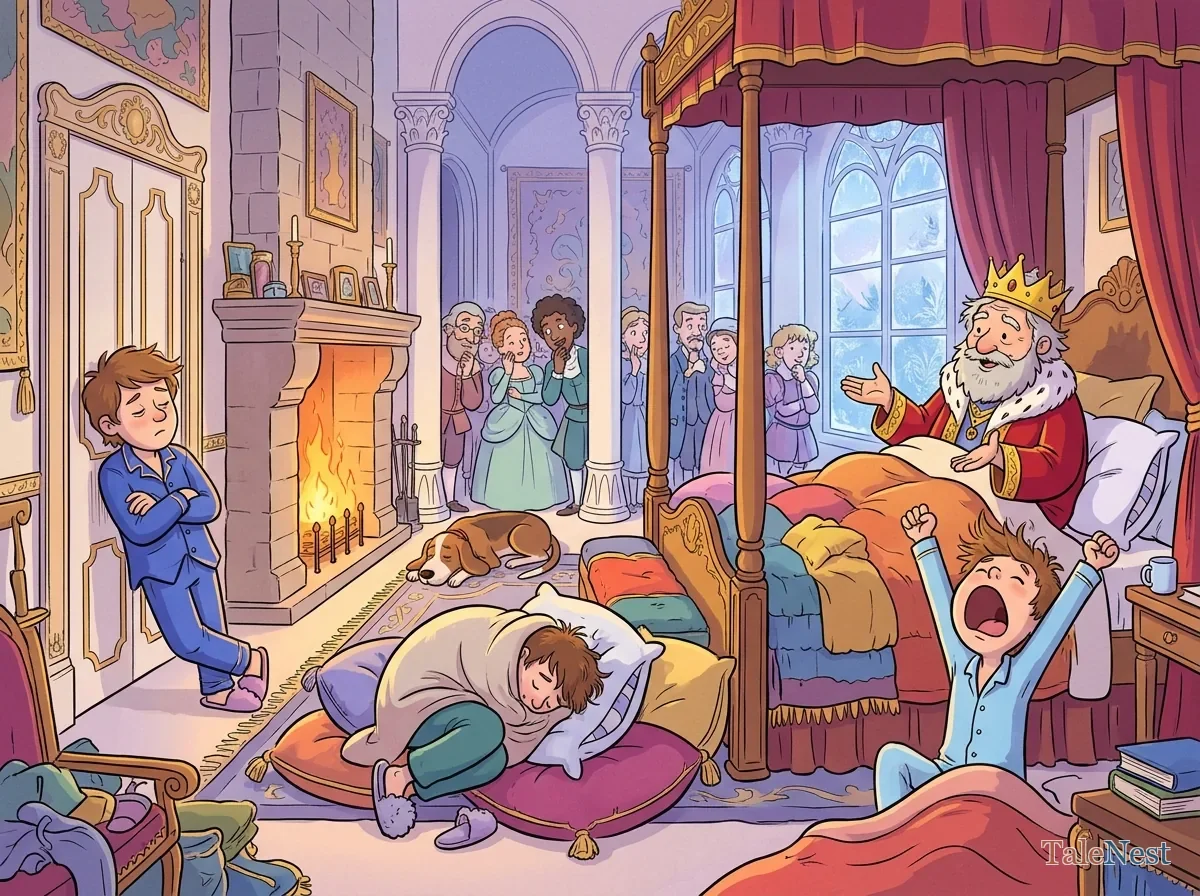
So one cold morning, when frost silvered the palace windows, the king had his three sons called to his bedchamber. The room was warm with firelight, and the nobles of the court stood along the walls, curious to hear what their ruler would say.
“There is a kind of laziness so complete it becomes its own strange kind of cleverness - though it is hardly a virtue to admire.”The little lesson
The three sons came in, yawning. The eldest leaned against the doorframe. The second found a cushion and settled onto it. The third yawned so widely that the jester behind him yawned too.
“My dearly beloved sons,” said the king, propping himself up on his pillows, “I have thought long and hard about which of you should wear my crown. I have loved you all as much as a father can, and I cannot bear to choose by favor. So I have decided the matter in a new way.”
The sons looked at one another. The second son's eyes half-closed.
“The throne,” said the king slowly, “shall go to whichever of you is the laziest.”
For a moment, nobody moved. Then the eldest son straightened as much as he could without actually standing up.
“Father,” he said, “then the kingdom is mine. I am so lazy that when I lie down at night, I cannot be bothered to close my eyes - even if a drop of rain falls straight into them. I would rather let it land than lift a single eyelid.”
A murmur ran through the court. The queen raised an eyebrow. The king nodded, though his face gave nothing away.
The second son stirred on his cushion and spoke without opening his eyes.
“Father, the crown belongs to me. My laziness is beyond compare. When I sit by the fire to warm myself, I would sooner burn my heels to cinders than draw my legs back. I simply cannot summon the effort.”
Now the murmurs grew louder. The nobles whispered among themselves, for they had never heard such boasting, and the two brothers glared at each other with what little energy they had.
Then the third son, the youngest, spoke in a voice as soft as a sigh.
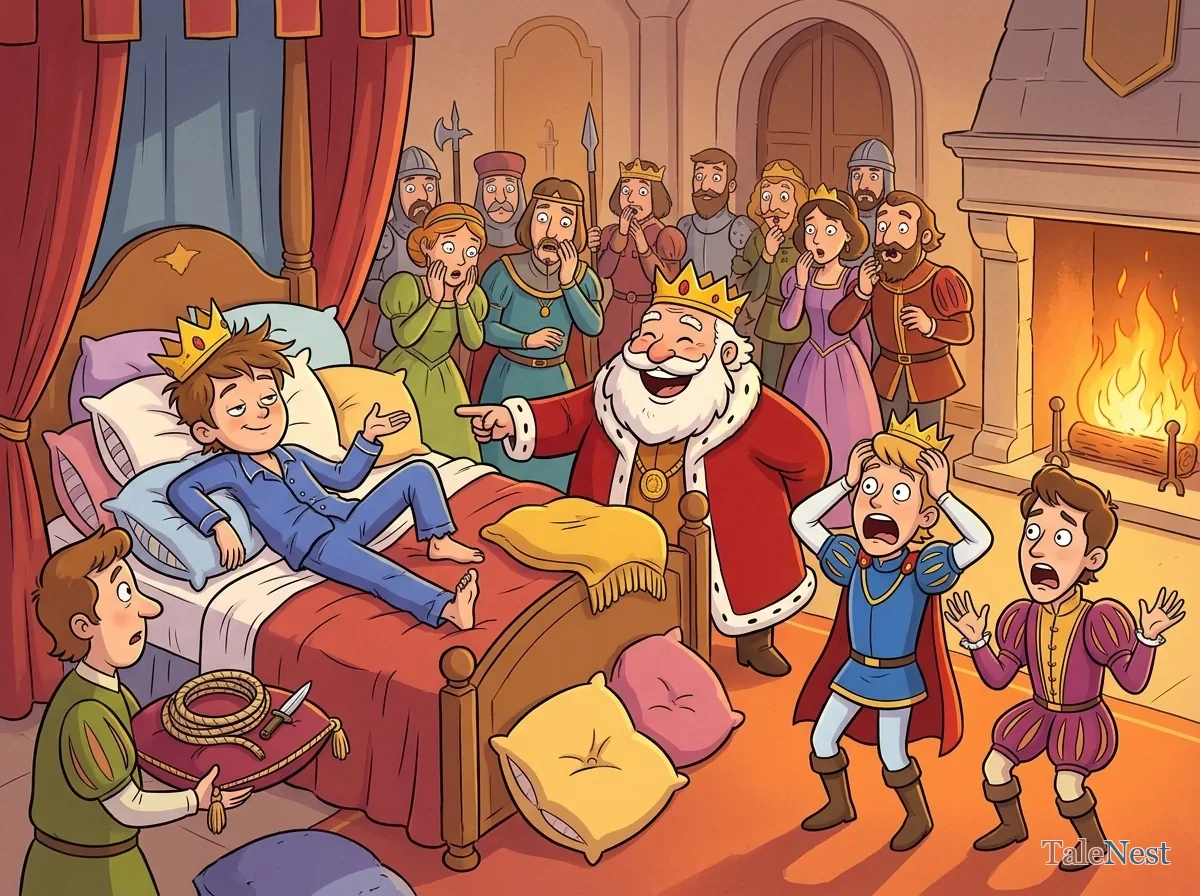
“Father,” he said, “I believe the throne is mine. Listen to this. Suppose they were taking me to the gallows, and the noose were already tight around my neck. Suppose someone put a sharp knife into my hand so that I could cut the rope and save my life. Well - I would let them hang me before I raised my hand to the rope. It would simply be too much trouble.”
The court fell silent. Even the jester forgot to yawn. The king stared at his youngest son, and then, very slowly, a smile spread across his tired face.
“You,” he said, pointing a trembling finger, “have carried the matter further than either of your brothers. No one could be lazier than that. Therefore you, my son, shall be king.”
And so it was settled. The youngest brother, who could not be troubled to save his own neck, was declared heir to the throne. The courtier who wrote it down said it was the laziest decision ever made in the history of the kingdom - and, as everyone agreed, the most fitting one.
As for the moral of the story, it is this: there is such a thing as being too lazy even to want the crown, and sometimes that is precisely what wins it.
There is a kind of laziness so complete it becomes its own strange kind of cleverness - though it is hardly a virtue to admire.


