
The Rooster, the Scythe, and the Cat
A father sends his three sons into the world with a rooster, a scythe, and a cat, promising that fortune waits wherever such ordinary things have never been seen.
 Retold by Idalia SantosAges 4+6 min read982 words
This is a work of fiction, retold in original language for TaleNest. Names, places and events are part of the story.
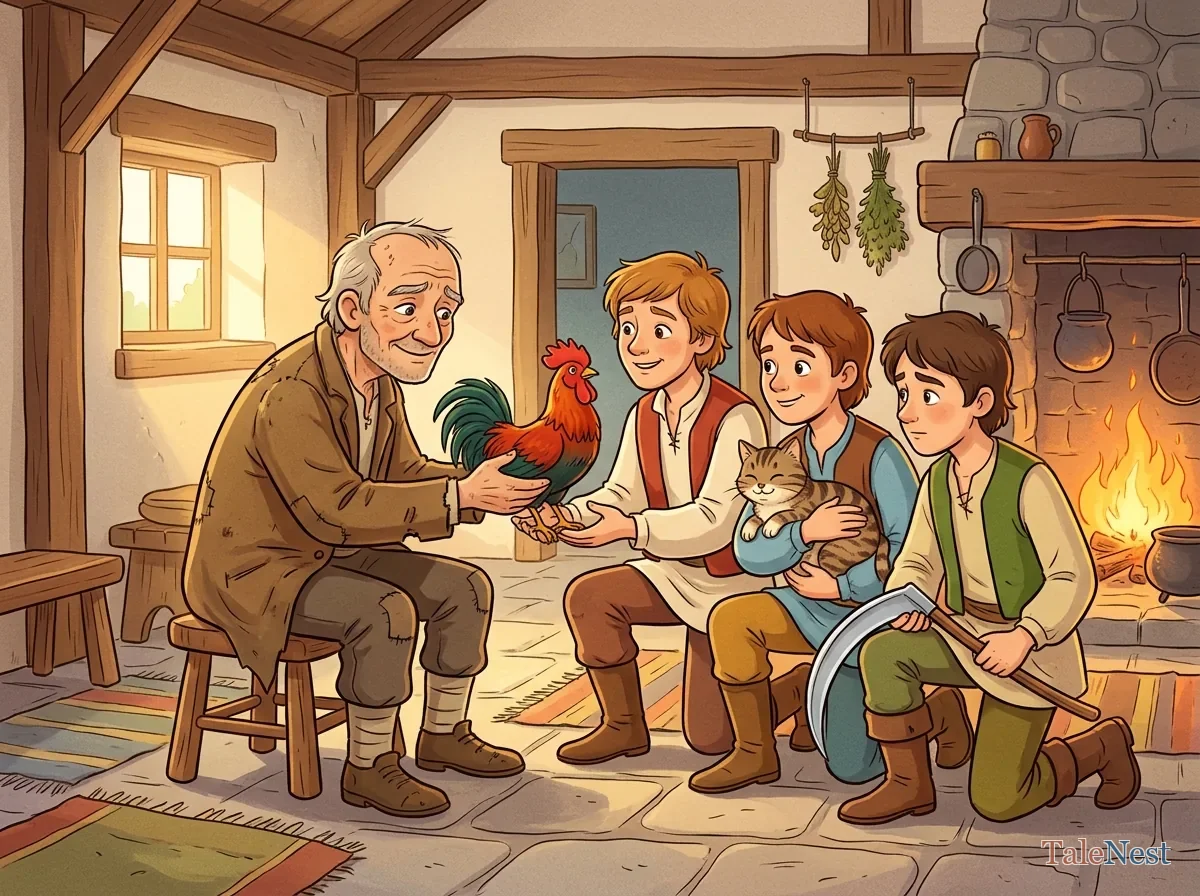
There was once an old man who felt his life drawing to a close, and so he called his three sons to his bedside and handed out the few possessions he had. To the eldest he gave a rooster, to the second a scythe, and to the third a cat. “I have no money to leave you,” he told them, “and these gifts may seem worthless enough. But their worth lies entirely in how you use them. Take each one to a country where such a thing has never been seen, and you will make your fortunes.” Before long the father died, and the three young men set out to put his strange advice to the test.
The eldest took the rooster and walked towards the nearest city. He had not gone far before he began to see his gift everywhere. High above the rooftops a painted rooster swung on a church spire, turning with every gust of wind; in the villages he passed, living birds crowed from every fence and dunghill. His own rooster was nothing special, and nobody so much as glanced at it. Week after week the young man travelled, and the bird seemed to bring him no luck at all.
At last he came to an island whose people had never in their lives set eyes on a rooster. What is more, they had no way of telling the time. They could distinguish morning from afternoon well enough, but when darkness fell and they went to sleep, they had no notion of the hour, and often lay abed until the sun was high.
“Look at this creature,” the young man said, holding the rooster up for them to see. “It wears a crown upon its head and spurs upon its feet like a knight in armour. At night it will sing three times at a fixed hour. When it sings for the third time, the sun will be ready to rise. And if it crows in the middle of the day, make ready, for the weather is certain to change.”
The islanders were enchanted. They stayed awake the whole night through to put the bird to the proof, and their delight was boundless when it announced the hours of two, four, and six. In the morning they crowded round the stranger and asked if he would sell so precious a treasure, and what price he might name.
“Fortune favours those who see the hidden worth in humble things and have the wit to carry them where they are needed.”The little lesson
“As much gold as a donkey can carry,” he replied. “A mere trifle for so wonderful a creature,” cried the islanders, and they weighed out every coin he asked for. The eldest brother rode home with a donkey staggering under his gold, and his siblings stared in wonder at the sight of him.
“Then I shall be next,” announced the second brother. “Let us see whether my scythe can serve me as well.” It seemed a hopeless errand, for farmers everywhere slung scythes over their shoulders as he did. Yet in time he too reached an island where no one knew the tool. When the grain stood ripe in the fields, the islanders hauled artillery out and blasted the stalks to the ground with cannon fire.
Before they could open fire, the young stranger stepped into the field and began to reap. He worked in silence and with such astonishing speed that the watching crowds stood open-mouthed. They begged him to name his price for the implement, and in the end he went away leading a horse loaded down with all the gold the animal could bear.
Now the third brother took his turn, determined to make the very best of his cat. His journey began like the others: on the mainland he found no takers, for cats were ten a penny, and so many kittens were born that most were drowned at once. But at length he boarded a ship and arrived at an island where, to his joy, nobody had ever seen a cat. Mice ruled the place. They danced across tables and benches, quite indifferent to whether the householder was at home.
The islanders had endured this plague for years, and the king himself could not clear the rodents from his palace. They swarmed everywhere. Then the cat was brought in, and in the twinkling of an eye he had emptied room after room of them. The people pleaded with the king to buy the wonderful beast for the good of the whole country.
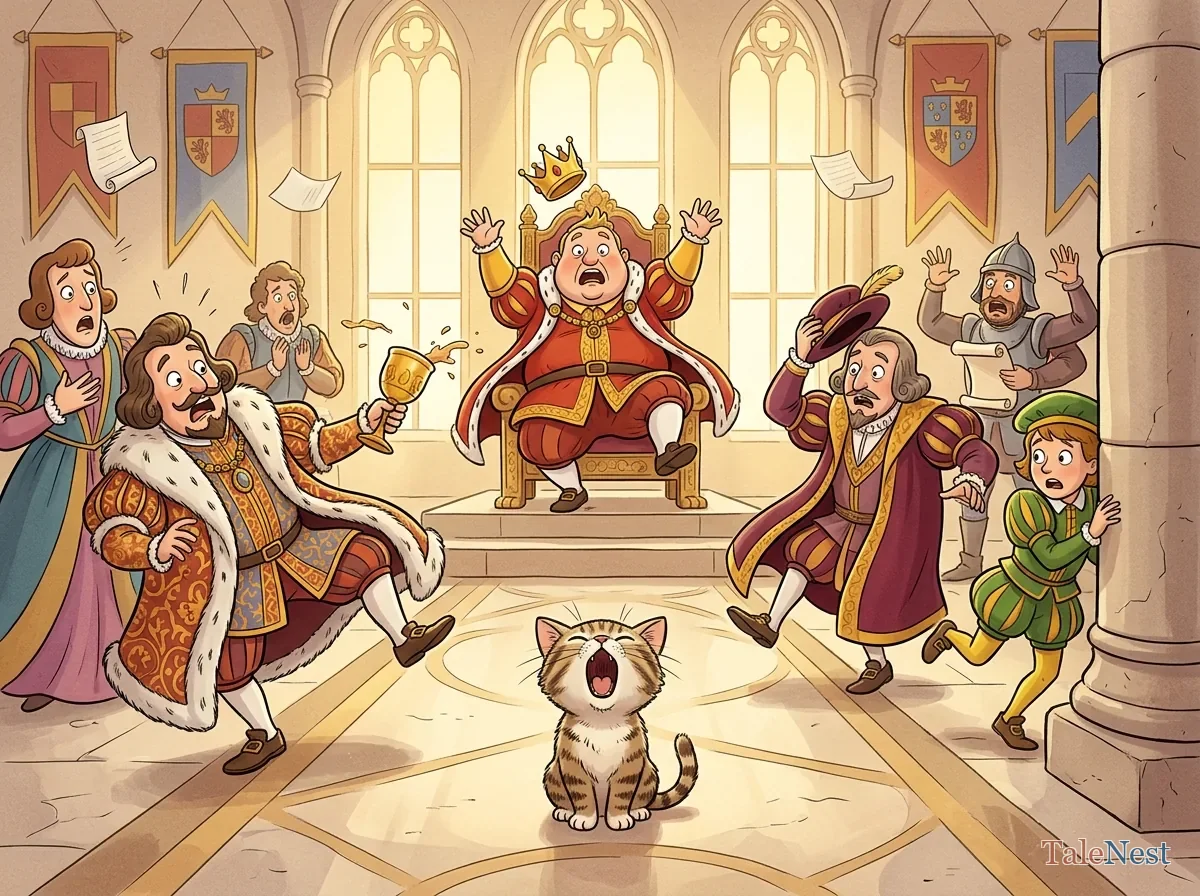
The king paid without a moment’s hesitation, a mule laden with gold, and the third brother returned home richer than both the others together. In the palace the cat lived like a nobleman, hunting mice until there was no one left to count them. At last, hot and thirsty after his labours, he paused, raised his head, and let out a loud “Meow, meow!” At that unearthly sound the king and his courtiers fled the palace in a stampede.
In the marketplace the king summoned his council to consider the crisis. They decided at last to send a herald to the cat, ordering him to quit the palace, with the threat of force if he refused. “Better the mice we know,” the counsellors agreed, “a trouble we understand, than hand our lives over to a monster like that.”
A page was dispatched to ask the cat to leave of his own accord. But the cat’s thirst was growing worse, and all he answered was another “Meow, meow!”, which the page took as a refusal. He hurried to tell the king.
“Then he must be made to go,” said the counsellors. They dragged the cannons into position and bombarded the castle with burning shells. When the fire reached the chamber where the cat sat, he saved himself by springing through a window; but the besiegers did not stop firing until the whole castle had been reduced to a smoking heap of rubble.
Fortune favours those who see the hidden worth in humble things and have the wit to carry them where they are needed.


