
The Piper of Hamelin and the Broken Promise
When a mysterious piper rids a prosperous town of its rats, the mayor's broken promise turns a triumph into the most heartbreaking lesson the townspeople will ever learn.
 Retold by Idalia SantosAges 3+6 min read900 words
This is a work of fiction, retold in original language for TaleNest. Names, places and events are part of the story.
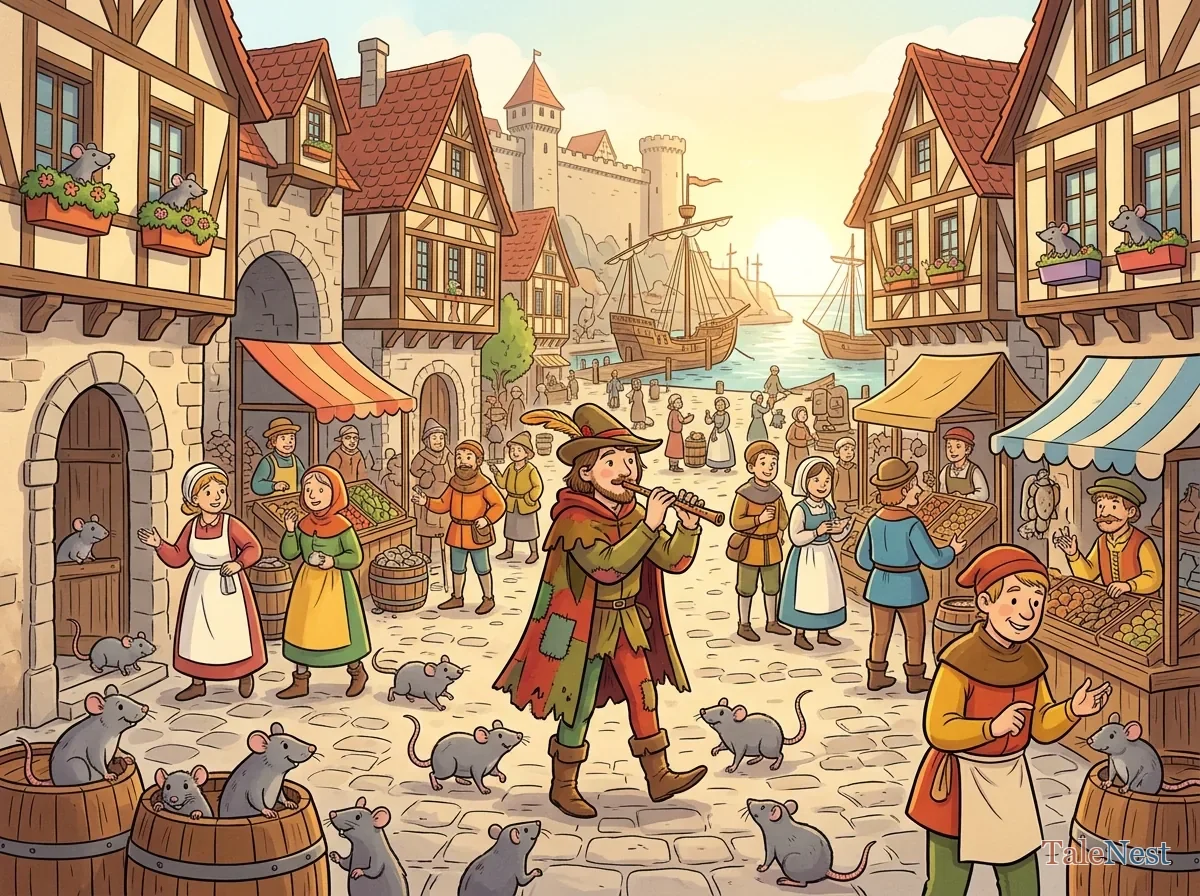
Long ago, in the heart of Germany, there stood a walled city called Hamelin. It was a handsome, prosperous place with a busy harbour, and merchants came from every corner of the known world to trade their silks, spices and timber. Its cobbled streets were always lively, its market stalls always full, and its people had not known a serious trouble in years. Life in Hamelin was good, and everybody said so.
Then one summer night, while the whole city slept, the rats came. They slipped through the gates and crept over the walls in their hundreds, as quiet as a rising shadow. By morning there was not a corner of Hamelin without a rat in it. They scurried through pantries and parlours, through cellars and shops. They nibbled the grain, gnawed the furniture and squeaked from beneath every floorboard. The noise was dreadful, a constant rustle and squeak that followed the townspeople from room to room.
The citizens woke to a city overrun. Never in living memory had anyone seen so many rats. The mayor did what he could. He sent for cats, and cats arrived by the cartload. He set traps and mousetraps in every doorway and pantry. He even tried poison. But the cats grew fat and sleepy, the traps caught only a handful, and the poison did nothing at all. Worst of all, the rats kept coming, more of them every day, until the people began to despair.
It was at that moment that a stranger walked into Hamelin. He was a wandering minstrel in a weathered cloak, with a curious little wooden flute tucked into his belt. Nobody had ever seen him before, and there was something about his quiet smile that made the mayor listen. He went straight to the mayor and announced, with a low bow, that he could clear the city of every last rat.
'You, all by yourself?' asked the mayor, more than a little doubtful.
'Of course,' said the minstrel. 'But for a service like that I ask one thousand gold coins.'
The mayor waved his hand as if brushing away a fly. 'Never mind the money. If you truly do it, I'll give you a million, if that's what it takes.'
That same afternoon the minstrel stepped into the market square. He drew the wooden flute from his pocket, lifted it to his lips, and began to play. The tune was light and bright and strange, and it floated over the rooftops of Hamelin.
“A promise given is a debt owed; breaking it may cost far more than any reward you hoped to keep.”The little lesson
At the very first note, the rats began to appear. They came from cellars and attics, from behind walls and beneath floorboards, from the harbour and the bakeries and the town hall itself. Hundreds and hundreds of them poured into the square, their tiny eyes fixed on the piper, their whiskers twitching with excitement.
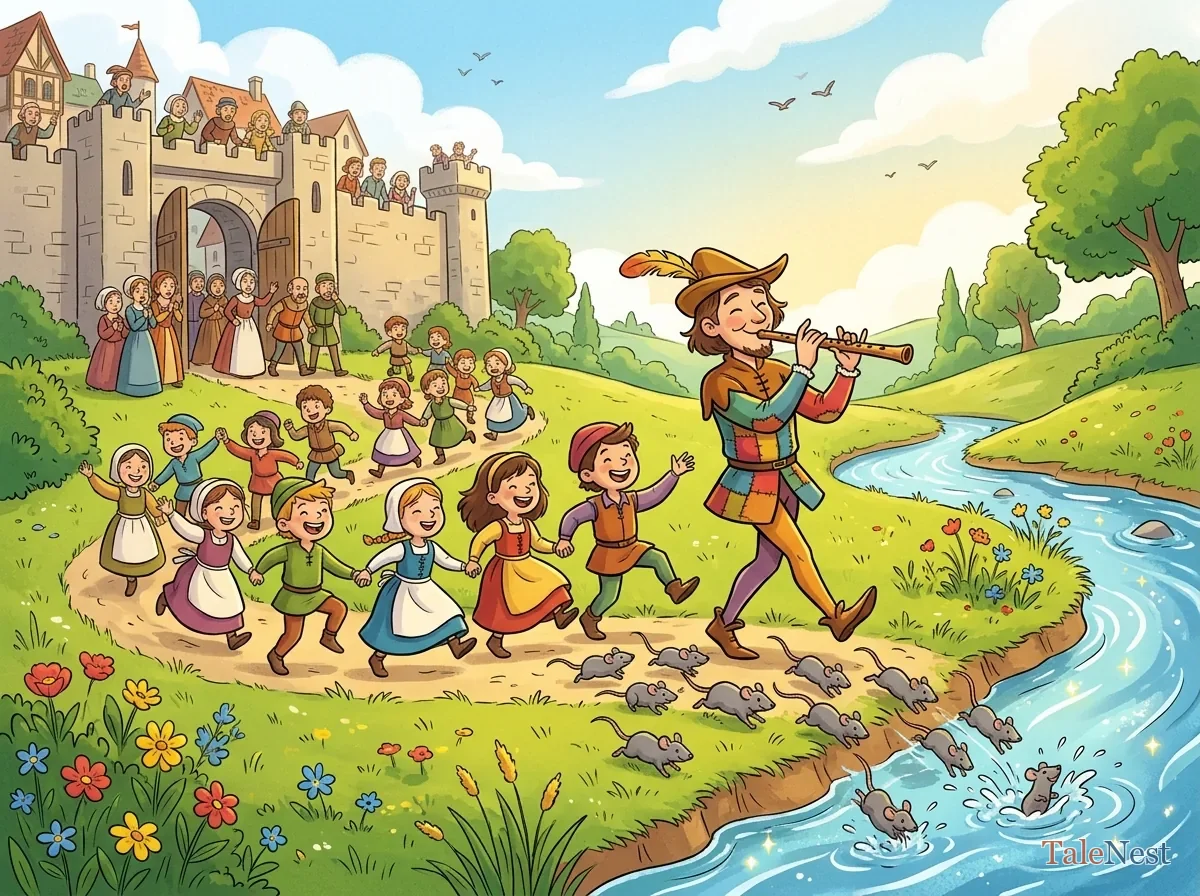
When he saw that he had them all, the minstrel turned and began to walk. He strolled through the streets of Hamelin, playing all the while, and the rats followed in a great grey river, twisting and bustling behind him. Out of the city he went, past the gates, and down to the broad river that ran alongside the town.
He stopped on the riverbank and kept on playing. The rats, quite bewitched by the music, scampered straight into the water, one after another, and were swept away by the current. In a little while, not a single rat was left in Hamelin. The city was clean again, and the people cheered. Not one of those rats ever bothered the city again.
The minstrel wiped his flute and went to the mayor to claim his reward.
'A thousand gold coins for a few tunes?' the mayor laughed, slapping his knee. 'My good man, I'll give you a hundred, and that is generous.'
'But that is not what you promised,' said the minstrel quietly.
'Promises are easily made,' said the mayor, still chuckling. 'Be glad I am in such a good mood.'
The minstrel looked at him for a long moment. 'Then you will be sorry,' he said, and walked away.
He went back to the square, raised the wooden flute, and played again, louder and sweeter than before, a tune that skipped and danced on the breeze.
This time it was not rats who answered. Doors flew open all over Hamelin, and the children came running, little ones and big ones, boys and girls, laughing and skipping, pulled by the music just as the rats had been. They gathered around the piper, their faces bright with delight.
The minstrel began to walk, and the children followed. He led them out of the square, through the streets, past the city gates and into the open countryside. The tune floated back over the rooftops, and the children skipped after it, waving to their parents as they went.
The grown-ups tried to follow, but the music carried the children on faster than anyone could run. By the time the mayor and the parents reached the gates, the piper and the children had vanished beyond the hills. They were never seen in Hamelin again. To this day the people of Hamelin still speak of that morning with a shiver.
And so the city learned its lesson the hard way. A promise given is a debt owed, and the price of breaking one can be far greater than a thousand gold coins.
A promise given is a debt owed; breaking it may cost far more than any reward you hoped to keep.


