
The Shepherdess and the Chimney Sweep
A porcelain shepherdess would rather face the wide world than marry a goat-legged lord, so her chimney sweep leads her up through the soot to a starlit roof.
 Retold by Idalia SantosAll ages5 min read983 words
This is a work of fiction, retold in original language for TaleNest. Names, places and events are part of the story.
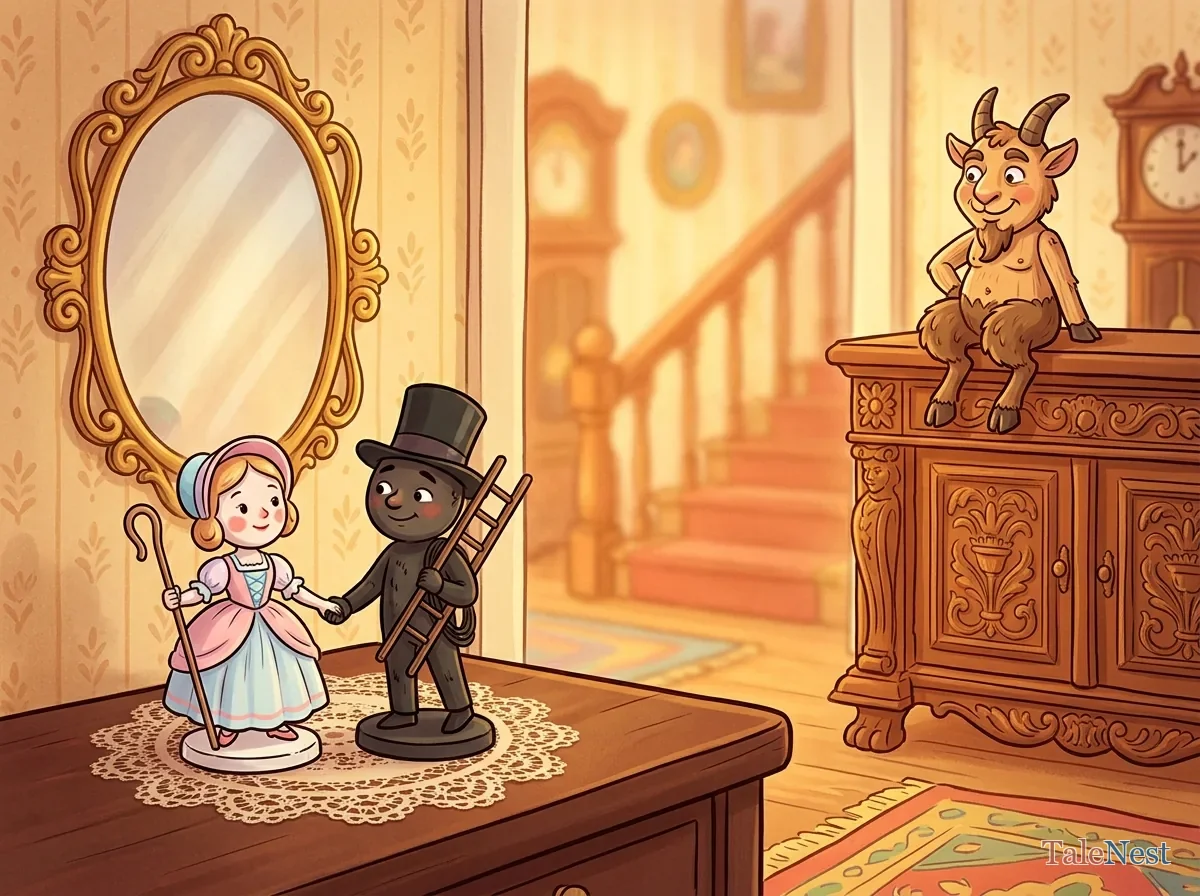
In a certain hall stood an ancient cupboard carved with scrolls and leaves, an heirloom from the great-grandmother, covered with roses and tulips. In its center was a comical full-length man: goat's legs, horns, and a long beard. The children called him the Sergeant-Major-and-Lesser-Field-Marshal-Goat-Legs.
There he stood, eyes fixed on the table beneath the mirror. On it sat a porcelain shepherdess, and beside her a chimney sweep, black as coal and of the same fragile stuff. He had his ladder and cheeks as white and rosy as hers, and being placed so near, they had fallen in love.
Nearby stood a figure three times their size: an old Chinaman who could nod. He claimed to be the girl's grandfather, with authority over her, and had already consented, with a solemn nod, to the Sergeant-Major's request for her hand.
“You shall have a husband,” the Chinaman told her, “who, I am nearly certain, is carved of ebony. He will make you Mrs. Sergeant-Major-and-Lesser-Field-Marshal-Goat-Legs. His cupboard is filled with silver, to say nothing of the secret drawers.”
“I will not go into that dark cupboard!” protested the shepherdess. “I have heard he keeps eleven porcelain wives shut up in there.”
“Then you shall be the twelfth,” replied the Chinaman. “Tonight, the moment the cupboard creaks, the wedding will take place.”
The shepherdess burst into tears. “Will you come away with me?” she asked the sweep. “We cannot go on living here.”
“I want whatever you want,” he answered. “Let us go at once.”
“Oh, if only we could get down from the table!” she said. “I shall never be happy until we are out in that world beyond.”
He comforted her and showed her how to set her foot on the carved corners and gilded leaves of the table leg. With his ladder they soon stood on the floor. But the cupboard was in a stir: every carved stag stretched its head and twisted its neck, while the Sergeant-Major leaped up shouting, “They are running away!”
“Real courage is choosing a hard, uncertain road with the one you love rather than accepting a gilded cage without freedom.”The little lesson
The frightened pair scurried into a drawer beneath the window, which held cards and a puppet theater stood up any which way. A performance was underway: the lady cards sat in front fanning themselves with tulips, while the jacks stood behind showing their two heads, one above and one below, as cards always do. The play was about two lovers who could never unite, and the shepherdess wept, it was so like her own. “I cannot bear it,” she cried. “I must get out of this drawer!”
Back on the floor they looked up to see the Chinaman tottering with his whole body, for beneath his head he was one solid piece. “The old Chinaman is coming!” cried the shepherdess.
“I have an idea,” said the sweep. “What if we climb into that big jug in the corner? We shall be hidden among roses and lavender, and if he comes near we can throw salt in his eyes.”
“That will not help,” she answered. “Besides, the Chinaman and the jug were once engaged, and some tenderness lingers in such a case. No, the only thing left is to throw ourselves upon the world.”
“Do you truly feel brave enough?” asked the sweep. “Have you thought how enormous it is, and that we can never come back?”
“Yes,” she said. He gazed at her and said, “My road goes up the chimney. We shall come out at the top, so high no one can reach us, where an opening leads into the wide world.” He led her to the oven door.
“How dark!” she cried, following him through the oven box and up the flue, black as a wolf's throat. “We are in the chimney now,” he told her. “Look up. Do you see the loveliest star?” It was a star sending down its light to show the way. They climbed to the upper rim and sat to rest.
Above them stretched the sky with all its stars, at their feet the city's rooftops. The shepherdess had never dreamed of anything so wonderful. She laid her head on her sweep's shoulder and wept.
“It is too much,” she sobbed. “The world is too big. I wish I were back on the table beneath the mirror! I shall not be happy until I am there again. I followed you into the wide world; now take me back, if you truly love me.”

The sweep reminded her of the Chinaman and the Sergeant-Major, but she wept harder, and he gave in. Down the chimney they crawled through the flue and oven box. Inside, they pressed their ears to the door. Silence. They looked: the Chinaman lay on the floor, broken into three pieces, while the Sergeant-Major remained at his post, thoughtful.
“Horrible!” cried the shepherdess. “Grandfather broken to pieces, and it is all our fault. I cannot bear it.”
“He can still be glued,” said the sweep. “They can glue him, and he will go on saying unpleasant things.”
“Do you think so?” she asked. And they climbed back up onto the table.
“See what we have gained,” said the sweep. “We might have spared ourselves all this trouble.”
“If only grandfather were glued again!” said the girl. “Do you think it will cost very much?”
Well, they glued him, and he was as good as new, except that he could no longer nod his head.
“You have grown very proud since you were broken,” said the Sergeant-Major. “And I see no reason for it. Are you going to give her to me or not?”
They cast a pleading look at the Chinaman, dreading to see him nod; but nod he could not, and it was awkward to explain to a stranger that he had a nail in the back of his neck. So the little porcelain people lived on, blessing Grandfather's nail and loving one another until they fell to pieces.


