
The Volcano That Felt the World
A girl befriends a gentle volcano that senses every footstep in her valley, and teaches her frightened neighbours to listen to the earth instead of fearing it.
 Retold by Idalia SantosAges 6+6 min read882 words
Retold and rewritten by Idalia Santos for TaleNest. This version is original prose in English; the illustrations and accompanying text were created for this site.
This is a work of fiction, retold in original language for TaleNest. Names, places and events are part of the story.
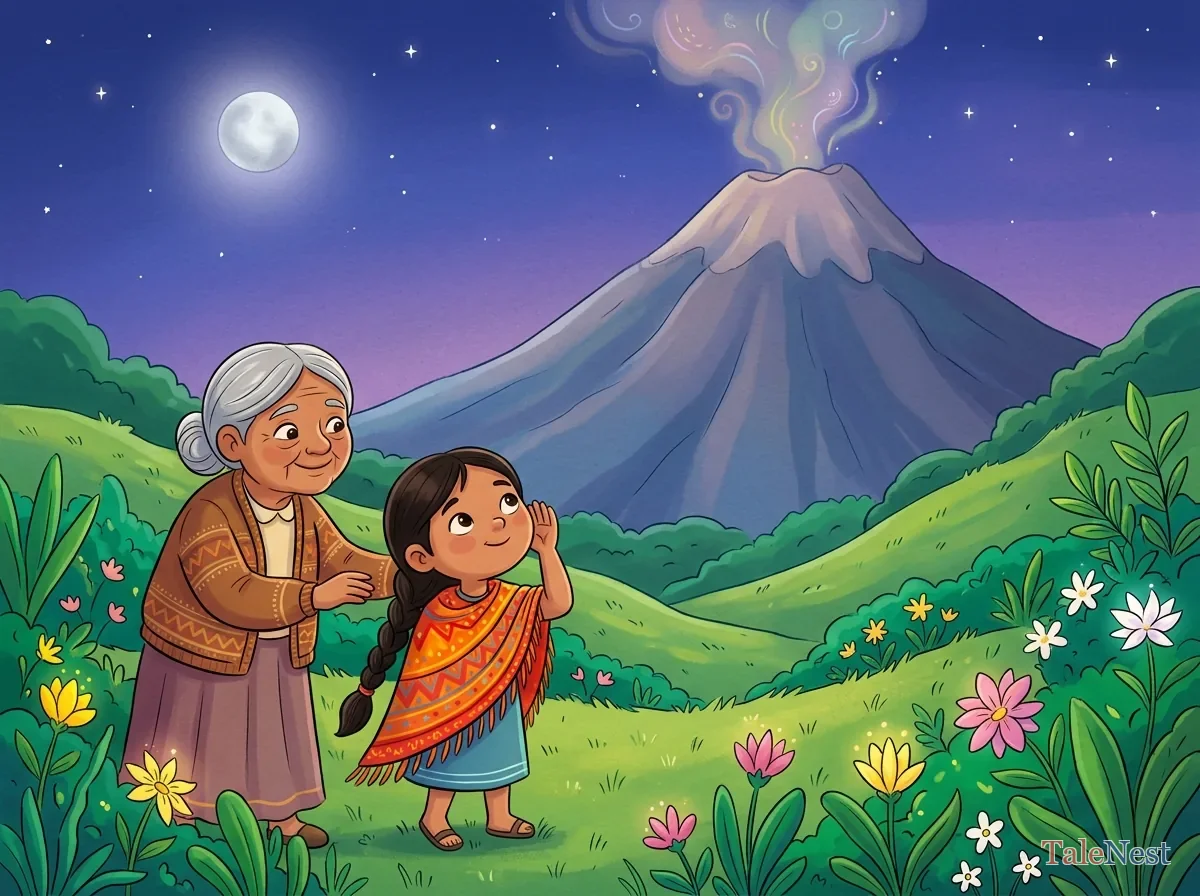
Mia lived in a green valley tucked beneath a towering mountain. The mountain had a name, Rumbi, and Rumbi was a volcano. On quiet nights the girl would lie awake and hear low, rumbling sounds drifting down from its peak. “Grandma,” she asked one morning, “what is that noise?”
“That's Rumbi talking, little one,” said her grandmother. “The volcano feels everything that happens down here in the valley.”
Mia's eyes went wide. A volcano that could feel things? She had to meet it.
The next day she set off up the mountain path, hopping from stone to stone. Suddenly a voice spoke from nowhere. “Every time you jump, Rumbi feels it,” it said.
Mia spun around. From between the rocks popped a plump mole with snow-white whiskers. “I'm Mr Mole,” he announced. “I make my home inside the mountain.”
“The volcano can feel me?” Mia asked.
“Of course! When you jump, you send out waves, just like dropping a pebble into a pond. Those waves travel through the ground all the way to Rumbi.” Mr Mole thumped the earth with his paw, and Mia felt a tiny shiver beneath her feet.
“Feel that?” he asked. “That's a vibration. Everything that moves makes vibrations.” Mia hopped once more and felt the ground quiver under her boots. “It's as if the earth were a giant drum!” she laughed.
“Exactly,” smiled Mr Mole. “And Rumbi listens to that drum better than anyone. It feels the patter of rabbits, the clip-clop of horses, even the slow stretch of tree roots pushing through soil.”
Together they climbed to the summit, where the rock was warm to the touch. Mia laid her palm flat against it. “Hello, Rumbi,” she whispered.
“Understanding turns fear into friendship, and empathy lets us live in harmony with the world around us.”The little lesson
The mountain trembled gently, not in a frightening way, but like a great contented purr. Mia kept her hand there a long while, feeling the faint rhythm travel up through the stone and into her bones. Above her the summit was dotted with small warm cracks, and steam curled from them like breath on a cold morning. It felt less like a mountain and more like a sleeping giant, kindly and enormous. “Why does it shake sometimes?” she wondered aloud.
“Rumbi keeps a great deal of energy bottled up inside,” explained Mr Mole. “It's like when you hold in a laugh for too long. Eventually you have to let it out.”
“Does Rumbi laugh, then?”
“In its own way, yes. When it releases energy in little shivers, it's simply stretching. It's its way of saying, 'Here I am. I need to move a bit.'”
Mia thought of all the times she had to fidget in her seat at school, and how good it felt to finally stretch. Perhaps Rumbi felt the same way, only with a whole mountain's worth of energy. She gave the warm rock a gentle pat, as though to say she understood.
Mia understood at last. The volcano was neither wicked nor frightening. It just felt the world, and sometimes it needed to move.
“The people down in the valley are scared of it,” she said.
“Because they don't know it,” said Mr Mole. “You could help them understand.”
Mia raced back down and gathered everyone in the village square. “Rumbi isn't scary!” she cried. “Rumbi can feel us!” She told them everything, about the waves and the vibrations, about how every single footstep carried a message up to the mountain.
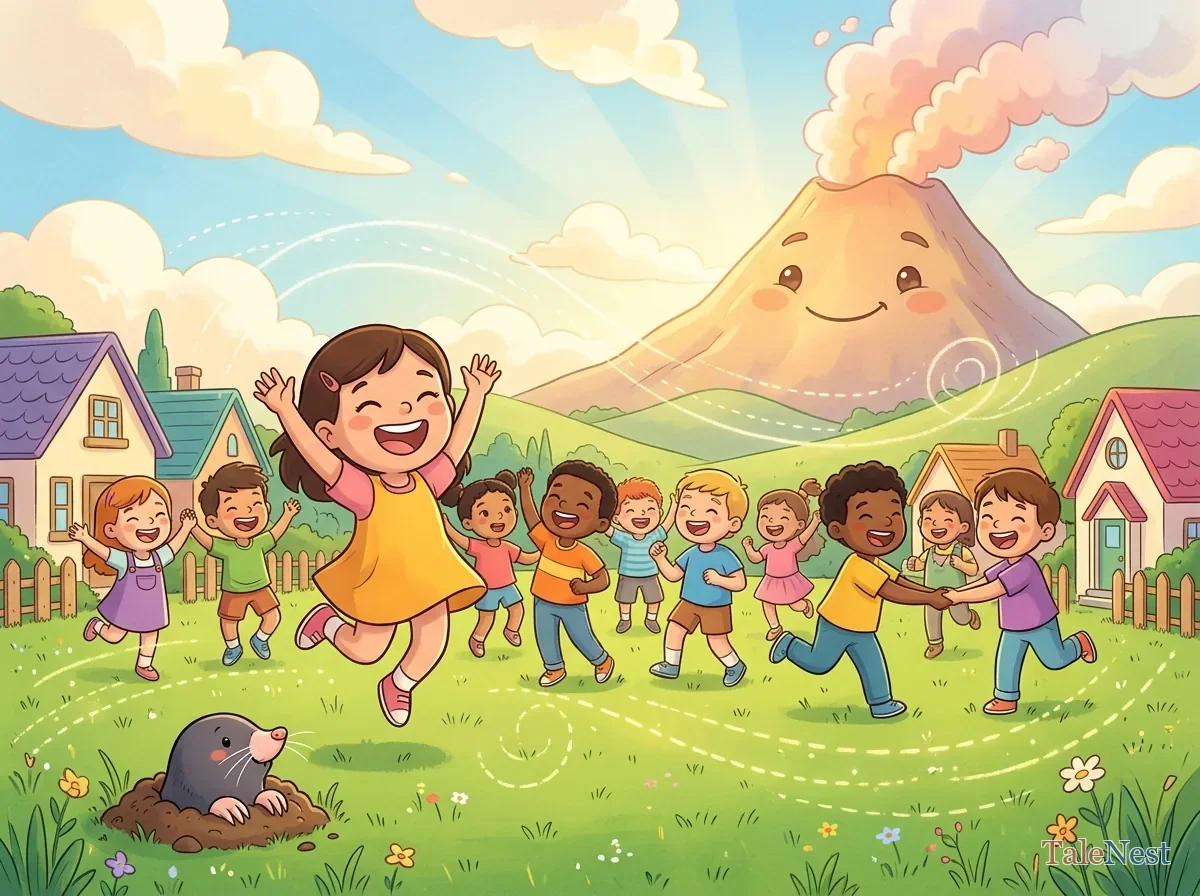
“When Rumbi gives a little shiver, it's only stretching,” she explained. “It's how it says hello.”
A small boy hopped in place. “Did Rumbi feel that?”
“I'm sure of it!” laughed Mia.
Soon everyone was jumping. Vibrations rippled through the earth like invisible waves, and high on the summit Rumbi felt every hop, every laugh, every landing. The volcano gave a gentle shudder, and this time nobody was afraid. It was its way of waving back.
From that day Mia visited Rumbi every week. She learned to read its signals. A strong tremor meant warning the valley to prepare; a soft one was only a friendly greeting. Mr Mole taught her more secrets besides: how waves race faster through solid rock than through soft soil, and how the small vibrations arrive before the big ones.
One afternoon she lay in the grass and pressed her ear to the ground. She felt the heartbeat of the earth, the distant step of a deer, the hush of an underground river, the deep pulse of the volcano itself. “Rumbi feels everything,” she murmured, “the way I feel it when Grandma hugs me.”
The valley learned to live beside Rumbi. Fear gave way to knowledge, and knowledge to a strange, quiet friendship. The farmers began greeting the mountain each morning, and the children waved to it on their way to school. When a tremor came, nobody screamed, they simply nodded, the way you might acknowledge an old friend clearing their throat. Rumbi, for its part, seemed to rumble a little more softly, as if pleased to be understood at last. Each night as Mia drifted off, she laid a hand on the floor and felt the world humming through it, felt the mountain whispering goodnight.
The volcano that felt the world finally knew that the world felt it too.
Understanding turns fear into friendship, and empathy lets us live in harmony with the world around us.


