
The Spanish Princess's Birthday
A spoiled Spanish princess invites rich and poor to her birthday feast, where a doting dwarf finds a mirror that reveals a truth no one has told him.
 Retold by Idalia SantosAges 8+5 min read991 words
This is a work of fiction, retold in original language for TaleNest. Names, places and events are part of the story.
The Spanish princess turned twelve on a morning so bright the city seemed washed and set out to dry. She played among children in silk and in rough linen, for the king let her invite whomever she pleased; royal blood was not required. She ran and laughed with the easiest joy in the world.
The king watched from a high window, unsharing the brightness. Beside him stood his confessor in black and his own brother, whom he despised. His heart was heavy, for his daughter's radiance brought back her mother, the queen who had died six months after the child's birth, whom he had loved without measure.
As she played on the terrace he remembered his wife. The girl was her very likeness, the same tilt of head and generous smile. But the children's shrieks set his teeth on edge and the sun hurt his eyes. At last he drew the curtain.
The princess noticed at once. Her brow clouded; she gave a small, stubborn shrug. Her father should have been beside her. She could not think why he was not.
Her uncle and the confessor suited her better. They bowed over her hand and poured out compliments. Hand in her uncle's, she descended with the dignity of a little queen while the others trooped after. At the garden's end a pavilion had been raised, where a make-believe bullfight delighted all, with jugglers, a choir of singing children, and a troupe of dancers.
As the company left church, gypsy children squatted in the square playing soft music, then fetched a brown bear on a chain with monkeys on its shoulders. But the wonder of the festival was the little dwarf's dance.
Misshapen, with a hump and crooked legs, he danced as if he had no thought but the princess, each step a message for her alone. When he finished she tossed him the white rose from her hair with her sweetest smile. He took it like a knight receiving a favor, pressed it to his lips, laid a hand on his heart, and knelt, eyes bright.
The princess asked her uncle for the dance again. When the dwarf heard he would perform once more before her, his pride knew no bounds. He went careening across the garden kissing the rose in the most absurd fashion.
Even the flowers were scandalized by his pirouettes and ridiculous arm-waving.
“He is too dreadful to be allowed where we are,” cried the tulips.
“If he would only drink poppy juice and sleep a thousand years!” sighed the lilies.
“How hideous he is!” howled the slipper-flowers.
“Vanity that treats another's pain as entertainment is its own ugliness, for the cruellest heart is the one that cannot see itself.”The little lesson
“And he carries my loveliest rose!” cried the white rosebush. “I gave it to the princess this morning. He has stolen it.”
And the rosebush shrieked: “Stop the thief! Thief! Thief!”
In his heedless race he brushed past the sundial, which was so startled it nearly forgot the minutes, and told the silver peacock that kings' sons were kings and charcoal burners' sons were charcoal burners. “Beyond question,” the peacock agreed.
The birds, though, loved him, fluttering around him with soft wings; he showed them the rose, saying the princess had given it as a token of her affection. The lizards too frisked about him as he rested on the grass. The flowers thought this disloyal.
When he wandered off, the flowers called after him. “Shut him up for life. Did you see that hump and those twisted legs?” They laughed mockingly, but he heard none of it. He loved the birds and lizards with his whole heart and thought flowers the loveliest things, next to the princess.
But where was the princess? The white rose would not answer. The palace seemed asleep. After wandering in circles he found a small door ajar, slipped through, and stood in a splendid hall. She was not there.
At the far end hung a black velvet curtain. He drew it aside. No one. Another room, lovelier still. He crossed the Persian carpets and opened the next door. She was not there either; the room stood empty. It was the throne room.
The air was close and heavy, and this the most magnificent room of all. But he was not alone. From the far doorway a small figure watched him and stepped forward.
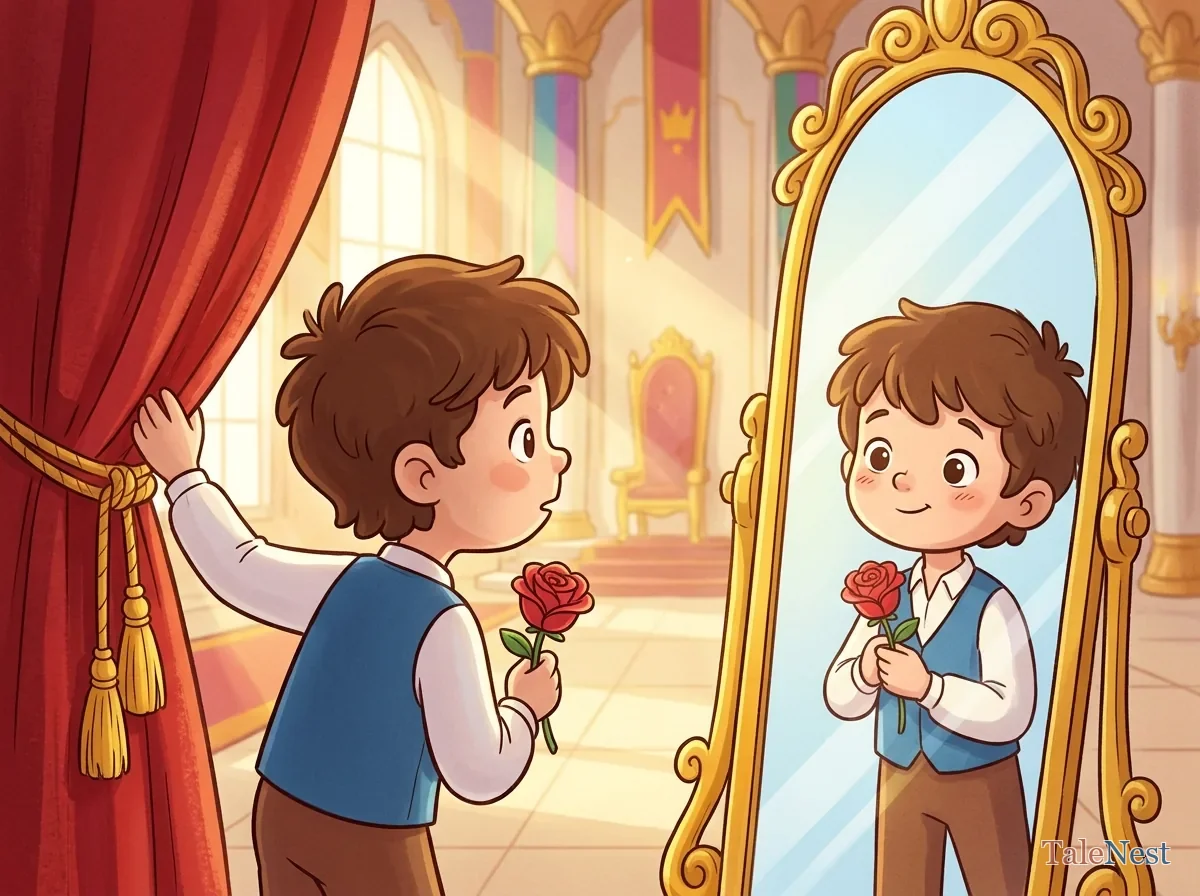
It seemed a large, grotesque monster mirroring his every movement. It even held a rose; when he drew his out to kiss it, the monster did the same.
When the truth broke over him the dwarf cried out and sank to the floor, sobbing. That deformed, humpbacked creature, so horrible to look upon, was himself. He covered his eyes and backed from the mirror.
Then the princess came through the open window with her ladies. Seeing the dwarf flat on the ground, pounding it with his fists in comical fashion, they burst into laughter.
“His dancing is funny,” said the princess, “but his antics are funnier.” She waved her fan and clapped.
The dwarf did not lift his head. His sobs grew fainter; he gave a strange sigh, pressed a hand to his side, then lay still.
“You were magnificent,” said the princess. “Now dance for us.”
“Yes,” cried the children. “Get up and dance. You are as clever as the Barbary apes and funnier.”
The dwarf made no answer. The princess stamped her foot. “My dwarf is disobedient,” she cried. “Lift him and tell him to dance.”
“Dance at once,” said her uncle. “The princess of Spain wishes to be amused.” Still he did not stir. “We must send for the executioner.”
“My fair princess,” said the chamberlain, “he will never dance again. A shame, for he was so ugly he would have made the king smile.”
“And why will he not dance again?” asked the princess.
“Because his heart is broken,” replied the chamberlain.
The princess knitted her brows. “From now on,” she cried, running into the garden, “see that no one who plays with me has a heart.”
Vanity that treats another's pain as entertainment is its own ugliness, for the cruellest heart is the one that cannot see itself.


